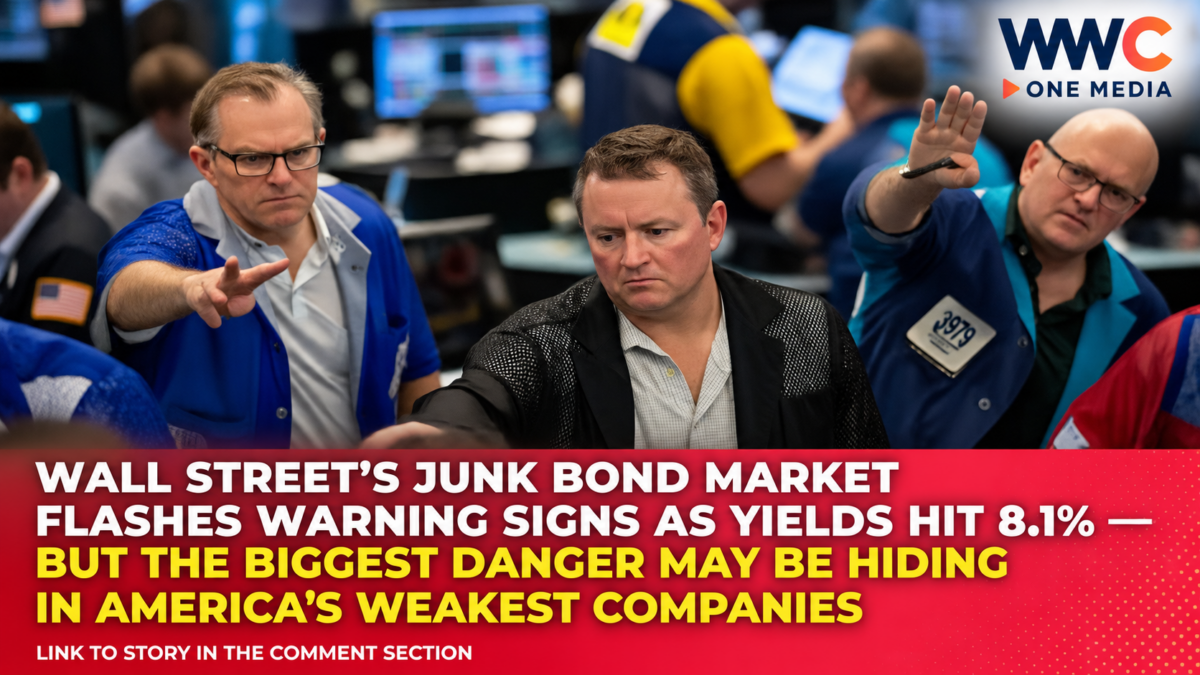
NEW YORK, United States — Warning signals are emerging from one of Wall Street’s most closely watched financial markets as yields on risky U.S. corporate bonds climb to 8.1%, raising concerns that rising borrowing costs, persistent inflation and growing debt pressures could expose serious weaknesses among financially vulnerable American companies.
The U.S. high-yield bond market, commonly known as the junk bond market, is showing signs of strain as investors demand greater compensation for lending money to companies with below-investment-grade credit ratings.
According to CNBC’s October 9, 2026 analysis, average high-yield bond yields have increased from approximately 7.22% a month earlier to 8.1%.
At the same time, the additional yield investors demand over U.S. government bonds has widened, suggesting growing caution about corporate credit risk.
The deterioration comes as higher energy prices, rising Treasury yields and concerns about government borrowing create a more difficult financial environment.
But while market strategists characterize the latest developments as a warning rather than an outright crisis, an important question is emerging: Could stress among America’s weakest corporate borrowers spread into the broader bond market and eventually threaten Wall Street’s stock market rally?
Junk Bond Yields Jump as Investors Demand More Compensation
Junk bonds are debt securities issued by companies considered to have higher credit risk than investment-grade borrowers.
Because these companies face a greater probability of failing to meet their financial obligations, investors typically demand higher yields to compensate for the additional risk.
The latest increase in yields highlights how quickly financing conditions have changed.
According to CNBC, average U.S. high-yield bond yields have climbed to approximately 8.1%, compared with 7.22% just one month earlier.
That represents an increase of 88 basis points, or 0.88 percentage points.
For companies seeking to issue new debt or refinance existing obligations, higher market yields can make borrowing substantially more expensive.
For investors who already hold fixed-rate bonds, rising yields generally mean falling market prices.
The increase does not automatically signal a wave of corporate defaults.
However, it suggests that investors are demanding better compensation for the financial risks associated with lending to lower-rated companies.
Credit Spreads Reach Their Widest Levels Since April
One of the most important indicators of stress is the high-yield credit spread.
A credit spread measures the additional yield investors demand for holding corporate debt instead of comparable government bonds.
When the spread widens, it generally indicates that investors want greater compensation for potential losses, weaker economic conditions or reduced market liquidity.
CNBC reported that the overall U.S. high-yield credit spread recently reached approximately 315 basis points, or 3.15 percentage points, its widest level since April.
The increase is significant because it shows that rising junk bond yields are not solely the result of higher U.S. Treasury yields.
Investors are also becoming more selective about which companies they are willing to finance.
However, current spreads remain below levels typically associated with severe systemic financial crises.
The market is therefore showing signs of caution rather than evidence of an inevitable credit collapse.
America’s Weakest Companies Face the Greatest Pressure
The deterioration is particularly pronounced among companies carrying CCC credit ratings or lower.
These businesses generally have weaker balance sheets, greater refinancing risks or more limited financial flexibility.
According to Financial Times reporting published in early October, borrowing costs for some of the lowest-rated U.S. companies have reached approximately 17%.
The risk premium for CCC-rated debt has also risen sharply, with some market measures reaching around 1,200 basis points or more.
Bloomberg reported in late September that spreads on CCC-rated bonds were approaching 1,000 basis points, reflecting increasing concern about the ability of vulnerable borrowers to manage higher interest rates.
Different bond indexes can produce different spread measurements because of differences in their composition and calculation methods.
Nevertheless, the overall direction is consistent: the weakest corporate borrowers are facing significantly more difficult financing conditions.
Companies that need to refinance debt at much higher interest rates could see their interest expenses rise, reducing cash flow available for operations, investment and debt repayment.
For financially strained businesses, prolonged high borrowing costs may eventually increase the risk of restructuring or default.
Why High Treasury Yields Are Making the Problem Worse
The pressure on junk bonds is unfolding alongside a sharp increase in U.S. government bond yields.
Reuters reported on October 9 that the benchmark 10-year Treasury yield had climbed dramatically since the escalation of the Middle East conflict earlier in 2026.
During the week’s trading, the 10-year yield reached approximately 5.36%, its highest level in more than two decades, according to additional market reporting.
The increase has been driven by a combination of persistent inflation concerns, elevated energy prices, heavy government borrowing and expectations that interest rates may remain high.
U.S. Treasury yields serve as an important benchmark for borrowing costs throughout the economy.
When government bond yields rise, companies generally face higher base financing costs even before investors account for their individual credit risks.
For weaker companies, the combination of rising Treasury yields and widening credit spreads can be especially damaging.
Higher borrowing costs can also affect mortgages, business loans and other financing arrangements.
The result is a tightening financial environment that can weigh on economic activity even without an immediate recession.
Higher Oil Prices Add Another Layer of Risk
Energy prices have become an important driver of the latest bond market turbulence.
The conflict involving Iran and disruptions affecting Middle Eastern energy supplies have intensified concerns about inflation.
Higher oil prices can increase transportation, manufacturing and operating costs across multiple industries.
For companies with limited pricing power, those additional expenses can reduce profitability.
At the same time, higher inflation can make it more difficult for the Federal Reserve to reduce interest rates.
This creates a challenging combination for indebted companies.
They may face rising operating expenses while also paying more to refinance their debt.
The impact will vary across industries.
Energy producers may benefit from higher commodity prices, while fuel-intensive businesses, manufacturers and transportation operators can face increased pressure.
Investors are therefore watching not only headline inflation but also how persistent cost increases affect individual companies’ ability to service their obligations.
America’s Nearly $2-Trillion Deficit Raises Financial Market Concerns
Another factor affecting bond-market sentiment is the scale of U.S. government borrowing.
CNBC’s analysis highlighted concerns about a federal budget deficit approaching $2 trillion for the fiscal year that ended September 30, 2026.
Large borrowing requirements can contribute to higher Treasury yields when investors demand greater compensation for holding longer-term government debt.
The effects can extend into corporate markets because companies must compete with government securities for investor capital.
When relatively safe Treasury securities offer higher yields, investors may become less willing to accept the additional risks associated with lower-rated corporate bonds.
That can force speculative-grade borrowers to offer even higher yields.
However, government borrowing is only one of several factors influencing yields.
Inflation expectations, Federal Reserve policy, economic growth, global demand for U.S. assets and financial market positioning also play important roles.
Artificial Intelligence Spending Creates Another Bond Market Challenge
The rapid expansion of artificial intelligence infrastructure is introducing an additional source of pressure.
Major technology companies and infrastructure developers are raising significant amounts of debt to finance data centers, computing facilities, energy systems and other AI-related investments.
Reuters has reported that the surge in corporate debt issuance associated with AI projects is contributing to pressure in the broader bond market.
Large bond offerings can increase the amount of debt investors must absorb.
According to Barron’s, corporate borrowing connected to AI investment could reach approximately $570 billion in 2026 and $1.3 trillion in 2027, based on market projections cited in its reporting.
These figures are estimates, not completed borrowing totals.
The issue is not that all AI-related borrowers are financially weak.
Many large technology companies have substantial cash reserves and strong credit ratings.
However, heavy borrowing across the market can influence bond supply, financing costs and investor appetite.
If the anticipated financial returns from major AI investments fall short of expectations, some debt-funded projects could face greater scrutiny.
For bond investors, this creates another reason to examine corporate fundamentals carefully.
Why Wall Street Has Not Entered Full Panic Mode
Despite the warning signals, several factors suggest that the junk bond market is not yet experiencing a broad credit crisis.
CNBC’s analysis noted that bonds rated BB, the strongest category within speculative-grade debt, account for more than 60% of the high-yield market.
This relatively large share of higher-quality speculative-grade borrowers provides some support for the overall market.
BB-rated companies generally have stronger financial profiles than issuers rated B or CCC.
Their ability to manage debt obligations may be more resilient during periods of economic volatility.
Additionally, widening credit spreads do not automatically mean companies are defaulting.
They can also reflect changing expectations about inflation, liquidity, monetary policy and future economic growth.
The distinction matters because a market correction can occur without developing into a systemic crisis.
Analysts are therefore watching whether stress remains concentrated among the weakest companies or begins spreading into higher-quality borrowers.
Five Warning Signs Investors Should Watch
The current environment has made several bond market indicators especially important.
1. High-yield credit spreads
A sustained widening in the difference between junk bond yields and Treasury yields could indicate that investors are demanding greater compensation for corporate credit risk.
2. CCC-rated bond performance
The lowest-rated borrowers often experience financial pressure before stronger companies.
Further increases in CCC yields and spreads could signal growing refinancing and default concerns.
3. Corporate default and restructuring activity
An increase in missed debt payments, distressed exchanges or corporate restructurings would provide more direct evidence that financial pressure is affecting borrowers.
4. Refinancing conditions and new bond issuance
If financially vulnerable companies struggle to issue new debt or must offer exceptionally high interest rates, they could face difficulties managing upcoming maturities.
5. Stress spreading into higher-quality bonds
A broader deterioration involving BB-rated high-yield bonds and investment-grade corporate debt would suggest that investor concerns are no longer confined to the riskiest companies.
These indicators should be assessed together rather than treated as automatic predictions of a market crash.
Financial Times Warns Corporate Borrowing Costs Are Rising Sharply
Additional reporting from the Financial Times provides evidence that financing conditions have become more difficult across corporate America.
Its October 2026 coverage highlighted a sharp increase in borrowing costs, particularly among companies with the weakest credit ratings.
The report noted that the yield gap for CCC-rated borrowers had expanded significantly as investors became more concerned about refinancing risks.
The same report said Bank of America had reduced its October corporate debt issuance forecast from $160 billion to $110 billion.
The adjustment reflects uncertainty about whether companies will proceed with planned financing under difficult market conditions.
Although strong investment-grade borrowers may still access capital markets, smaller and more heavily indebted companies could experience greater pressure.
This divergence is important because the bond market can remain active overall even while financing conditions deteriorate for its weakest participants.
Could Junk Bond Stress Threaten the Stock Market?
The connection between corporate debt and the stock market makes the latest developments particularly important.
When companies face higher borrowing costs, their interest expenses can increase, potentially reducing profits.
If refinancing conditions become more difficult, businesses may also delay investments, reduce spending or restructure operations.
These developments can influence stock valuations and investor confidence.
Higher Treasury yields create an additional challenge because bonds become more competitive with equities as an investment option.
When relatively safe government securities offer attractive returns, investors may demand higher expected returns from stocks to justify the additional risk.
This can pressure equity valuations, particularly for companies whose market prices depend heavily on expectations of future earnings growth.
However, rising junk bond yields alone do not establish that a stock market crash is imminent.
Corporate earnings, economic growth, monetary policy and investor sentiment remain important influences on equity performance.
What Higher Junk Bond Yields Mean for Investors
The rise in high-yield bond yields creates both risks and potential opportunities.
New investors may be attracted to the higher income available from speculative-grade securities.
However, the advertised yield is not the same as a guaranteed return.
Bondholders face the possibility of falling prices, delayed payments, restructuring and losses if issuers default.
Funds that invest in junk bonds can diversify exposure across companies, but diversification does not eliminate credit or market risk.
Investors also need to distinguish between losses caused by higher Treasury yields and losses caused by deterioration in corporate credit quality.
Longer-duration bonds may be more sensitive to changes in interest rates, while lower-rated issuers can be especially vulnerable to financial distress.
The suitability of high-yield debt depends on an investor’s objectives, liquidity needs and ability to tolerate losses.
For now, the central lesson is that unusually attractive yields often reflect unusually significant risks.
The Bigger Picture: A Credit Market Warning, Not Yet a Financial Crisis
The widening of U.S. high-yield bond spreads comes at a time when financial markets are absorbing several major pressures simultaneously.
Inflation remains a concern, government borrowing requirements are elevated, energy prices have risen and major corporations are seeking capital for substantial infrastructure investments.
Together, these developments have increased the cost of borrowing and made investors more selective.
The clearest signs of strain are currently concentrated among lower-rated borrowers.
That does not mean the entire corporate bond market is on the verge of collapse.
But it does mean that companies with weak balance sheets and large refinancing needs may face more difficult conditions if elevated interest rates persist.
For investors, policymakers and corporate executives, the coming months will test whether these pressures remain manageable or develop into a broader deterioration in credit quality.
THE BOTTOM LINE
Wall Street’s junk bond market is beginning to flash warning signals as average yields climb to 8.1%, high-yield credit spreads widen and the weakest American companies face sharply higher borrowing costs.
The deterioration reflects a combination of inflation concerns, rising Treasury yields, geopolitical uncertainty and growing refinancing risks.
Yet the market has not reached the level of widespread distress normally associated with a severe financial crisis.
A substantial share of high-yield debt remains concentrated in relatively stronger BB-rated borrowers, providing some resilience.
The biggest danger is not simply that junk bond yields are rising — but that financially vulnerable companies may eventually find themselves unable to refinance debt at affordable rates.
If stress spreads beyond the weakest borrowers, the consequences could extend into corporate investment, employment and the broader stock market.
For now, Wall Street is receiving a warning rather than confirmation of a crisis.