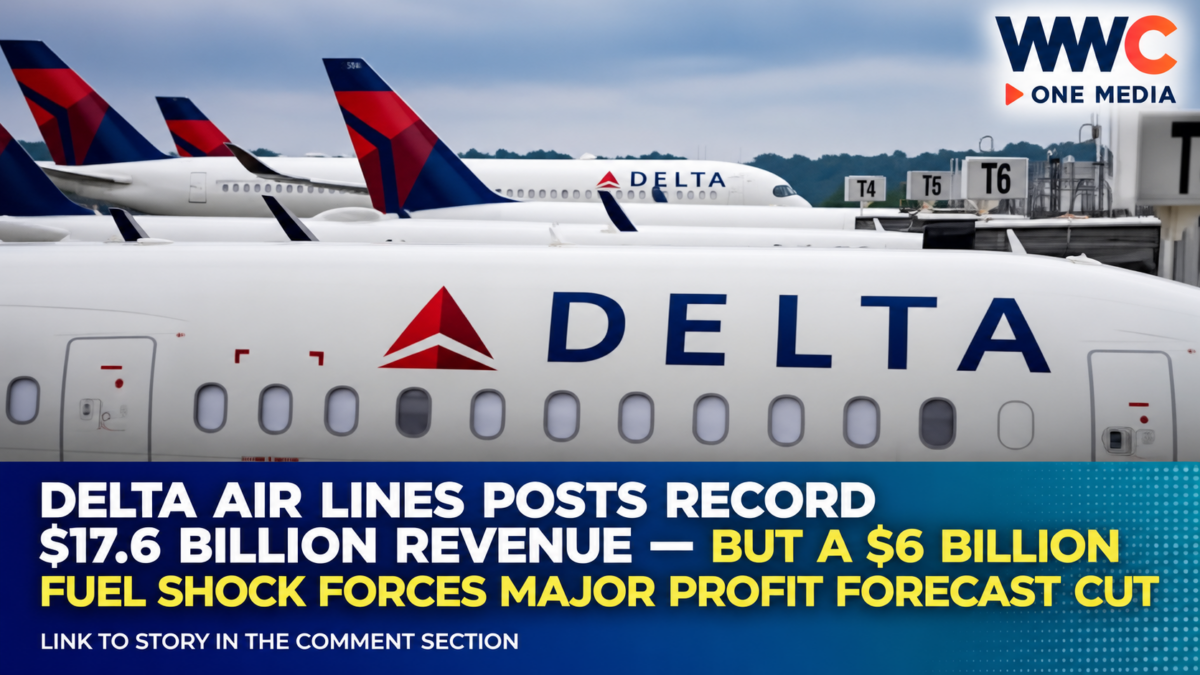
ATLANTA, United States — Delta Air Lines has delivered record third-quarter revenue as Americans continue spending heavily on travel, premium cabins and international flights. But the airline’s impressive sales performance is being overshadowed by a massive surge in jet fuel costs that has forced management to slash its 2026 profit forecast and reconsider how much flying the industry can afford.
The Atlanta-based carrier reported $17.6 billion in adjusted operating revenue for the third quarter ended September 30, 2026, representing a 16% increase from the same period last year.
Despite strong demand, Delta earned just $1.72 per share on an adjusted basis, narrowly missing analysts’ expectations of approximately $1.77.
The airline also lowered its full-year adjusted earnings outlook to between $5.10 and $5.60 per share, down from its previous projection of $6.50 to $7.50.
The downgrade comes as Delta expects its annual fuel bill to increase by approximately $6 billion compared with 2025.
The results reveal a troubling development for the global aviation industry: even as passengers continue flying and ticket prices rise, expensive fuel is consuming much of the additional revenue.
The bigger question is whether airlines can continue raising fares without eventually pushing travelers away — or whether the next step will be fewer flights, reduced capacity and higher prices across the industry.
Delta’s Record Revenue Fails to Protect Its Profit Outlook
Delta’s third-quarter financial results delivered a sharp contrast between strong revenue growth and mounting operating expenses.
The company reported adjusted revenue of $17.6 billion, adjusted operating income of approximately $1.7 billion and adjusted pre-tax income of $1.5 billion.
Its adjusted operating margin reached 9.4%, down from 11.1% a year earlier.
On a generally accepted accounting principles (GAAP) basis, the carrier generated $20.2 billion in operating revenue but reported net income of $756 million, a decline of 47% from the same quarter in 2025.
GAAP earnings per share fell to $1.15 from $2.17 a year earlier.
The difference between GAAP and adjusted revenue partly reflects adjustments for third-party refinery sales and other items.
For investors, the results show that Delta’s ability to generate sales remains strong, but its profitability is increasingly vulnerable to energy costs.
The airline also reported adjusted earnings per share of $1.72, slightly higher than the $1.70 recorded a year earlier.
However, that performance fell short of market expectations and was not enough to prevent a reduction in management’s full-year earnings forecast.
Jet Fuel Costs Surge 62% as Middle East Conflict Shakes Aviation
The biggest challenge facing Delta is the rising cost of aviation fuel.
Its adjusted fuel expense jumped 62% year over year to approximately $4.1 billion during the third quarter.
The average adjusted fuel price climbed 60% to $3.61 per gallon.
According to Reuters, the increase in jet fuel prices has been driven partly by geopolitical tensions and disruptions associated with the conflict involving Iran.
The impact has been substantial.
Delta expects to spend approximately $6 billion more on fuel in 2026 than it did in 2025, an increase roughly $2 billion higher than previously anticipated.
For the fourth quarter, the airline is projecting an all-in fuel price of approximately $4.25 per gallon, even after considering benefits from its refinery operations.
Higher fuel prices place pressure on airlines because fuel is one of their largest operating expenses.
Even relatively small movements in fuel costs can significantly affect profitability when multiplied across thousands of flights.
For Delta, the problem has intensified despite higher ticket prices and strong passenger demand.
Delta Cuts 2026 Profit Forecast by Nearly a Quarter
The financial pressure has forced Delta to make a major adjustment to its full-year outlook.
The airline now expects adjusted earnings of $5.10 to $5.60 per share in 2026.
That compares with its previous forecast of $6.50 to $7.50.
At the midpoint, the revised outlook represents a reduction of approximately 23.6%.
Delta has also reduced its expected full-year free cash flow to approximately $2.5 billion, compared with its earlier target of $3 billion to $4 billion.
The revised projections indicate that the airline’s strong commercial performance is not fully offsetting the additional cost of fuel.
Nevertheless, Delta still expects to generate approximately $4.5 billion in pre-tax profit for the year on an adjusted basis.
The company also plans to repay more than $2 billion in debt during 2026.
Management maintains that its financial position remains resilient, even as the company faces one of the most expensive fuel environments in recent years.
CEO Ed Bastian Warns Airlines May Need to Cut Capacity
Delta Chief Executive Officer Ed Bastian has indicated that airlines may need to become more disciplined about how many flights and seats they offer if fuel prices remain elevated.
According to Reuters, Bastian emphasized that expanding flight capacity is not an effective solution when the additional costs of operating those flights are rising faster than expected revenue.
Instead, airlines may need to limit capacity growth to protect profit margins.
For passengers, that strategy could have important consequences.
If airlines offer fewer seats while travel demand remains strong, ticket prices could remain elevated or increase further on certain routes.
Reduced capacity could also mean fewer flight choices, particularly in markets where demand is weaker or operating costs are unusually high.
However, Delta has not announced a sweeping cancellation program tied to its third-quarter earnings.
Its remarks concern industry capacity management and potential future adjustments, rather than confirmation that large numbers of flights will immediately be eliminated.
Premium Travel Becomes Delta’s Biggest Competitive Advantage
Despite rising costs, Delta continues to benefit from strong demand for premium travel.
Premium revenue increased 18% in the third quarter, supported by higher yields, strong passenger demand and a 6% increase in premium seating capacity.
The company’s diversified revenue streams accounted for 61% of adjusted revenue.
These include premium products, loyalty programs, cargo operations, maintenance services and other business activities.
Delta’s strategy has increasingly focused on attracting travelers willing to pay more for additional comfort, convenience and services.
The airline has invested in premium cabins, airport lounges, loyalty partnerships and upgraded customer experiences.
This approach provides an important advantage when operating expenses rise.
Premium customers and business travelers may be less sensitive to certain fare increases than highly price-conscious leisure passengers.
However, even stronger premium demand cannot fully insulate the airline from exceptionally high fuel prices.
The challenge for Delta is maintaining a balance between pricing power, passenger satisfaction and profitability.
Corporate Travel and International Flights Remain Strong
Delta’s third-quarter results also showed resilience across domestic and international markets.
Domestic unit revenue rose 16% year over year, supported by higher ticket yields and disciplined capacity management.
International unit revenue increased 12%.
Latin American routes delivered particularly strong performance, with unit revenue increasing 22%.
Transatlantic unit revenue grew 11%, while transpacific revenue increased 13% on an 8% increase in capacity.
Corporate travel sales also posted double-digit growth across all major sectors, led by banking, technology and energy companies.
Delta said that more than 90% of corporate survey respondents expect their travel activity to increase or remain unchanged in 2027.
These figures suggest that demand for air travel remains resilient despite high ticket prices and broader economic uncertainty.
But strong demand alone may not be enough to protect the airline industry’s margins if energy expenses continue rising.
Delta Expects 20% Revenue Growth in Fourth Quarter
Looking ahead, Delta expects fourth-quarter revenue to grow approximately 20% compared with the same period last year.
The airline forecasts adjusted earnings of $1.15 to $1.65 per share and an operating margin of 7% to 9%.
Management expects the revenue improvement to be supported by continued strength in premium travel, international operations and corporate demand.
However, the company’s forecast assumes elevated fuel costs.
Delta estimates that its all-in fuel price could average approximately $4.25 per gallon during the December quarter.
That assumption remains vulnerable to movements in global oil markets and geopolitical developments.
If fuel costs increase beyond expectations, the airline could face additional pressure on its earnings.
If energy prices decline, the company may receive some financial relief.
For investors, the fourth quarter will therefore be a crucial test of Delta’s ability to maintain pricing power while controlling expenses.
Delta’s Oil Refinery Offers Protection — But Not Enough
Unlike most major airlines, Delta owns a refinery through its subsidiary Monroe Energy.
The Pennsylvania facility provides the carrier with an additional way to manage aspects of its fuel supply and exposure to refining margins.
During the third quarter, Delta reported a refinery benefit equivalent to approximately 13 cents per gallon on an adjusted basis.
For the fourth quarter, the company expects a larger benefit of approximately 40 cents per gallon.
However, those advantages have not been enough to offset the broader increase in aviation fuel prices.
The refinery does not make Delta immune to global energy-market volatility.
Its financial benefits depend on refinery operations, market conditions and the difference between crude oil and refined fuel prices.
The latest earnings results demonstrate that even a carrier with its own refinery can face substantial pressure when fuel prices rise sharply.
Delta’s SkyMiles and American Express Partnership Deliver Growth
Beyond passenger ticket sales, Delta continues to expand its loyalty and financial-services partnerships.
Total loyalty revenue increased 18% during the quarter.
Remuneration from its American Express partnership rose 15%, supported by continued growth in co-branded credit card spending and new customer acquisitions.
Delta expects its full-year American Express remuneration to exceed $9 billion.
The partnership provides an important revenue stream beyond traditional ticket sales.
It also strengthens customer engagement by encouraging travelers to earn and redeem rewards through the SkyMiles ecosystem.
For Delta, these diversified revenue sources can help reduce dependence on economy-class ticket sales.
But they cannot completely eliminate the financial risks associated with fuel inflation and rising operating expenses.
Delta Announces Los Angeles-to-Manila Flights for 2027
One notable development for Asian travelers is Delta’s announcement of new international routes beginning in 2027.
The airline has identified Los Angeles-to-Manila service among its planned network additions, alongside Seattle-to-Tokyo Narita and other international routes.
The planned Manila service could provide another direct travel option between the Philippines and the United States once launched.
It could also increase competition in the transpacific aviation market.
However, Delta’s October 9 earnings release did not specify all operating details for the Manila route, and travelers should verify schedules and booking availability through the airline.
The announcement is significant because it shows that Delta is still pursuing international growth opportunities despite its cautious approach to overall capacity.
Management is seeking to prioritize routes where demand and expected financial returns justify the additional investment.
Wall Street Reacts to Delta’s Lower Earnings Forecast
Delta shares faced selling pressure after the airline reported weaker-than-expected earnings and reduced its profit outlook.
MarketWatch reported that the stock declined in premarket trading as investors assessed the impact of higher fuel costs.
The reaction reflected concerns that strong passenger demand may not translate into the earnings growth previously anticipated.
For investors, Delta’s results provide an important signal about the broader airline industry.
Major U.S. carriers operate in similar fuel markets and face many of the same inflationary pressures.
Reuters reported that U.S. airlines collectively spent $42.9 billion on fuel during the first eight months of 2026, approximately $13.2 billion more than a year earlier.
That increase highlights how energy costs are affecting the entire industry, not just Delta.
If fuel prices remain elevated, other carriers may also face pressure to revise their earnings expectations, increase fares or adjust capacity.
Could Higher Airfares Affect Global Travel Demand?
Airlines have been able to increase ticket prices as demand for travel remains strong.
However, the ability to keep raising fares is not unlimited.
Budget-conscious travelers may eventually reduce discretionary trips, select less expensive destinations or postpone bookings if prices become too high.
Business travelers may be more willing to absorb higher costs, but corporate travel budgets can also become constrained during periods of economic uncertainty.
This creates a difficult balance for airlines.
Higher fares can help offset fuel expenses, but excessive price increases could weaken passenger demand.
Reducing capacity may protect margins, but it can also limit opportunities for revenue growth.
For travelers, the result could be continued volatility in ticket pricing and flight availability, particularly on routes affected by high operating costs.
The actual impact will vary by market, season, competition and the direction of fuel prices.
The Bigger Picture: Airlines Face a Profitability Crisis Despite Strong Demand
Delta’s results reveal an increasingly important challenge for the global aviation industry.
Strong demand and record revenue do not necessarily guarantee stronger profits.
Airlines must manage fuel, labor, maintenance, aircraft ownership and airport operating costs while competing for passengers.
When fuel expenses increase sharply, carriers have only a limited number of options.
They can raise fares, reduce capacity, improve operational efficiency or seek additional revenue from premium services and loyalty programs.
Each strategy comes with risks.
Higher fares may eventually discourage customers, while reduced flying can affect market share and connectivity.
Delta’s performance suggests that airlines with established premium brands and diversified revenue sources may be better positioned to withstand cost pressures.
But even those advantages cannot fully remove the effects of a prolonged fuel-price shock.
THE BOTTOM LINE
Delta Air Lines has delivered record third-quarter adjusted revenue of $17.6 billion, supported by strong domestic and international travel demand, premium ticket sales and expanding loyalty revenue.
Yet the airline’s financial outlook has deteriorated as jet fuel expenses surge.
With an expected $6 billion increase in annual fuel costs, Delta has reduced its 2026 earnings guidance to $5.10–$5.60 per share and lowered its free cash flow forecast.
The airline remains profitable and expects strong revenue growth in the fourth quarter, but maintaining those results will require careful management of pricing, capacity and operating expenses.
The bigger warning for global aviation is clear: passengers may still be filling aircraft, but if fuel costs keep climbing, airlines could face an increasingly difficult choice between raising ticket prices and cutting flights.
For travelers and investors, Delta’s next earnings report may reveal whether the airline can continue absorbing the fuel shock — or whether the financial pressure will force even tougher decisions across the industry.