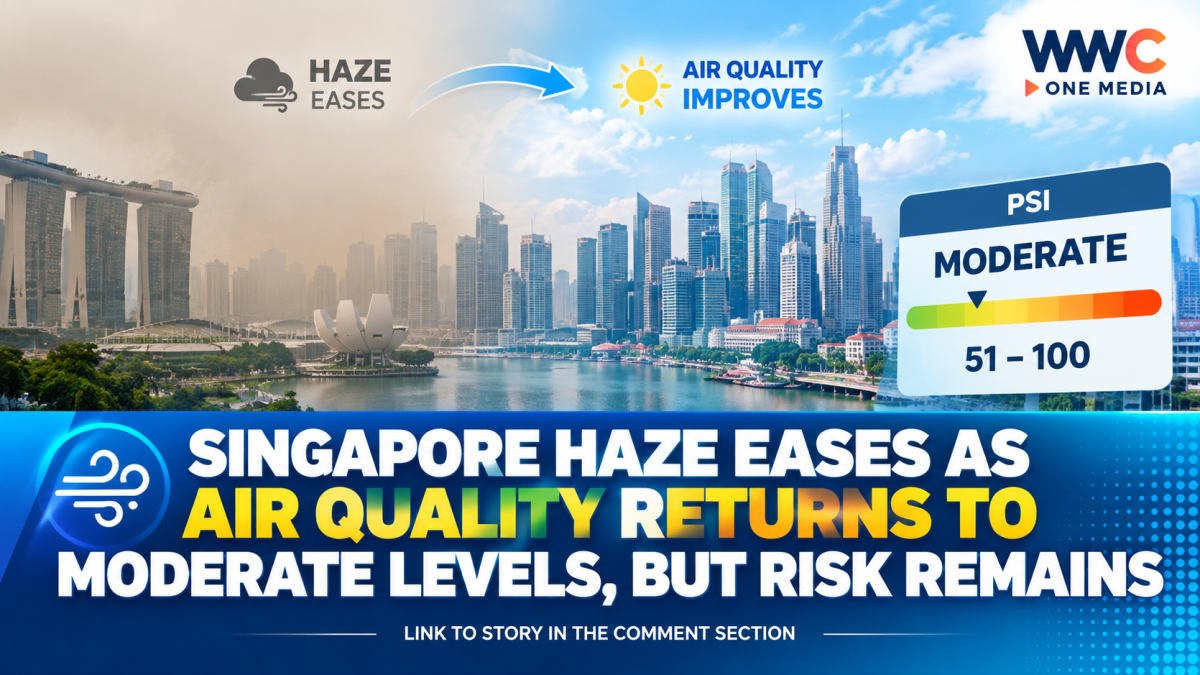
SINGAPORE — Singapore’s air quality improved to the moderate range on Sept. 28, offering some relief after haze pushed parts of the island into unhealthy levels just a day earlier.
At 6am on Sept. 28, the 24-hour Pollutant Standards Index (PSI) stood at 80 in the central region, while readings were 62 in the north, 68 in the south, 74 in the east and 68 in the west. All five regions were therefore within the moderate range.
The improvement followed a sharp deterioration on Sept. 27. At 7am that day, the central region recorded a PSI of 128, while readings reached 115 in the east and 106 in the west, placing those areas in the unhealthy range.
By midnight, however, the central reading had dropped to 95, returning to the moderate category.
Haze Risk Has Not Disappeared
Despite the improvement, Singapore’s haze situation remains closely linked to weather and regional fire conditions.
The National Environment Agency (NEA) said showers were expected over Singapore and parts of the surrounding region on Sept. 28. However, dry conditions were forecast to continue over southern Sumatra and southern Kalimantan, where smoke plumes from fires have been observed.
With prevailing winds expected to blow from the southeast, there remains a risk that smoke haze could affect Singapore again.
The NEA therefore advised residents to monitor 1-hour PM2.5 readings when deciding on immediate outdoor activities, while the 24-hour PSI forecast can be used when planning activities for the following day.
Singapore’s official haze monitoring system classifies PSI readings of 51–100 as moderate and 101–200 as unhealthy.
Outdoor Activities Were Already Affected
The recent deterioration has already disrupted activities in Singapore.
On Sept. 27, Decathlon’s inaugural Kiprun race was modified because of poor air quality. The scheduled 21.1km half-marathon was shortened to 10km, while the other race distances remained unchanged.
The latest improvement comes after a month in which Singapore repeatedly experienced elevated haze levels. The PSI first entered the unhealthy range on Sept. 4, marking the first such occurrence since October 2023, according to The Straits Times.
The central region subsequently reached a peak PSI reading of 154 on Sept. 15, highlighting how quickly conditions can change when regional smoke combines with unfavorable weather patterns.
What Happens Next?
For now, Singapore is seeing a welcome improvement in air quality, but the latest readings do not necessarily signal the end of the haze episode.
Regional fires, prevailing winds and rainfall will continue to influence conditions. With dry weather persisting in parts of southern Sumatra and Kalimantan, Singapore could still experience further periods of haze.
For residents, the situation remains one to watch closely — because the skies may have cleared for now, but the regional conditions behind Singapore’s haze have not completely changed.
WWC ONE MEDIA G,A