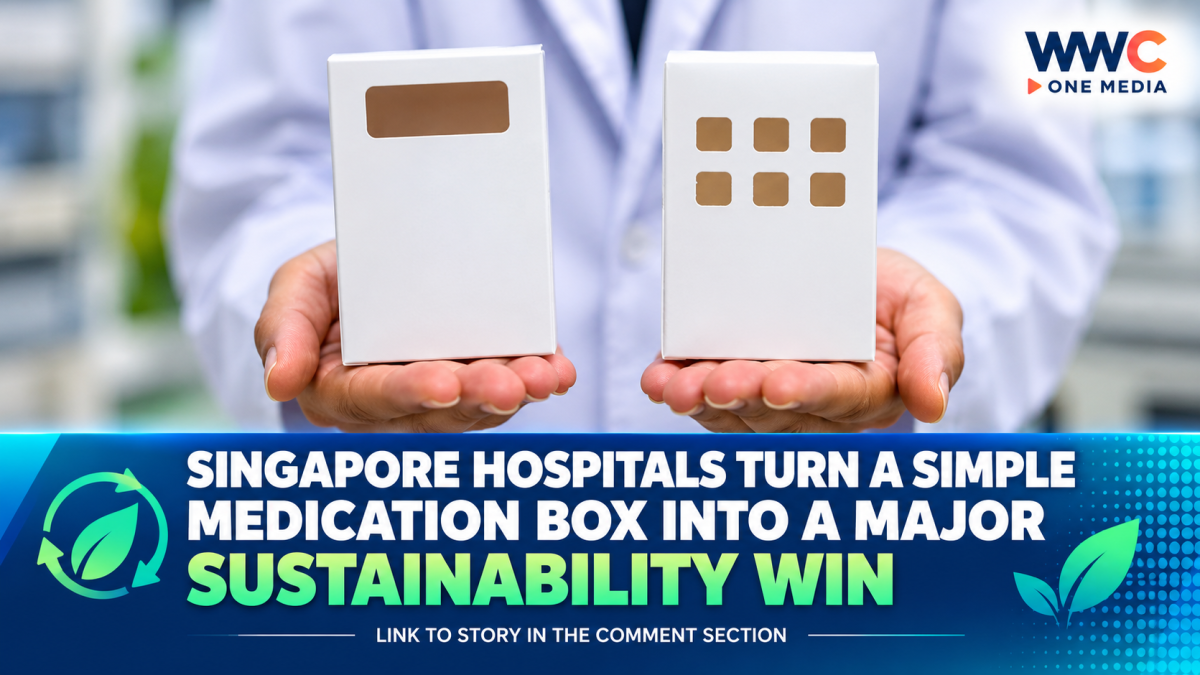
SINGAPORE — A small redesign of the humble medication box is showing how Singapore’s healthcare system can cut waste, reduce emissions and lower costs—without compromising patient safety.
Pharmacists at Tan Tock Seng Hospital (TTSH) redesigned the medication box by removing its plastic window and replacing it with a single-material paper design that remains sturdy enough for automated pharmacy-dispensing machines.
The seemingly simple change could allow an estimated 4.36 million medication boxes to be recycled every year as hospitals and polyclinics across Singapore progressively adopt the new design.
From Plastic-and-Paper to a Recyclable Box
The previous medication packaging contained a small plastic window that allowed pharmacists and patients to see the medicine inside.
Because it combined paper and plastic, however, the box could not easily be recycled.
The redesigned version removes that plastic component while maintaining the functionality needed in pharmacies.
The result could eliminate approximately 1,837kg of plastic use annually, equivalent to around 122,000 plastic bottles, according to TTSH and NHG Health.
The change is also expected to reduce about 4,600kg of carbon emissions each year, roughly equivalent to 24 round trips between Singapore and Bangkok.
A Small Change With Healthcare-Wide Impact
The initiative is part of a broader sustainability push across Singapore’s public healthcare system.
The redesigned boxes are being progressively adopted by hospitals and polyclinics across the country’s three public healthcare clusters. This gives the packaging change a potential impact far beyond a single hospital.
Earlier reporting on the project also said the redesign could deliver about 29% savings in packaging costs, amounting to roughly S$400,000 over four years. The team developed and tested multiple versions before arriving at a design that could work safely with existing pharmacy equipment.
That process illustrates an important point: sustainability in healthcare does not necessarily require replacing an entire system. Sometimes, the biggest gains can come from redesigning everyday items that are used millions of times.
Why This Matters Beyond Recycling
Healthcare has a particularly complicated relationship with sustainability.
Hospitals must operate around the clock while maintaining strict requirements for ventilation, infection prevention, temperature control and patient safety. At the same time, healthcare facilities consume substantial amounts of energy and materials.
The environmental impact also extends beyond hospital buildings.
Medicines, medical devices, disposable supplies and transportation all contribute to healthcare’s wider carbon footprint.
That is why healthcare sustainability increasingly involves changing how services are designed and delivered—not simply installing greener infrastructure.
Sustainability and Patient Care Can Work Together
NHG Health has been incorporating sustainability considerations into quality-improvement efforts by examining three questions: whether a change improves health outcomes, whether it reduces costs or resource use, and whether it lowers environmental impact.
The medication-box redesign is one example of how those objectives can overlap.
Other initiatives include improving waste segregation, reducing avoidable clinical waste, exploring recycling opportunities and reviewing high-volume consumables. Healthcare teams are also examining ways to reduce unnecessary medication waste and improve resource efficiency.
The broader goal is to make sustainability part of everyday healthcare decisions rather than treating it as a separate programme.
Preparing Singapore’s Healthcare System for Climate Change
The sustainability push also comes as Singapore’s healthcare sector prepares for climate-related challenges, including extreme heat, haze, changing disease patterns and potential disruptions to supplies.
Reducing emissions addresses part of the long-term challenge, while strengthening hospitals’ resilience helps them continue providing care as environmental conditions change.
The medication box may therefore appear to be a minor innovation—but its significance lies in the principle behind it.
If similar changes can be applied across millions of healthcare products and processes, small improvements can accumulate into substantial environmental and financial benefits.
And that is where the humble medication box becomes more than packaging: it offers a glimpse of how everyday healthcare decisions could shape a more sustainable system.
WWC ONE MEDIA G,A