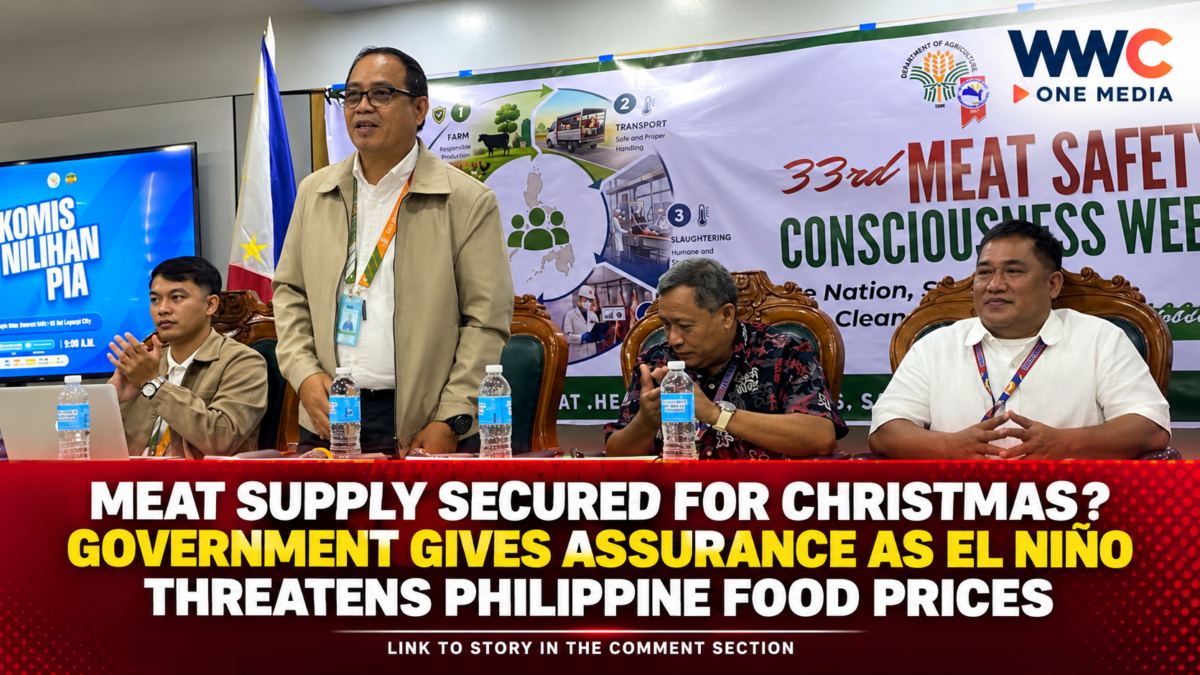
MANILA, Philippines — Filipino families may have one less reason to worry about their Christmas grocery lists, as government officials assure the public that pork and chicken supplies remain sufficient despite the threat of a strong El Niño. But while meat availability appears reassuring, the bigger question is whether prices will stay affordable as drought threatens agricultural production.
The National Meat Inspection Service (NMIS) in Bicol said meat supplies in the region remain stable, citing increased slaughtering activities reported by major slaughterhouses. The agency made the assurance during a media forum marking the 33rd Meat Safety Consciousness Week and the 54th NMIS Founding Anniversary in Legazpi City on October 15.
Dr. Alex Templonuevo, NMIS Bicol regional technical director, said the agency monitors the number of animals slaughtered through daily and monthly reports submitted to the Department of Agriculture (DA).
He explained that increasing slaughtering activity indicates that the current supply situation remains sufficient. The NMIS, meanwhile, continues to inspect meat and ensure that slaughterhouses follow food safety requirements.
The announcement comes as the Philippines prepares for the Christmas and New Year holidays, when demand for pork, chicken and other food products typically rises.
Palace Reports 170 Days of Pork and 125 Days of Chicken Stocks
The government’s nationwide supply outlook also offers reassurance to consumers.
According to the Philippine Information Agency’s October 14 report, Malacañang said the country had approximately 170 days’ worth of pork stocks and 125 days’ worth of chicken stocks. The Palace also reported a 75-day rice supply.
Presidential Communications Office Undersecretary and Palace Press Officer Claire Castro said the government could import additional supplies if necessary to maintain food availability.
President Ferdinand Marcos Jr. has directed government agencies to intensify preparations for El Niño, focusing on food security, water resources, electricity, public health and the protection of livelihoods.
The Philippine News Agency separately reported that the President convened key government agencies to strengthen preparedness and response measures against the expected effects of drought.
These stock estimates are encouraging, but they should not be interpreted as a guarantee that every market will have identical inventory levels or that prices will remain unchanged throughout the holiday season.
El Niño Threatens Agricultural Production as 2026 Ends
Despite the government’s assurances, weather-related risks remain a concern.
The Department of Agriculture said on October 10 that farm output could slow during the second half of 2026 as weather disruptions and the possible strong El Niño affect production.
Agriculture Secretary Francisco Tiu Laurel Jr. said the government was preparing measures to help farmers cope with worsening conditions. These include solar-powered irrigation systems, solar pumps, additional seeds and fertilizers, and other forms of agricultural support.
The DA is also expanding KADIWA ng Pangulo, which enables farmers and cooperatives to sell directly to consumers, potentially reducing costs associated with distribution.
In an earlier report, the Philippine Daily Inquirer highlighted the pressure that the developing El Niño could place on domestic food production and prices. The DA has been updating its response plans as weather, water, crop and market conditions change.
The Philippine Atmospheric, Geophysical and Astronomical Services Administration (PAGASA) has also issued an El Niño advisory dated October 7, underscoring the need to monitor the evolving climate situation.
Chicken and Pork Face Different Production Challenges
The country’s livestock sector will be important in determining whether meat supplies remain stable in the coming months.
The Philippine Statistics Authority’s livestock and poultry statistics show that the country’s swine inventory stood at approximately 8.93 million heads as of June 30, 2026, down 1% from the same period a year earlier.
By contrast, the chicken inventory reached approximately 228.49 million birds, up 7.4% year on year.
These figures suggest that the two sectors entered the second half of 2026 with different inventory trends. However, animal inventories alone do not determine the amount of meat reaching supermarkets, wet markets and restaurants. Production rates, animal health, feed availability, transport and market demand also influence actual supply.
The government will therefore need to keep monitoring both sectors as weather conditions change and holiday consumption increases.
Why Sufficient Meat Supply Does Not Automatically Mean Lower Prices
Even when stocks are adequate, Filipino consumers may still face changes in the cost of their holiday meals.
Meat prices are affected by several factors, including animal feed, fuel, transportation, farm production costs, import volumes and consumer demand. A stable national supply does not necessarily translate into cheaper pork or chicken in every community.
The DA acknowledged that higher fuel and fertilizer costs, together with weather-related disruptions, could put pressure on agricultural production and food prices.
In a separate October 9 report, Philstar quoted DA Undersecretary Asis Perez as saying that pork supplies could last up to 170 days after December 31, while poultry products could last 125 days. The report also discussed the importance of balancing supply with demand to avoid creating additional pressure on producers and prices.
The differing rice-stock figures reported by government sources also illustrate why consumers should check the dates and definitions behind supply estimates rather than treating them as fixed guarantees.
What Filipino Consumers Should Watch Before Christmas
For households planning their holiday budgets, the next several weeks will be crucial.
Consumers should watch official retail-price monitoring, updates from the DA and NMIS, and any new measures involving imports or assistance for local livestock producers. Changes in feed costs, transportation expenses and drought conditions could influence the price of meat even if supply remains sufficient.
The government’s current position is that there is no immediate reason to panic over pork and chicken availability. Yet the effects of El Niño on agriculture and household expenses will depend on how conditions develop and how effectively the government and private sector respond.