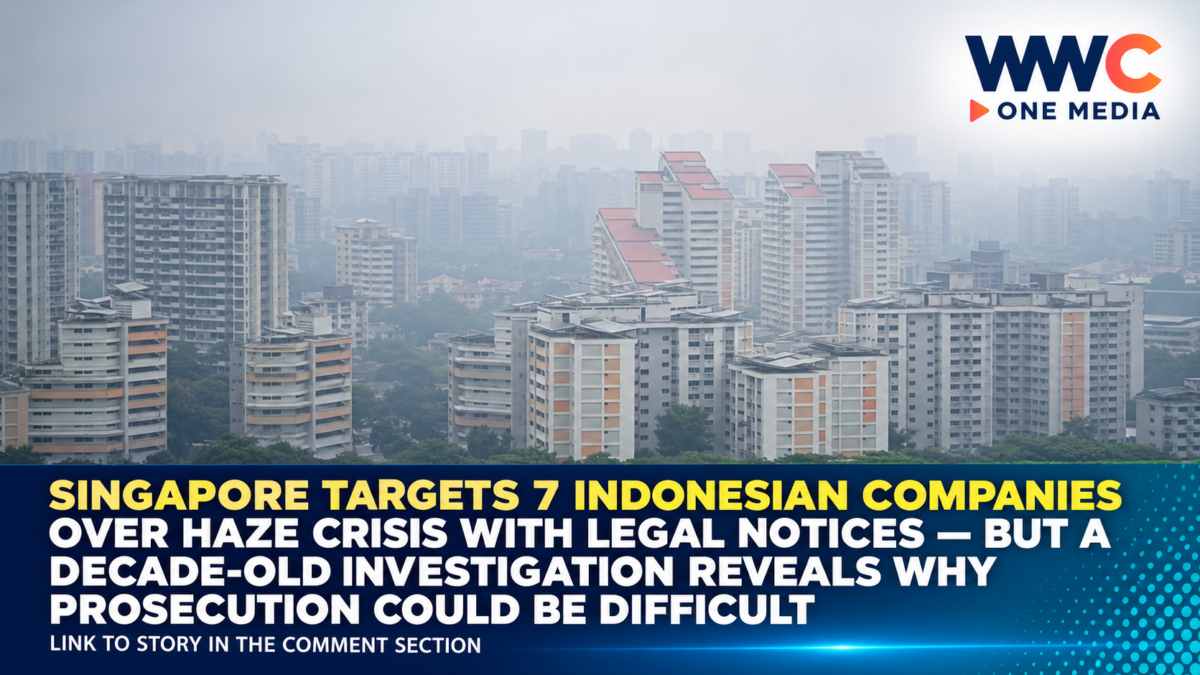
The recurring haze crisis affecting Singapore and neighbouring countries is once again raising difficult questions about accountability, diplomatic relations and the legal responsibilities of governments when pollution crosses national borders.
The latest debate centres on whether legal action could be pursued against parties responsible for transboundary haze originating from Indonesia, and whether Singapore has practical options beyond diplomatic engagement to address the problem.
The issue is particularly sensitive because smoke from land and forest fires in Indonesia has historically travelled across national borders, affecting air quality in Singapore and other parts of Southeast Asia. During severe haze episodes, residents can face reduced visibility, unpleasant air conditions and potential health risks, while businesses and outdoor activities may also be disrupted.
Legal experts examining the situation have highlighted the challenges of holding responsible parties accountable. Although Singapore has legislation designed to address transboundary haze pollution, enforcing it can become complicated when the companies or individuals allegedly responsible operate outside the country’s jurisdiction.
The latest developments have brought the issue closer to a possible enforcement showdown. On October 16, Singapore’s Minister for Sustainability and the Environment, Grace Fu, announced that the government would send preventive measure notices to seven companies in Indonesia identified as responsible for fires contributing to the current haze crisis.
The notices will require the companies to deploy firefighting personnel to extinguish existing fires or prevent them from spreading on land they own or occupy. This represents a more direct step by Singapore to pressure businesses linked to the fires rather than relying exclusively on diplomatic discussions with Jakarta.
Singapore’s Haze Law Could Reach Companies Operating in Indonesia
Singapore’s Transboundary Haze Pollution Act, which took effect in September 2014, gives authorities the power to pursue companies whose activities outside Singapore cause or contribute to haze pollution within its borders.
Under the legislation, companies found guilty of causing or contributing to transboundary haze pollution can face fines of up to S$100,000 per day, subject to an overall maximum of S$2 million.
The law also allows affected individuals and businesses to pursue civil claims for qualifying personal injuries, property damage and economic losses.
However, having legislation in place does not guarantee successful prosecution. Investigators must establish a connection between a company’s activities, the fires on its land or areas under its control, and the resulting pollution in Singapore.
A Decade-Long Investigation Highlights the Difficulties
Singapore’s experience following the severe 2015 haze crisis demonstrates how difficult enforcement can be.
The National Environment Agency identified fires on concession lands associated with six Indonesian companies and issued legal notices to all six.
Investigations involving two companies were subsequently closed after authorities accepted explanations that the companies were no longer associated with the affected land when the fires occurred.
However, investigations involving the remaining four companies are still ongoing, more than a decade later.
The prolonged investigations underline the difficulties of collecting evidence, identifying responsible parties and establishing legal accountability when the suspected activities occur outside Singapore’s territory.
Indonesia’s Sovereignty Adds Another Layer of Diplomatic Tension
The legal question is not the only obstacle facing Singapore.
Environmental law experts have warned that pursuing companies operating in Indonesia could create diplomatic complications between the neighbouring countries.
During Singapore’s previous efforts to enforce its haze legislation in 2015, the move attracted criticism in Indonesia, with concerns that Singapore was interfering with Indonesian sovereignty.
However, legal experts have pointed out that national sovereignty does not give a country unlimited freedom to allow activities within its territory to cause environmental harm beyond its borders.
The challenge is finding a way to enforce environmental accountability without unnecessarily damaging bilateral relations.
Singapore and Indonesia maintain important economic, political and regional partnerships, making the handling of the haze dispute particularly sensitive.
Regional Haze Crisis Intensifies as Fires Continue
The renewed controversy comes amid a particularly severe haze season across Southeast Asia.
Persistent forest and peatland fires in Indonesia, particularly in Sumatra and Kalimantan, have contributed to deteriorating air quality across neighbouring countries.
The prolonged dry conditions associated with an unusually strong El Niño have made the situation worse by increasing the likelihood of fires spreading and making them more difficult to extinguish.
Recent reporting has highlighted the growing health and economic consequences, including respiratory illnesses, school closures and disruptions to air travel.
Singapore has also experienced unhealthy and, at times, very unhealthy air quality readings during the latest episode.
Reuters
+1
Why the Seven Companies Could Face More Than Financial Penalties
The consequences of the renewed enforcement effort could extend beyond potential fines.
Companies found responsible for contributing to cross-border pollution could face reputational damage, legal expenses and increased scrutiny from investors, lenders and international business partners.
Environmental responsibility has become an increasingly important consideration for companies operating in agriculture, plantations and other industries associated with land development.
For Singapore, the challenge is to demonstrate that its legislation can deliver meaningful accountability rather than simply serve as a warning.
For Indonesia, the situation presents a difficult balancing act: protecting its sovereignty and economic interests while addressing a recurring environmental problem that affects millions of people across national borders.
The latest preventive notices could therefore become an important test of how far Singapore is prepared to go in enforcing its environmental laws against overseas companies.
Ultimately, the haze crisis is no longer just an environmental issue. It has become a question of public health, corporate accountability, international law and diplomatic relations across Southeast Asia.