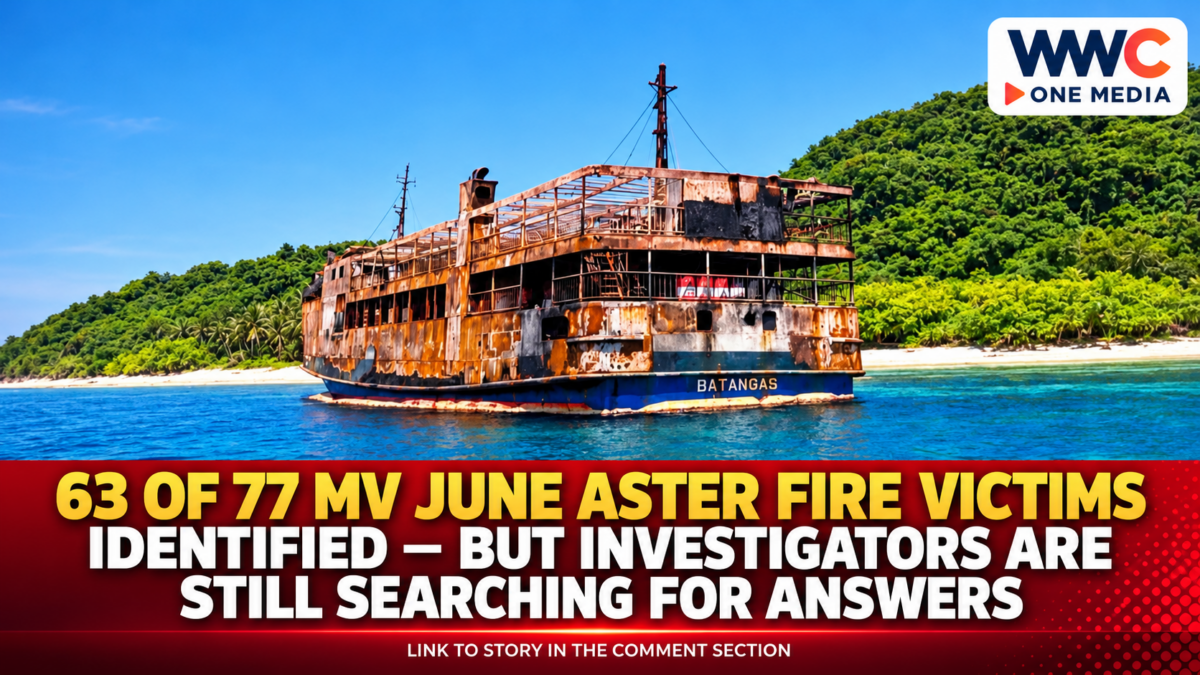
CORON, Palawan — Authorities are continuing the painstaking process of identifying victims of the deadly MV June Aster fire, as investigators examine possible safety violations and accountability issues surrounding the maritime disaster that claimed 77 lives.
According to the Philippine Daily Inquirer report, 63 of the 77 fatalities have been identified, while the investigation into the cause of the September 9 tragedy remains ongoing.
The Philippine Coast Guard (PCG) and the Philippine National Police (PNP) Forensic Group have been coordinating with affected families to establish identities and facilitate the release of remains. A separate Philippine News Agency report published on October 13 placed the number of identified victims at 60, with 11 identification certificates still being processed at that time. The figures reflect different reporting dates and should not be treated as simultaneous updates. PNA report.
Families Still Await Answers
The MV June Aster, a passenger roll-on/roll-off vessel traveling from Batangas to Coron, caught fire on September 9, 2026.
The latest verified figures reported by the PCG and PNA account for 128 people confirmed aboard the vessel: 77 fatalities, 43 survivors and eight people still missing.
For families affected by the disaster, identifying the victims is only one part of the difficult process. Authorities have also been helping relatives complete the documentation required to claim their loved ones’ remains.
The local government of Coron established a One-Stop Shop Assistance Desk at the Emergency Operations Center to assist families with identification and release procedures. According to the PCG figures reported by PNA on October 13, two claimants had visited the center to process the requirements, although no remains had yet been formally claimed at that time.
Investigation Examines Cargo, Safety and Possible Violations
The investigation has expanded beyond the recovery and identification of victims to examine what caused the fire and whether safety procedures were properly followed.
Survivors previously described the fire spreading rapidly through the vessel. The cargo hold has drawn particular attention because it reportedly carried an electric vehicle, a pickup truck, a forklift and five motorcycles, along with other cargo.
However, authorities have not established that the electric vehicle caused the fire. Its possible role remains a subject of investigation, and no suspected cause should be treated as a final finding before investigators complete their work.
The Department of Labor and Employment (DOLE) has also reported labor and occupational safety violations involving the vessel’s management, Atienza Interisland Ferries Inc. The findings included alleged unpaid overtime and other wage-related deficiencies, missing safety programs and emergency response plans, insufficient personal protective equipment, and failures involving mandatory occupational safety reports.
These findings raise additional questions about working conditions and safety management, but they do not, by themselves, establish that a particular violation caused the fatal fire.
Possible Charges Against Responsible Parties
In a report published by the Philippine Information Agency on October 16, authorities said they were considering possible criminal and anti-graft charges against individuals and entities whose actions or omissions may have contributed to the tragedy.
Potentially accountable parties could include members of the vessel’s crew, its owners and officers, cargo handlers, and government personnel, depending on the evidence and their respective responsibilities.
Possible offenses cited by authorities include reckless imprudence resulting in multiple homicide and violations of the Anti-Graft and Corrupt Practices Act where applicable. Investigators are also examining cargo declarations, the handling and placement of potentially hazardous materials, and why the vessel was reportedly cleared to sail despite a mechanical problem that delayed its departure.
These are potential charges under consideration, not final determinations of guilt. Any criminal liability must be established through the appropriate legal process.
What Happens Next?
The continuing identification process, the accounting of missing people and the investigation into possible safety failures remain central to the case.
Authorities must determine not only how the fire started and spread, but also whether inspection procedures, cargo controls, emergency preparedness and other safeguards were adequate.
For the families of those who died or remain missing, the central questions are still unanswered: What triggered the disaster, could it have been prevented, and who—if anyone—should be held legally responsible?
The answers will depend on the evidence gathered by investigators and the findings of the relevant government agencies.