
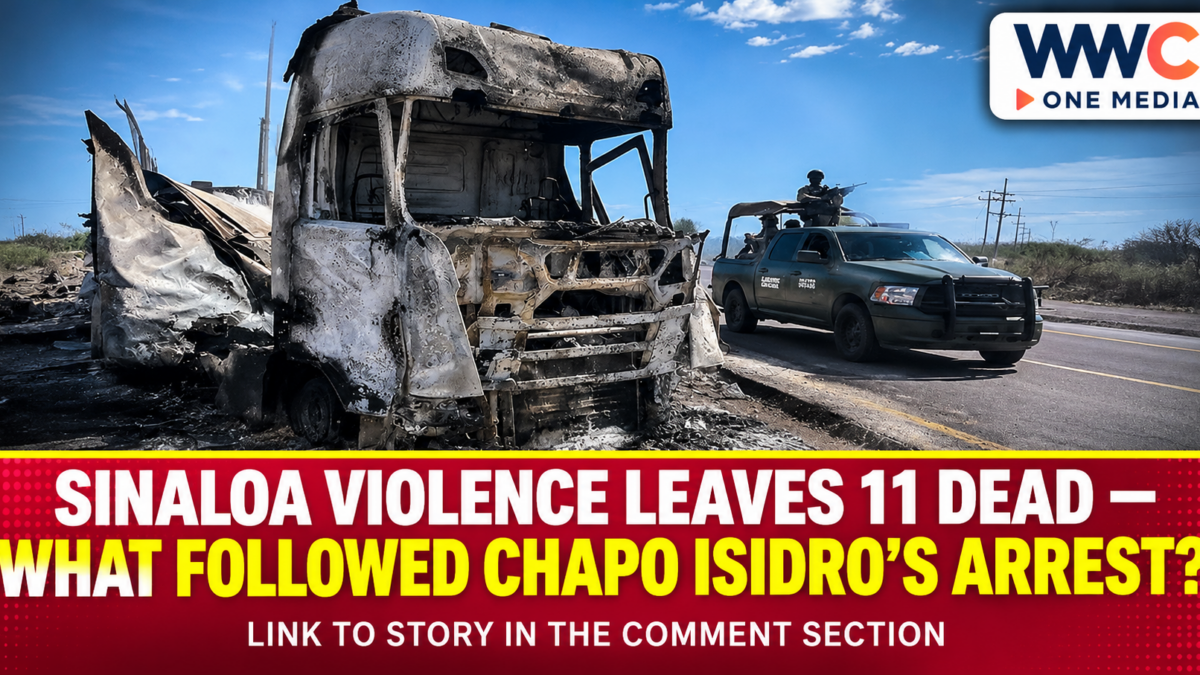
GUASAVE, Mexico — Nov. 22, 2026. Mexico’s Defence Ministry reported that seven people it described as attackers and four soldiers died during and around the military operation to capture Fausto Isidro Meza Flores, known as “Chapo Isidro,” in Sinaloa. US authorities separately confirmed that Mexican military forces arrested Meza Flores in Guasave on Nov. 20, bringing a high-profile international fugitive case into a new phase.
The Sinaloa violence figures establish a deadly cost to the operation, but they do not establish that security has returned to normal or that criminal networks have been dismantled. Authorities must now distinguish between the reported tactical outcome, the treatment of detainees and the broader protection of residents.
Sinaloa Violence: What the 11-Death Report Actually Covers
Mexico’s Defence Ministry announced on Nov. 21 that seven people it classified as aggressors had died during the operation. It also reported the deaths of four army infantry personnel who were moving to reinforce security in the municipality of Guasave amid resistance to the capture.
Together, those official categories account for 11 deaths. They should not be described as a confirmed count of civilian victims. Nor should the ministry’s description of the seven people be treated as a judicial finding about each person’s conduct.
The military statement reported no known impact on people uninvolved in the incident at the time it was issued. That is a dated operational assessment, not proof that no other harm could subsequently be identified.
The US Justice Department’s Nov. 21 statement confirmed the capture and offered condolences to the families of soldiers killed. It did not provide an independent breakdown of all 11 deaths. The two governments’ records therefore serve different purposes and must not be presented as if they document identical details.
The Capture in Guasave and the Wider Security Response
The US Justice Department said Meza Flores was detained in Guasave on Nov. 20 following an operation by Mexican military forces supported by a US Homeland Security Task Force investigation. It also confirmed the arrest of Germán Rolando Gálvez Meza, known as “El Serafín.”
Mexico’s Defence Ministry described the arrests as part of a wider operation in which additional suspects were detained. Its report also addressed road blockages in several Sinaloa municipalities and described a security response intended to restore movement.
A road blockade can interrupt daily life even when it does not cause a reported injury. Whether a specific school, hospital, transport company or business was affected requires a separate local record; the operational account cannot establish each downstream consequence.
The existing WWC report on Chapo Isidro’s capture and US indictment addresses the arrest’s legal background. The additional development here is the military’s subsequent casualty accounting and what it reveals—and does not reveal—about security on the ground.
Why an Arrest Does Not Settle the Criminal Case
Meza Flores faces charges described in a six-count US federal indictment. The Justice Department identified allegations involving a continuing criminal enterprise, drug trafficking for importation into the United States, money laundering, material support to a terrorist organisation, narcoterrorism and firearms offences.
Those allegations are not convictions. The indictment sets out what prosecutors allege and must prove through the applicable judicial process; a military capture does not establish guilt.
The department said a second superseding indictment was returned on Sept. 25, 2026. It stated that conviction could carry the death penalty or a mandatory life sentence. These are possible legal consequences, not a sentence already imposed.
That distinction extends to the people killed in the Mexican operation. An official operational description should not replace individual identification, forensic review or any appropriate investigation into the circumstances of their deaths.
The Longer Security Problem in Sinaloa
Mexico’s federal security authorities had already documented operations associated with the network before the November capture. In an Oct. 28 joint release, they described an Oct. 26 encounter near Alfredo V. Bonfil in the municipality of Sinaloa, during which two people died after a reported attack on naval personnel.
At the time, authorities said one deceased person’s possible identity required genetic and fingerprint confirmation. That earlier case should not be folded into the Nov. 20–21 death toll or treated as a confirmed identification before forensic procedures are completed.
A separate Mexican government security briefing in September described a strategy aimed not merely at arresting leaders but also at disrupting criminal organisations’ finances, logistics and capacity for violence. That gives a more demanding benchmark for assessing the current operation than the capture of one prominent suspect alone.
The wider issue of cross-border enforcement was also examined in WWC’s coverage of US–Ecuador anti-cartel security talks. That is a separate country and policy process; it illustrates the broader need to test security cooperation against outcomes rather than announcements.
What the Official Records Cannot Yet Show
The government announcements confirm an arrest, reported military casualties and the existence of a security response. They do not provide a final, independently adjudicated account of each death or establish how quickly normal movement resumed in every affected community.
The reports also do not establish that armed groups have ceased operating, that no further violence will occur or that businesses can safely resume activities without consulting local authorities.
For comparisons with criminal proceedings elsewhere in Mexico, WWC’s report on the Morelos student killing investigation discusses a distinct incident in which detention and allegations likewise needed to be separated from court findings. It is not evidence about events in Sinaloa.
The practical lesson is to preserve distinctions between what security forces reported, what prosecutors allege, what courts determine and what local residents experience.
What Happens Next?
The next measurable developments are any updated Mexican reports on public security, completed identification and casualty assessments, and formal steps in the relevant criminal proceedings. The US Justice Department’s announcement does not itself establish an extradition timetable or the outcome of any future hearing.
The capture is a significant enforcement action, but safety in Sinaloa must ultimately be assessed through conditions faced by communities and evidence of sustained disruption to criminal activity. Neither can be inferred automatically from the arrest or the initial death toll.
Frequently Asked Questions
How many people died during the Chapo Isidro operation?
Mexico’s Defence Ministry reported seven people it classified as attackers and four soldiers killed, a total of 11, in its Nov. 21, 2026 update.
When and where was Chapo Isidro captured?
The US Justice Department confirmed that Mexican military forces captured Fausto Isidro Meza Flores on Nov. 20, 2026, in Guasave, Sinaloa.
Does the arrest mean Meza Flores was convicted?
No. He faces US federal criminal charges, which are allegations subject to the judicial process.
Were civilians reported killed in the operation?
The Mexican military said its Nov. 21 report had no identified harm to people uninvolved in the events. That statement is not a final, independently verified casualty assessment.
Is Sinaloa safe after the arrest?
The official records reviewed do not establish that all security disruptions have ended. Residents should rely on current local government advisories.










