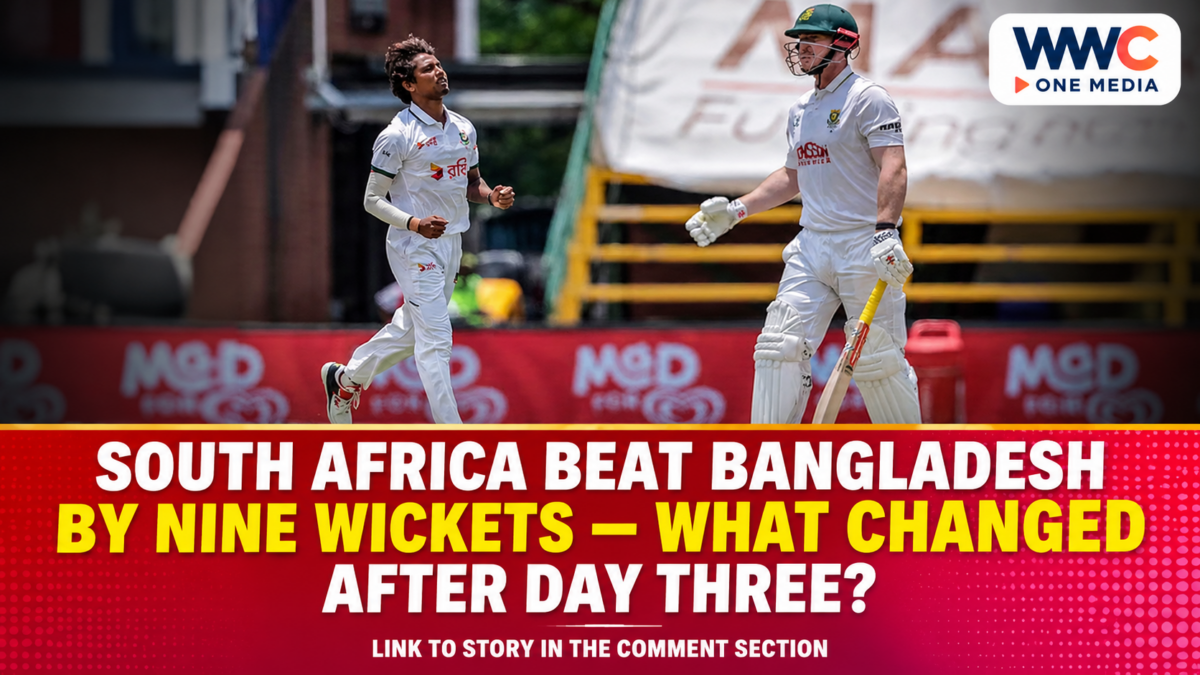
JOHANNESBURG, South Africa — South Africa beat Bangladesh by nine wickets at the Wanderers on Nov. 19, 2026, taking a 1–0 lead in their two-Test series. This followed a third day when the hosts had been 386 for seven, still 14 runs behind Bangladesh’s first-innings total, before rain halted play.
The Test turned on a bigger contrast: Bangladesh’s impressive first-innings recovery was followed by a far more effective South African response with bat and ball. The victory also lifted South Africa to the top of the 2025–27 ICC World Test Championship standings, turning a difficult passage in Johannesburg into an important result for the wider campaign.
How South Africa Beat Bangladesh: The numbers shift
Bangladesh made 400 after an uncertain beginning. The visitors had slipped to 22 for three and later 121 for five, but Towhid Hridoy’s 137 and Litton Das’s 120 rebuilt the innings. Tanzid Hasan Tamim contributed 67, helping Bangladesh reach their highest Test total on South African soil.
South Africa’s response looked less secure when the third day ended at 386 for seven. That did not settle the match. Test cricket measures the contest across two innings per side, and a deficit can disappear if the remaining batters add runs.
That is precisely what happened. The hosts reached 557, a lead of 157. Bangladesh then managed only 168 in their second innings, leaving a target of 12, which South Africa reached at 12 for one in 1.3 overs. The final margin was nine wickets.
Why the third-day disruption did not decide the match
South Africa had been recovering from Bangladesh’s 400 when the match was interrupted on Nov. 17. Persistent rain washed out the final two sessions, leaving the hosts seven wickets down and still short of the visitors’ total.
Captain Temba Bavuma’s calf problem added uncertainty. He had stopped batting during the third day but returned on the fourth, when the lower order and established batters made the difference. Neither disruption determined the outcome.
Ryan Rickelton reached 102, while Kagiso Rabada delivered a career-best Test batting score of 72 and Dane Paterson added 29. Bavuma finished unbeaten, although the ICC’s separate match reports differ by one run on his final score, so the precise figure is not needed to explain the result.
Those contributions transformed the match. By the time Bangladesh batted again, the tourists had to erase 157 runs merely to make the hosts bat for a meaningful target. That changed the pressure on every subsequent partnership.
Rabada and Harmer made the advantage count
Rabada shaped both halves of the match. He took five for 70 in Bangladesh’s first innings, then added 72 with the bat as South Africa built their lead. He followed with three for 48 in Bangladesh’s second innings and was named Player of the Match.
But it was Simon Harmer who delivered the decisive finish. The off-spinner took six for 51 in the second innings, including a sequence of wickets on the final morning that stopped Bangladesh from establishing a viable resistance.
Bangladesh had ended the fourth day at 100 for five, still 57 behind. Litton added 39 before Rabada bowled him, and Mushfiqur Rahim made 22. Harmer then dismissed the remaining batters as Bangladesh were all out for 168.
South Africa’s chase was brief. Marques Ackerman fell without scoring, but Aiden Markram and Zubayr Hamza completed the task. Markram finished unbeaten on eight, including a six. The hosts needed fewer than two overs to secure the match.
What the win means for the World Test Championship
The result had consequences beyond a home-series lead. The ICC’s Nov. 19 update placed South Africa first in the 2025–27 World Test Championship standings on a points percentage of 75%, ahead of New Zealand on 72.22% and Australia on 69.23%.
Points percentage matters because teams do not all play the same number of Tests in the championship cycle. A win can therefore change both a team’s points and its position relative to rivals with different schedules.
WWC has previously examined New Zealand and India’s World Test Championship contest, another series where each match affects the wider table. The championship is also shaped by disciplinary deductions, as shown in WWC’s earlier coverage of Pakistan’s World Test Championship points penalty.
For South Africa, the immediate significance is straightforward: a nine-wicket victory converted a vulnerable mid-match position into a successful start to the Bangladesh series. It does not guarantee a place in the championship final, but it strengthens the position from which the team continues its campaign.
Bangladesh have reasons to examine both innings
Bangladesh’s 400 showed that the batting line-up could recover after losing early wickets. Hridoy and Litton each made centuries, and the team’s first-innings total was a notable achievement in South African conditions.
The difficulty was sustaining that performance. Bangladesh conceded a 157-run lead despite having reduced South Africa to 386 for seven. Their second innings then ended at 168, leaving almost no room for the bowlers to influence the final chase.
Analysis: The difference was not simply one poor session. South Africa gathered runs from multiple contributors and then kept taking wickets when Bangladesh needed a substantial partnership. Bangladesh’s challenge for the next Test is to turn promising individual innings into a result sustained across both batting efforts.
The teams also remain part of a wider cricket calendar. WWC’s coverage of the 2027 Cricket World Cup ticket ballot illustrates the scale of interest in upcoming international fixtures, although that one-day tournament is separate from this Test series and its championship points.
What happens next
The second and final Test is scheduled for Nov. 23–27 at SuperSport Park in Centurion. South Africa lead the series 1–0, so Bangladesh must win to draw the series; another South African win would complete a sweep.
Bavuma’s availability remains an issue after the calf problem in Johannesburg. He discussed the injury following the first Test, but the precise selection decision for Centurion should be taken from a subsequent official team announcement rather than assumed in advance.
Frequently asked questions
Who won the first South Africa vs Bangladesh Test in November 2026?
South Africa won by nine wickets in Johannesburg on Nov. 19, 2026, and took a 1–0 series lead.
What were the final innings scores?
Bangladesh scored 400 and 168. South Africa made 557 and then reached 12 for one to win.
Why was the third day significant?
South Africa were 386 for seven, still 14 behind, when rain ended play early. The hosts recovered on the fourth day and built a 157-run first-innings lead.
Who was Player of the Match?
Kagiso Rabada was Player of the Match after taking five first-innings wickets, scoring 72 and claiming another three wickets in Bangladesh’s second innings.
When is the second South Africa vs Bangladesh Test?
The second Test is scheduled for Nov. 23–27, 2026, at SuperSport Park in Centurion.