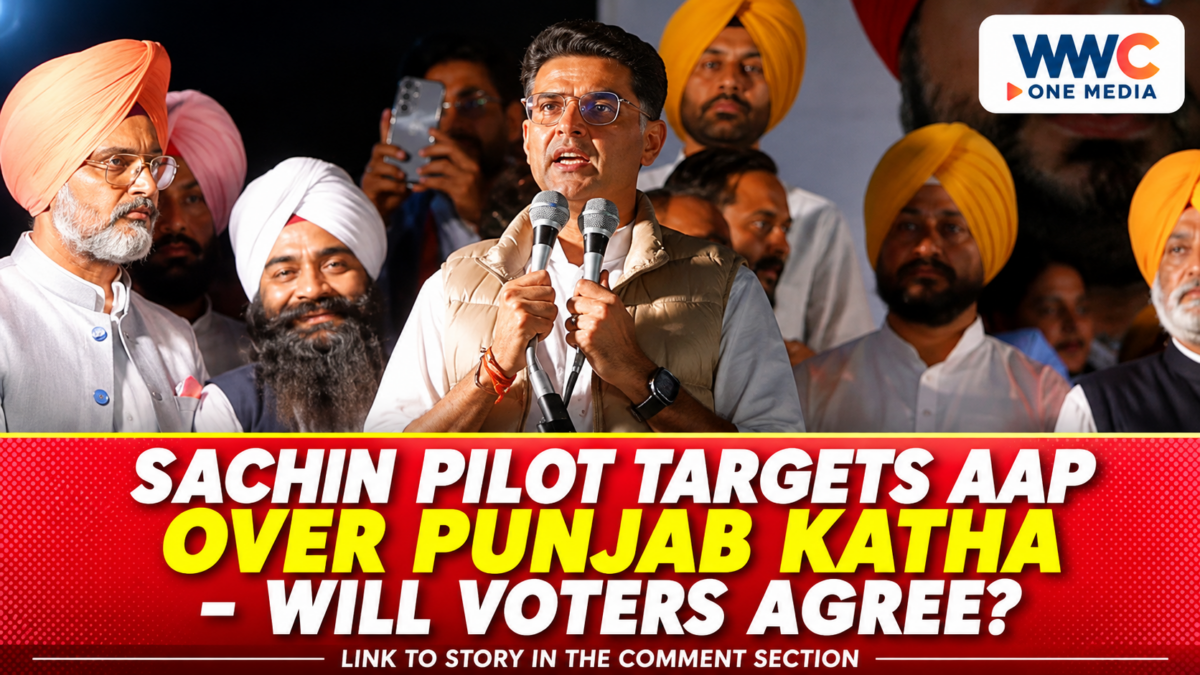
A religious gathering in Pathankot has become a political talking point ahead of Punjab’s next Assembly election, after Congress leader Sachin Pilot questioned the Aam Aadmi Party’s presence at an event featuring Hindu preacher Dhirendra Krishna Shastri.
Pilot argued that religious programmes alone cannot secure electoral victories, insisting that Punjab’s voters are more concerned about employment, public safety and law and order. His remarks put the spotlight on how political parties engage with religious gatherings while competing for support in a state where governance and security remain central campaign issues.
The three-day Shri Hanumant Katha and Divya Darbar took place in Pathankot from Nov. 22 to 24, 2026. The programme was listed by Bageshwar Dham, the religious institution associated with Shastri, with the first two days reserved for the Hanumant Katha and the final day for the Divya Darbar.
The event attracted political attention after AAP leader Manish Sisodia attended the final day and addressed the gathering. Pilot subsequently used the appearance to challenge the ruling party’s political priorities.
Why the Pathankot religious event became political
The gathering was held in Pathankot, a city in Punjab’s northern border region. Its programme featured Dhirendra Krishna Shastri, the head of Bageshwar Dham in Chhatarpur district, Madhya Pradesh.
The official event calendar listed the Hanumant Katha on Nov. 22 and 23, followed by the Divya Darbar on Nov. 24. The programme was presented as a religious gathering rather than an official election rally.
However, the presence of political figures gave the event additional significance ahead of the 2027 Punjab Assembly election.
Manish Sisodia, AAP’s Punjab in-charge, attended the final day’s programme. In his remarks, he spoke about education, national development and the Bhagwant Mann government’s work in areas including schools, hospitals, employment, farmers and traders. He also sought the blessings of religious leaders for the state government.
Shastri, meanwhile, described the purpose of his religious discourses as spreading the message of Sanatan Dharma, unity and brotherhood. He said people from different sections of society had participated in the Pathankot gathering.
The distinction matters: political leaders attended a religious programme, but that alone does not establish that the event was formally organised as an AAP election campaign.
Sachin Pilot says voters want jobs and security
Pilot, Congress general secretary and the party’s Punjab in-charge, criticised AAP’s political engagement with the gathering during a media interaction in Jaipur.
He argued that elections are won by addressing public concerns rather than relying on religious events. He identified employment, security and better law and order as issues that should receive greater attention from the Punjab government.
Pilot also criticised Chief Minister Bhagwant Mann, questioning his approach to serious governance concerns in a state that shares an international border.
His remarks form part of Congress’s broader effort to challenge the AAP government’s performance before the next state election.
The criticism is political, however, and should be distinguished from independently established findings about crime or public safety. Pilot also cited a figure of 395 murders over 24 months, but that claim requires separate verification against official Punjab Police or government crime statistics before it can be presented as an established total.
For voters, the larger question is whether parties can demonstrate measurable progress on employment, public security and the delivery of public services rather than relying primarily on campaign messaging.
AAP’s position and the role of religious leaders
Sisodia’s remarks at the gathering offered a different picture of the relationship between religious participation and public life.
He framed his attendance around seeking blessings for education, national development and Punjab’s progress. He also praised the Mann government’s work in several public-service areas.
Shastri, for his part, said he did not belong to any one political party when asked about political support. His statement is important because attendance by political leaders should not automatically be interpreted as an endorsement of a party or candidate.
The episode highlights a recurring challenge in electoral politics: religious gatherings can attract political representatives from different parties, while their participation may later become part of campaign arguments.
The controversy also follows wider public attention surrounding Shastri. WWC recently examined the separate Ramdev-Dhirendra Shastri disagreement over religious remarks, which raised questions about public influence, religious expression and responsibility among prominent spiritual figures.
These are separate developments. The Ramdev dispute concerned religious commentary, while the Pathankot controversy centres on the political meaning attached to politicians attending a religious programme.
Punjab’s 2027 election is taking shape
The exchange comes as parties prepare for the next Punjab Assembly election, expected in 2027.
The previous election, held in 2022, produced a decisive result. The Election Commission of India recorded 92 seats for AAP and 18 for Congress in the 117-member Assembly. The result established AAP as the dominant party in the state legislature and left Congress seeking to recover ground.
That electoral history helps explain why the latest criticism matters. Congress is attempting to position itself as a credible alternative to the incumbent government, while AAP has an interest in defending its record and maintaining its support.
The wider political field is also changing. The Bharatiya Janata Party and the Shiromani Akali Dal have announced plans to contest the 2027 election together, restoring a partnership that broke down in 2020. Their return adds another dimension to the contest, as explored in WWC’s report on the BJP-SAD alliance and the issues that could test its return.
The renewed alliance does not determine the election outcome. Its eventual influence will depend on candidate selection, constituency arrangements, voter response and the parties’ ability to address issues that contributed to their earlier split.
The issues likely to shape the campaign
Pilot’s comments point to three major areas that could feature prominently in the coming campaign.
Employment: Parties will face questions about job creation, opportunities for young people and the ability of the state economy to retain skilled workers.
Security and law enforcement: Punjab’s location along India’s international border makes public safety and cross-border security important political concerns. Claims about crime trends, however, should be assessed using official statistics rather than campaign statements alone.
Governance and public services: Education, healthcare, agriculture and the delivery of government programmes will remain important measures by which voters assess the incumbent administration and opposition alternatives.
The election debate also takes place within a wider national discussion about political participation and electoral confidence. WWC has examined the evidence behind India’s voter-roll controversy and the questions surrounding official electoral records. That issue is separate from Punjab’s religious gathering, but it reinforces the importance of transparent evidence when political claims are made.
What happens next?
The Pathankot event has ended, but the political argument surrounding it may continue as Punjab’s parties intensify their preparations for 2027.
For Congress, Pilot’s challenge is an attempt to keep attention on governance, employment and security. For AAP, the task is to defend its record and explain how its public programmes address those concerns.
The gathering itself does not establish which party benefits electorally. Nor does the presence of politicians at a religious event prove that the religious leader has endorsed their campaign.
Ultimately, the political test will be whether parties can persuade voters that their promises translate into results.
The question facing Punjab’s political leaders is no longer just who attended the Pathankot gathering. It is whether voters will judge the parties by their religious outreach—or by what they deliver on jobs, security and governance.
Frequently asked questions
Why did Sachin Pilot criticise AAP after the Pathankot event?
Pilot argued that elections are won by addressing public concerns such as employment, security and law and order, rather than by organising or attending religious programmes.
When was Dhirendra Shastri’s Pathankot event held?
The Shri Hanumant Katha and Divya Darbar programme ran from Nov. 22 to 24, 2026.
Did Manish Sisodia attend the event?
Yes. AAP leader Manish Sisodia attended the final day’s programme and addressed the gathering.
When is the next Punjab Assembly election?
The next Punjab Assembly election is expected in 2027.
Did Dhirendra Shastri endorse AAP?
His remarks at the gathering described his religious mission and stated that he did not belong to any one political party. Attendance by AAP leaders does not establish an endorsement.