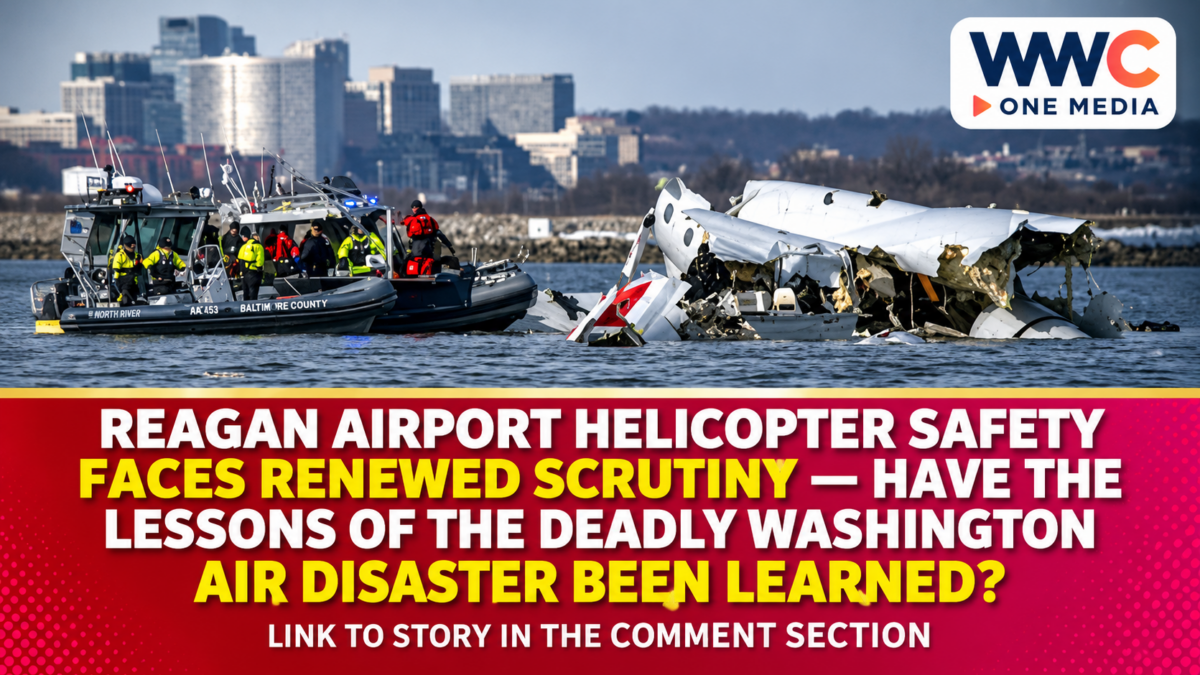
WASHINGTON — Aviation safety reforms surrounding Ronald Reagan Washington National Airport are facing a critical test as US lawmakers work to resolve outstanding military aviation provisions in proposed legislation designed to prevent another catastrophic midair collision.
Nearly two years after the January 29, 2025, collision between American Airlines Flight 5342 and a US Army helicopter killed 67 people, federal authorities have introduced permanent flight restrictions, revised air traffic control procedures and recommended extensive improvements to aviation safety systems.
However, an agreement announced by congressional leaders on November 17, 2026, revealed that important provisions governing military aircraft remained unresolved despite progress on civilian aviation reforms.
The outstanding issues raise a fundamental question: can military aviation requirements coexist with commercial airline operations without compromising passenger safety?
Reagan Airport Helicopter Safety Remains a National Concern
The January 2025 collision exposed systemic weaknesses in the management of military and commercial aircraft operating within Washington’s congested airspace.
The National Transportation Safety Board (NTSB) identified deficiencies involving airspace planning, regulatory oversight, air traffic controller workload, collision avoidance technology and military safety management.
Investigators concluded that the disaster resulted from multiple failures rather than an isolated operational error.
The investigation also identified weaknesses in coordination between aviation organisations and the management of previously recognised safety risks.
The NTSB issued 50 safety recommendations intended to address the problems identified during its investigation.
These recommendations extend beyond helicopter operations near Reagan National Airport, highlighting broader concerns about how aviation authorities identify risks, communicate safety information and implement corrective measures.
The importance of reliable coordination was also examined in WWC ONE MEDIA’s earlier coverage of communication failures involving Marine One and Reagan National Airport.
Although the incidents are separate, both underscore the importance of dependable communication and clearly defined responsibilities when military and civilian aircraft operate within shared airspace.
FAA Introduces Permanent Helicopter Restrictions
On January 22, 2026, the US Department of Transportation announced permanent restrictions affecting certain helicopter and powered-lift aircraft operations near Reagan National Airport.
The interim final rule took effect on January 23, formalising restrictions introduced after the fatal collision.
Certain essential operations may qualify for exceptions, meaning the restrictions do not constitute a universal prohibition on military helicopter activity throughout Washington.
The Federal Aviation Administration (FAA) has also introduced several operational improvements, including:
- Stronger separation requirements for military and commercial aircraft.
- Revised helicopter operating arrangements.
- Updated aircraft identification and tracking requirements.
- Increased support, staffing and oversight for air traffic controllers.
- Improved coordination procedures involving military aviation facilities.
These measures are intended to reduce the possibility of conflicting aircraft movements and strengthen the safeguards available to aviation personnel.
Nevertheless, implementing restrictions is only one component of a comprehensive aviation safety programme.
Authorities must also establish whether revised procedures are effective in practice, whether communication systems perform reliably and whether additional operational risks have been adequately addressed.
Any proposal to expand military helicopter operations should therefore be assessed against the safety requirements established following the 2025 disaster.
Congress Reaches Partial Agreement on Aviation Safety Legislation
A significant development emerged on November 17, 2026, when bipartisan congressional leaders announced an agreement in principle covering civilian aviation safety reforms.
The proposed framework incorporates requirements involving Automatic Dependent Surveillance–Broadcast In, commonly known as ADS-B In.
However, lawmakers confirmed that provisions affecting military aircraft operating within civilian airspace had not yet been fully resolved.
The outstanding discussions involve congressional transportation and armed services committees.
The proposed legislation seeks to reconcile provisions from two separate aviation safety measures:
- The Rotorcraft Operations Transparency and Oversight Reform Act, or ROTOR Act.
- The Airspace Location and Enhanced Risk Transparency Act of 2026, or ALERT Act.
The congressional agreement represents progress towards a unified legislative framework, but an agreement in principle is not equivalent to an enacted federal law.
For passengers, the distinction is important because proposed safety improvements cannot be assumed to be operational merely because lawmakers have agreed on their general objectives.
Why Aircraft Tracking Technology Matters
Aircraft surveillance technology has become a central component of the legislative debate.
ADS-B Out enables aircraft to transmit information about their position, while ADS-B In allows appropriately equipped aircraft to receive relevant information about surrounding air traffic.
These capabilities can improve situational awareness and provide additional information to flight crews.
However, technology does not eliminate every operational risk.
Its effectiveness depends on equipment compatibility, reliable data transmission, appropriate procedures and effective integration into aviation safety systems.
The NTSB identified limitations in aircraft traffic awareness and collision alerting capabilities among the contributing factors in the January 2025 disaster.
Strengthening these systems could provide additional protection, but technological improvements must operate alongside effective training and regulatory oversight.
The wider importance of reliable aviation technology was highlighted in the investigation into the November 2026 nationwide FAA ground stop.
That disruption involved a separate set of technical circumstances, but it provides another example of why dependable aviation infrastructure and effective contingency planning remain essential.
Military Readiness and Passenger Safety Must Be Balanced
Military aviation serves important national security and emergency response functions. Maintaining operational readiness requires training, equipment testing and coordination with civilian aviation authorities.
However, the presence of military aircraft within airspace used by commercial airlines creates a responsibility to manage risks across both organisations.
Following a separate aviation incident involving an Army helicopter and commercial flights on May 1, 2025, the Army conducted an internal operational review.
Its review identified concerns involving legacy aircraft tracking systems and air traffic coordination. The Army also confirmed that it was working with the FAA on updated operating procedures before resuming Pentagon flight operations in support of national security missions.
The challenge is not simply whether military helicopters should be permitted to operate near commercial airports.
It is whether the supporting safety arrangements provide sufficient protection for passengers, flight crews, controllers and military personnel.
Effective coordination must extend beyond individual aircraft to encompass the institutions responsible for managing shared airspace.
Why Aviation Safety Reforms Matter Across the Asia-Pacific
The Washington investigation raises issues relevant to major aviation markets worldwide, including those across the Asia-Pacific.
Airports supporting commercial transportation, government aviation, emergency services and military activities must manage competing operational requirements without allowing efficiency objectives to undermine safety.
Airlines also depend on predictable regulations, reliable communications and consistent traffic management procedures to maintain dependable operations.
The importance of managing aviation risks across different operational environments was explored in WWC ONE MEDIA’s coverage of the Copa–UPS taxiway collision at Miami International Airport.
While that incident is unrelated to the Washington disaster, it illustrates how aviation safety requires continuous attention throughout aircraft operations.
For international aviation authorities, the broader Washington case reinforces the value of proactive risk assessments, effective safety reporting systems and cooperation between civilian and military organisations.
Commercial efficiency and military readiness remain important objectives, but neither should substitute for independently evaluated safety standards.
What Happens Next?
The next major milestone is the resolution of outstanding congressional disagreements involving military aviation safety provisions.
Lawmakers have expressed their intention to complete comprehensive legislation before the end of the 119th Congress.
Meanwhile, aviation authorities must continue evaluating and implementing safety recommendations arising from the 2025 investigation.
Any future expansion of military helicopter operations near Reagan National Airport must be considered within the applicable regulatory framework and supported by appropriate safety assessments.
The congressional agreement announced on November 17 represents meaningful progress, but it does not resolve every outstanding issue.
The ultimate measure of these reforms will not be the number of legislative announcements or revised operating procedures.
It will be whether those changes provide lasting, demonstrable protection for everyone sharing America’s skies.
Frequently Asked Questions
What happened near Reagan National Airport in January 2025?
American Airlines Flight 5342 and a US Army helicopter collided on January 29, 2025, killing all 67 people aboard the two aircraft.
How many safety recommendations did the NTSB issue?
The NTSB issued 50 safety recommendations following its investigation, addressing issues including air traffic management, aircraft surveillance, training and institutional oversight.
Are helicopter flights banned near Reagan National Airport?
Permanent restrictions took effect on January 23, 2026, affecting certain helicopter and powered-lift operations. Exceptions exist for qualifying essential operations.
What is ADS-B In?
ADS-B In is aircraft surveillance technology that enables appropriately equipped aircraft to receive information about surrounding air traffic, helping improve situational awareness.
Has Congress completed its aviation safety legislation?
Congressional leaders announced an agreement in principle on civilian aviation provisions on November 17, 2026. Military aviation provisions remained unresolved at the time of that announcement.