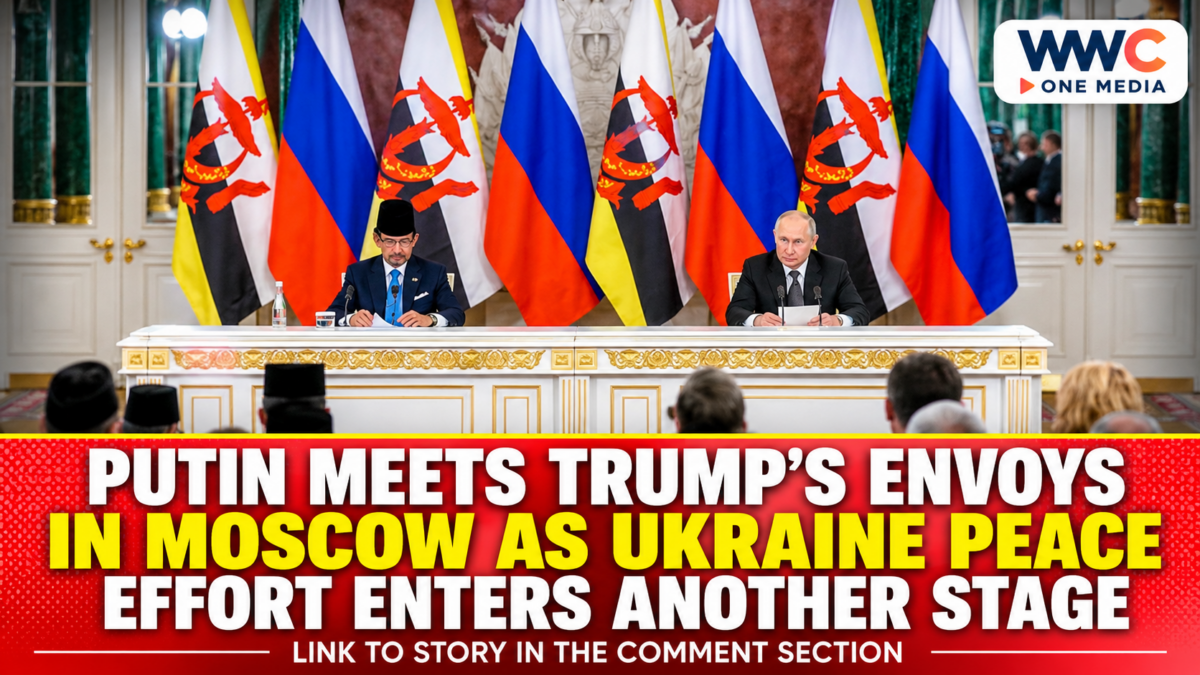
MOSCOW, Russia — November 12, 2026 — Russian President Vladimir Putin met US President Donald Trump’s special envoy Steve Witkoff and entrepreneur Jared Kushner at the Kremlin for discussions involving the war in Ukraine, humanitarian cooperation and continued contacts between Moscow and Washington.
The meeting placed humanitarian issues alongside the wider diplomatic effort to bring Russia and Ukraine closer to negotiations, with Putin acknowledging progress involving prisoner exchanges and indicating that further humanitarian steps were being discussed.
The encounter matters because it shows that communication between the United States and Russia is continuing even as the central disagreements surrounding Ukraine remain unresolved. It also highlights how humanitarian arrangements can provide opportunities for cooperation without necessarily producing a broader political settlement. Telegram+1
Putin US envoys meeting brings humanitarian issues forward
In his opening remarks, Putin thanked Trump for arranging contacts with the Ukrainian side and acknowledged the involvement of American representatives in the diplomatic process.
He identified humanitarian cooperation as an area where progress had already been made.
“There have been POW exchanges, and another major step in this direction is now taking shape,” Putin said.
The statement placed the treatment and return of prisoners among the issues receiving attention during the broader diplomatic engagement.
Putin also acknowledged the involvement of US First Lady Melania Trump in efforts addressing the humanitarian situation in and around Alyoshki in the Kherson Region.
These comments are significant because humanitarian arrangements can create practical areas of cooperation even when the parties remain divided over territory, security and the future political relationship between Russia and Ukraine. Telegram+1
Why prisoner exchanges matter in the negotiations
Prisoner exchanges are among the most tangible humanitarian outcomes that can emerge from negotiations between countries involved in an armed conflict.
Unlike a comprehensive peace agreement, an exchange can be arranged through a narrower understanding that does not require the parties to resolve every political or military disagreement.
For families waiting for the return of captured relatives, such arrangements have immediate human consequences.
For governments, they can also demonstrate that communication channels remain functional.
The November 12 Kremlin meeting followed the November 10–11 US-mediated discussions in Abu Dhabi. Those discussions placed humanitarian questions within a wider diplomatic process involving Russia, Ukraine and the United States.
WWC previously examined the Abu Dhabi negotiations and the major obstacles facing a Russia-Ukraine peace agreement.
The important distinction is that progress on prisoner exchanges does not automatically mean the parties have reached an agreement on ending the war. Humanitarian cooperation and political negotiations operate on different levels.
Washington’s diplomatic role remains central
Witkoff and Kushner’s participation illustrates the continued involvement of Trump’s administration in direct engagement with Moscow.
The presence of two American representatives also reflects the administration’s effort to maintain communication with Russian leadership while pursuing contacts involving Ukraine.
However, diplomatic meetings should not be confused with formal agreements.
A discussion can establish areas of common interest, communicate proposals or identify possible next steps. It does not, by itself, demonstrate that the participating governments have accepted a final settlement.
This distinction is particularly important in negotiations involving territorial claims, security arrangements and the future relationship between Ukraine and Western governments.
WWC previously covered the earlier Moscow meeting between Putin and Trump’s representatives, illustrating how Washington has continued using direct diplomatic engagement as part of its approach to the conflict.
The November meeting represents another stage in that engagement, but its ultimate significance depends on what follows through official negotiations.
The humanitarian question extends beyond the negotiating table
The opening remarks also referred to the humanitarian situation in Alyoshki, in the Kherson Region.
Putin specifically acknowledged Melania Trump’s involvement in addressing conditions in and around the town.
This reference demonstrates that humanitarian concerns were part of the public discussion surrounding the meeting, rather than the conversation being presented solely as a military or territorial negotiation.
Humanitarian questions in an armed conflict can include the return of prisoners, civilian protection, access to essential assistance and arrangements affecting communities near contested areas.
Each issue requires practical coordination, and progress in one area should be assessed separately from developments in others.
WWC has also reported on the proposed major Russia-Ukraine prisoner exchange following the Abu Dhabi discussions.
Such developments underline why humanitarian negotiations remain important even when a comprehensive political agreement is still beyond reach.
What the Moscow meeting does not establish
There is an important limitation to what can be concluded from the published opening remarks.
They establish that Putin publicly acknowledged US involvement in contacts with Ukraine, referred to progress on prisoner exchanges and recognised humanitarian activity involving Alyoshki.
They do not independently establish that Russia and Ukraine have agreed to a comprehensive ceasefire, accepted a territorial settlement or finalised a new security arrangement.
Nor does the public opening statement provide a complete account of every issue discussed during the private negotiations.
For readers following the peace process, separating confirmed developments from diplomatic expectations is essential.
The difference between an expressed willingness to continue discussions and a signed agreement can determine whether a reported breakthrough produces an actual change on the ground.
What happens next
The next important developments will depend on whether the diplomatic contacts produce concrete humanitarian arrangements and further structured negotiations involving Russia and Ukraine.
Prisoner exchanges remain one possible area where practical progress can be achieved without first resolving the most difficult political questions.
The public record of the November 12 meeting establishes continued engagement between Putin and Trump’s representatives. It does not establish that the wider conflict is close to a final settlement.
For Washington, Moscow and Kyiv, the challenge remains turning diplomatic contact into arrangements that can be implemented and sustained.
The next phase of negotiations will therefore be judged not simply by the number of meetings held, but by whether those meetings produce verifiable outcomes.
Frequently asked questions
1. When did Vladimir Putin meet Steve Witkoff and Jared Kushner?
The meeting took place at the Kremlin in Moscow on November 12, 2026.
2. Why did Putin thank Donald Trump?
Putin thanked Trump for arranging contacts with the Ukrainian side and acknowledged US involvement in humanitarian discussions.
3. What humanitarian progress did Putin mention?
He referred to prisoner exchanges and said another major humanitarian step was taking shape.
4. What role did Melania Trump receive recognition for?
Putin acknowledged her involvement in addressing the humanitarian situation in and around Alyoshki in the Kherson Region.
5. Did the meeting produce a final Russia-Ukraine peace agreement?
The published opening remarks do not establish that a comprehensive peace agreement was reached.