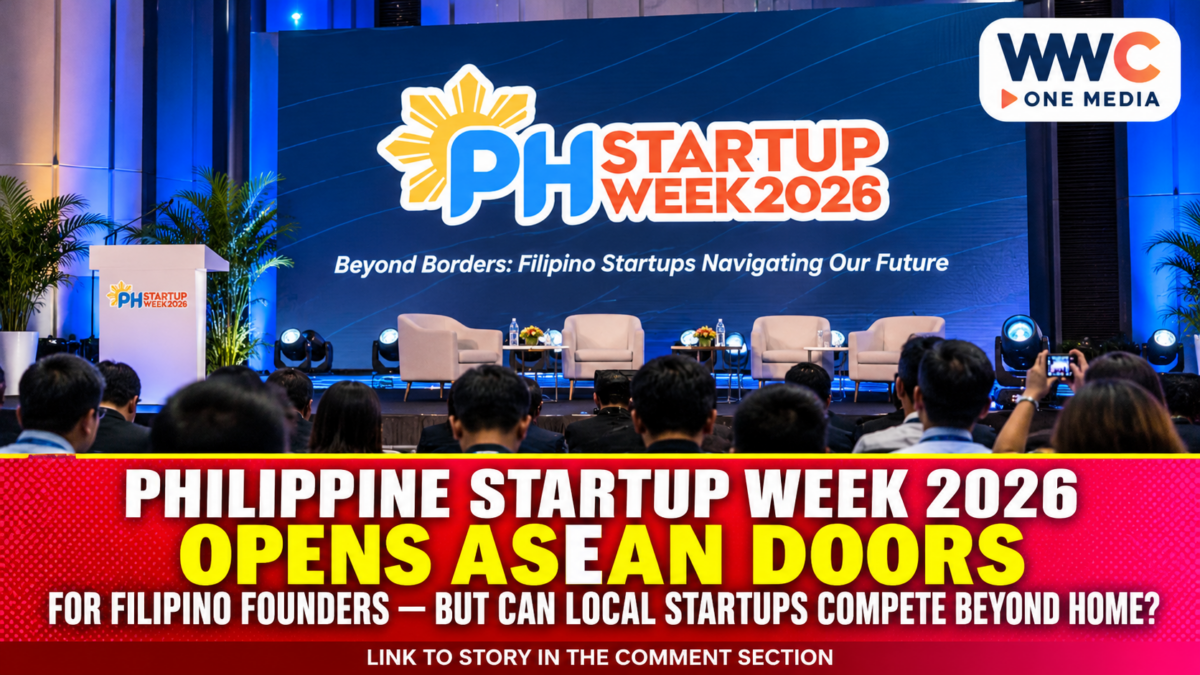
The Philippines is stepping up efforts to bring homegrown startups closer to international investors, technology companies and potential business partners as Philippine Startup Week 2026 brings together entrepreneurs, government agencies and industry leaders in Quezon City.
Held from November 9 to 12 at the Quezon City Meetings, Incentives, Conferences and Exhibitions (M.I.C.E.) Center, the eighth edition of the national startup conference carried the theme “Beyond Borders: Filipino Startups Navigating Our Future.” The event brought together representatives from the Department of Information and Communications Technology (DICT), Department of Science and Technology (DOST), Department of Trade and Industry (DTI) and the Quezon City government.
The gathering comes at an important time for the country’s technology industry. While Filipino entrepreneurs continue developing digital platforms, artificial intelligence applications and other technology-driven businesses, expanding beyond the domestic market remains a significant challenge.
For the government, the bigger objective is to create stronger connections between Filipino innovators and the regional business ecosystem, particularly as the Philippines assumes a more prominent role in ASEAN economic cooperation in 2026.
Philippine Startup Week 2026 Puts Regional Expansion in Focus
The conference was designed to bring together different parts of the startup ecosystem rather than concentrate exclusively on technology demonstrations.
Its official programme identified five major tracks: Discover, Collaborate, Develop, Showcase and Invest. These covered opportunities for founders to learn about emerging industries, develop partnerships, strengthen business capabilities and connect with potential sources of financing.
The event also brought together startup founders, investors, corporations, academic institutions, media organisations and government agencies.
Quezon City hosted the opening programme at its M.I.C.E. Center, with Mayor Ma. Josefina Joy Belmonte, DICT Secretary Robert Joseph M. de Claro and DOST Secretary Renato Solidum Jr. among the government officials participating.
The gathering also reflected a broader government effort to position innovation as part of the country’s economic development strategy.
Rather than treating startups as isolated technology projects, the participating agencies are working to strengthen the environment in which new businesses can develop, attract investment and eventually compete internationally.
Filipino Startups Get a Closer Look at ASEAN Opportunities
One of the most important elements of this year’s programme was its focus on regional collaboration.
A scheduled session, titled “Connecting Startup Ecosystems: Unlocking Collaborative Opportunities Between the Philippines, Vietnam, and Cambodia,” placed cross-border cooperation directly on the conference agenda.
The discussion was particularly relevant for businesses looking beyond the Philippine market.
Expanding into another ASEAN economy can introduce a startup to a much larger customer base, but it also requires an understanding of different regulations, business practices, consumer preferences and commercial partnerships.
For example, a Philippine software company seeking customers in Vietnam may need local distribution partners, language support and an understanding of the country’s business environment.
A technology startup targeting Cambodia may face different operational and market-entry requirements.
These considerations make regional networking important, but connections alone do not guarantee successful expansion.
Companies must still demonstrate that their products solve real problems, have commercially viable business models and can compete with established regional providers.
The conference also featured a founder’s spotlight highlighting a Filipino startup that had expanded into ASEAN and beyond, providing an opportunity to examine how local businesses can develop international operations.
Investment and Funding Remain Critical Challenges
Access to financing remains one of the biggest questions facing Philippine startups.
A promising technology product may attract attention, but developing it into a sustainable business requires money for research, employees, infrastructure, marketing and customer acquisition.
The investment-focused sessions at Philippine Startup Week addressed this important part of the entrepreneurial journey.
The programme included an Investor’s Stage featuring representatives from Gobi Partners, Foxmont Capital Partners and Kickstart Ventures.
These organisations operate within the investment ecosystem that helps finance and support emerging businesses.
Their participation highlighted the importance of connecting entrepreneurs with investors who understand the risks and opportunities associated with early-stage companies.
The funding environment, however, remains challenging.
WWC ONE MEDIA previously examined the country’s startup financing conditions in its report on Philippine startups attracting $81 million despite a declining number of investment deals.
The figures illustrated an important distinction: higher investment values do not necessarily mean that more businesses are receiving funding.
For smaller companies, the ability to secure their first institutional investment can be just as important as attracting larger funding rounds for established startups.
This makes direct engagement between founders and investment professionals particularly valuable.
However, participation in an investor conference should not be confused with securing financing. Actual investments depend on business performance, financial requirements, investor assessments and mutually agreed terms.
Government Agencies Want to Strengthen the Startup Pipeline
The involvement of DICT, DOST and DTI reflects the government’s recognition that startup development requires more than access to investors.
Each agency has a different role in supporting the country’s innovation environment.
DICT is responsible for developing the information and communications technology sector and supporting digital transformation initiatives.
DOST contributes through research, science and technology development, innovation programmes and support for technology commercialisation.
DTI plays a role in enterprise development, industry competitiveness and helping Philippine businesses expand their commercial opportunities.
Quezon City’s participation adds a local government dimension to these efforts through StartupQC, its initiative supporting the city’s startup ecosystem.
The collaboration is important because entrepreneurs frequently encounter challenges that extend beyond developing a product.
They may need technical assistance, research partnerships, business registration guidance, intellectual property protection, industry connections and access to financing.
A more coordinated support system could make these resources easier to navigate.
The country’s broader efforts to strengthen innovation infrastructure can also be seen in the development of the Philippine Innovation Hub in Marikina, which WWC ONE MEDIA previously examined in its report on the government’s efforts to connect startups with investment services.
Such initiatives demonstrate how government support can extend beyond conferences into facilities and programmes intended to help businesses develop over time.
Artificial Intelligence and Technology Skills Take Centre Stage
Artificial intelligence was another important subject across the conference programme.
The scheduled activities included discussions about building AI capabilities, developing technology solutions for real-world problems and preparing Filipino developers for the next generation of digital industries.
One session, titled “The Role of Developer Communities: Building the Talent Pipeline for the Next Decade of Philippine AI,” highlighted the connection between technology development and workforce preparation.
Another programme explored how Filipino businesses could move beyond basic chatbots towards more advanced AI-assisted applications and automated business processes.
These discussions are significant because international competitiveness depends not only on the number of startups being established but also on the quality of their products and the skills of their employees.
The Philippines already has a substantial pool of technology and business-process outsourcing professionals. Developing more specialised expertise in artificial intelligence, software engineering and advanced digital systems could create additional opportunities for local companies.
The growing importance of these skills is also reflected in private-sector initiatives.
In a separate report, WWC ONE MEDIA examined a Philippine technology company’s $1-million commitment to developing artificial intelligence engineers, highlighting the increasing demand for Filipino professionals capable of building and implementing AI-powered business solutions.
For startups, access to qualified talent can influence how quickly a company develops its products and enters new markets.
Ninety Startup Exhibitors Highlight the Growing Ecosystem
The conference also provided a platform for businesses to present their products and connect with potential partners.
A Quezon City government update covering the second day of Philippine Startup Week reported the participation of 90 startup exhibitors at the M.I.C.E. Center.
The programme also featured representatives from the Japan External Trade Organization (JETRO) Manila and the Embassy of Japan in the Philippines.
Two memoranda of understanding were signed as part of activities intended to strengthen technology and innovation connections between the Philippines and Japan.
These developments added an international dimension to the gathering.
Japan has an established technology and industrial base, while Philippine startups offer opportunities for collaboration in software, digital services and emerging technologies.
For smaller Filipino businesses, partnerships with foreign organisations could provide access to expertise, commercial networks and opportunities to understand overseas markets.
However, the long-term value of these connections will depend on whether they develop into practical business arrangements, technology partnerships and sustainable commercial opportunities.
What Happens Next: Turning Startup Connections Into Actual Businesses
Philippine Startup Week 2026 concluded on November 12, but the bigger challenge for the country’s startup ecosystem continues beyond the conference.
The government has created a platform where entrepreneurs, investors, corporations and public institutions can meet.
The next step is ensuring that those connections translate into measurable business results.
These could include new investments, successful product launches, international partnerships, technology licensing agreements and Filipino startups establishing operations in other ASEAN economies.
There is also a need to ensure that smaller businesses outside Metro Manila can benefit from the same opportunities.
A startup ecosystem cannot become internationally competitive if meaningful support remains concentrated in a limited number of urban centres.
Regional incubators, university partnerships, accessible financing programmes and stronger digital infrastructure could help bring more entrepreneurs into the national innovation network.
Ultimately, the success of Philippine Startup Week should not be measured solely by attendance, exhibitor numbers or the number of networking sessions conducted.
The more meaningful indicators will be how many participating businesses grow, how many attract sustainable investment, how many create employment and how many successfully bring Filipino-developed products and services into international markets.
The Philippines has made another effort to bring its startup community closer to the wider ASEAN business environment.
But the real test begins after the conference doors close.
Can Filipino founders turn four days of networking, investment discussions and international exposure into businesses capable of competing across Southeast Asia?
That is the opportunity Philippine Startup Week 2026 has placed before the country’s next generation of entrepreneurs.