MONTEVIDEO, URUGUAY / SÃO PAULO, BRAZIL / MANILA, PHILIPPINES — November 5, 2026 | WWC ONE MEDIA | Global Business, E-Commerce, Fintech and Financial Markets
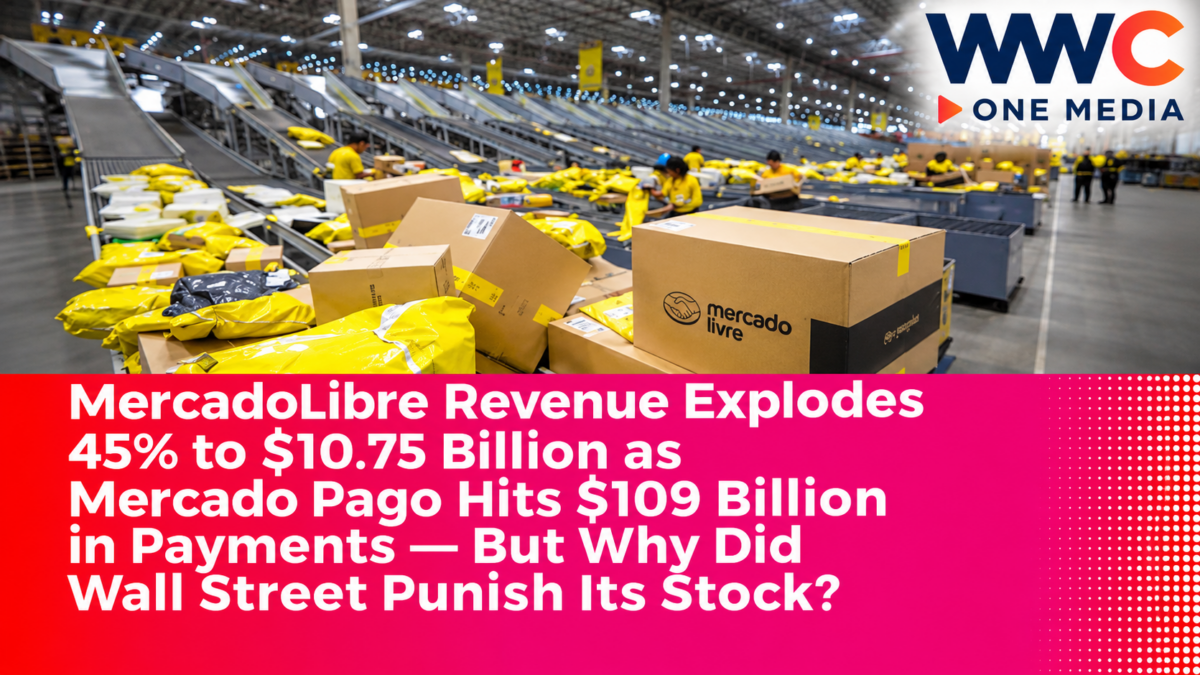
Latin America’s e-commerce powerhouse MercadoLibre has delivered another quarter of explosive growth, reporting $10.75 billion in revenue and financial income as its digital payments business expanded and online shoppers purchased hundreds of millions of products across the region.
But despite the impressive results, Wall Street responded with a sharp selloff.
Shares of MercadoLibre fell approximately 8% in after-hours trading on November 4 after the company reported third-quarter net profit of $448 million, below analysts’ expectations of roughly $476 million.
According to Bloomberg, Reuters and MercadoLibre’s official financial disclosures, the company is experiencing a growing divide between rapid business expansion and the rising costs required to sustain that growth.
Revenue surged 45% year over year, driven by stronger e-commerce activity, the expansion of Mercado Pago and increased customer engagement.
Meanwhile, its financial technology division processed an extraordinary $109 billion in payments during the quarter, up 53% from a year earlier.
The company’s online marketplace sold 867 million items, a 36% increase, while its credit portfolio expanded 62%.
But these achievements came with a price.
Higher logistics expenses, expanded free shipping, increased marketing spending and investments in financial services compressed operating margins.
The question now is whether MercadoLibre’s strategy of sacrificing near-term profitability to dominate Latin American digital commerce will deliver enormous long-term rewards — or whether the cost of expansion is becoming its biggest financial weakness.
MercadoLibre Revenue Soars 45%, but Profit Misses Wall Street Forecasts
MercadoLibre reported net revenue and financial income of $10.75 billion for the three months ended September 30, 2026.
The figure represents a 45% increase from approximately $7.41 billion a year earlier.
Reuters reported that revenue exceeded the $10.66 billion consensus estimate compiled by LSEG.
However, the earnings picture was more complicated.
Net income reached $448 million, increasing approximately 6% from $421 million in the corresponding quarter of 2025.
That was below the $476 million consensus reported by Reuters.
Bloomberg Línea cited a slightly different estimate of $473 million, reflecting its own analyst sample.
Both benchmarks establish that MercadoLibre’s quarterly earnings fell short of expectations.
Earnings per share reached $8.83, compared with approximately $9.34 expected by analysts cited by Investing.com.
Operating income totaled $676 million, down from $724 million a year earlier.
The company’s operating margin stood at 6.3%, compared with approximately 9.8% in the year-earlier quarter.
That margin pressure is central to the market’s negative reaction.
Investors are increasingly asking whether MercadoLibre can continue growing at exceptional rates while delivering sufficient profits from that expansion.
Why MercadoLibre Shares Fell Despite Strong Revenue Growth
The sharp after-hours decline reflected disappointment over profitability rather than a collapse in customer demand.
Reuters reported that the shares dropped approximately 8% to around $1,600 in extended trading.
Investing.com separately recorded a decline of about 7.8% following the earnings release.
These were after-hours trading observations, not confirmed November 5 closing prices.
Before the earnings announcement, MercadoLibre shares had already declined approximately 14% during 2026, according to Reuters.
That followed a remarkable advance of nearly 140% between 2023 and 2025.
The market’s reaction reflects the high expectations investors have developed for one of Latin America’s most valuable technology companies.
Rapid revenue growth alone is no longer enough.
Investors also want evidence that shipping investments, credit expansion and advertising initiatives will produce stronger margins over time.
MercadoLibre Sells 867 Million Products as E-Commerce Demand Accelerates
MercadoLibre’s e-commerce operations remained a major growth engine.
Commerce revenue increased 47% year over year to approximately $6.1 billion.
Gross merchandise volume, or GMV, reached around $23 billion.
That represented 38% growth in US dollar terms and 33% growth on a foreign-exchange-neutral basis.
GMV measures the value of merchandise sold through the platform; it should not be confused with revenue retained by MercadoLibre.
The company reported 867 million items sold, representing 36% annual growth.
Unique active buyers increased 22% to approximately 94 million.
Customers also became more active, with items purchased per buyer rising approximately 12%.
These figures demonstrate that MercadoLibre is not simply attracting new users.
Existing customers are purchasing more frequently.
That behavior is central to management’s strategy of increasing consumer engagement and building long-term loyalty.
Brazil Becomes the Powerhouse Behind MercadoLibre’s Growth
Brazil delivered the company’s strongest e-commerce performance.
Items sold in Brazil rose 45% year over year.
Gross merchandise volume grew 36% on a foreign-exchange-neutral basis.
The growth follows MercadoLibre’s decision to lower the minimum purchase required to qualify for free shipping.
The strategy encourages customers to place smaller and more frequent orders.
But it also increases pressure on fulfillment and delivery expenses.
Smaller orders can be more expensive to process relative to their value.
The company is accepting those costs in the expectation that greater purchasing frequency will eventually improve profitability through scale.
Mexico also delivered growth, with items sold increasing 25%.
Argentina recorded a 19% increase in items sold, while foreign-exchange-neutral GMV expanded 40%.
The results demonstrate that MercadoLibre’s expansion is not dependent on a single national market.
However, Brazil remains particularly important because of its scale and contribution to growth.
Mercado Pago Processes $109 Billion as Fintech Business Expands
MercadoLibre’s financial technology division continues to develop into a major business alongside its marketplace.
Mercado Pago generated approximately $4.6 billion in quarterly revenue, up 42% year over year.
Total payment volume increased 53% to $109 billion.
Monthly active fintech users rose 29% to approximately 93 million.
Assets under management increased 67% to around $25 billion.
These figures highlight Mercado Pago’s expanding role in digital payments, savings, investments and consumer credit.
Mexico surpassed 18 million monthly active fintech users, reinforcing the company’s growing financial-services presence.
The integration between marketplace activity and financial services provides an important competitive advantage.
Consumers can purchase products, transfer money, use payment services and access eligible financial products through the same broader ecosystem.
Merchants can also use Mercado Pago to receive payments and access business financing.
The strategy creates opportunities to deepen customer relationships and increase revenue per user.
However, greater financial-services exposure also introduces risks associated with lending, regulation and credit quality.
Mercado Pago Credit Portfolio Surges 62% to Nearly $18 Billion
Mercado Pago’s credit portfolio expanded 62% year over year to approximately $17.9 billion.
The company is increasing its presence in consumer and merchant lending, including credit cards.
The expansion supports revenue growth but also increases exposure to borrowers who may struggle to repay their obligations.
Reuters reported that MercadoLibre is becoming more cautious about originating new loans in Brazil and Argentina.
Chief Financial Officer Martín de los Santos cited difficult credit conditions in both markets.
The company’s short-term nonperforming loan indicator remained around 7%, according to Brazilian financial reporting.
That figure should not be interpreted as applying identically to every category of the company’s credit portfolio.
It also does not mean that 7% of MercadoLibre’s entire revenue is at risk.
Credit-quality indicators require careful examination of the relevant loan categories, delinquency definitions and accounting provisions.
For investors, the central concern is whether rapid credit growth can continue without a proportionate increase in defaults and financing costs.
Free Shipping and New Warehouses Are Squeezing Profit Margins
MercadoLibre increased fulfillment capacity by nearly 20% compared with the previous quarter.
The expansion came ahead of major shopping events, including Black Friday and the year-end holiday season.
New fulfillment capacity may allow the company to process more orders, improve delivery performance and serve more customers.
MercadoLibre reported that 79% of its fast shipments were delivered within 48 hours.
However, logistics expansion creates upfront expenses.
Warehouses require equipment, personnel, transportation networks and inventory-handling systems.
Free-shipping incentives can also increase the cost MercadoLibre absorbs on behalf of customers.
Reuters reported that higher fuel costs and increased marketing spending added further pressure.
Management expects that new capacity will eventually support stronger revenue and operating efficiency.
But those benefits depend on sufficient order volumes and cost discipline.
The operating margin of 6.3% demonstrates that the financial impact of expansion is already significant.
Shopee’s Philippine Success Reveals a Similar E-Commerce Strategy
MercadoLibre’s willingness to invest heavily in customer acquisition reflects a broader global e-commerce trend.
Online marketplaces increasingly compete through delivery incentives, creator partnerships, promotional campaigns and better shopping experiences.
In the Philippines, Shopee has been expanding its affiliate marketing ecosystem to attract buyers and help merchants increase sales.
WWC ONE MEDIA recently examined the development in Shopee Reports Over 1.5x Surge in Affiliate Sales as Filipino MSMEs Turn Ordinary Creators Into Powerful Sales Partners — But Can Small Businesses Really Compete With E-Commerce Giants?.
The report highlighted growing demand for creator-driven product discovery.
MercadoLibre is also increasing its investment in affiliate programs and marketing partnerships.
Advertising revenue through Mercado Ads increased 58% in US dollar terms during the quarter.
That suggests merchants are using the platform not only to process orders but also to reach potential customers.
For marketplace operators, advertising can become a valuable source of additional revenue.
However, attracting merchants and consumers requires continued investment in tools, technology and customer experience.
MercadoLibre’s Advertising Business Grows 58%
Mercado Ads delivered one of the strongest growth rates within MercadoLibre’s ecosystem.
Advertising revenue increased 58% year over year in US dollar terms.
On a foreign-exchange-neutral basis, growth reached approximately 51%.
Advertising allows merchants and brands to promote their products within the marketplace.
The business benefits from MercadoLibre’s access to information about shopping behavior and purchasing activity.
As more customers use the platform, sellers may become more willing to pay for visibility.
But advertising revenue also depends on the financial health of merchants.
Small businesses with narrow profit margins may reduce marketing spending if commissions, shipping costs or other expenses become too burdensome.
MercadoLibre must therefore maintain an ecosystem in which merchants can grow profitably while the platform generates sufficient returns on its investments.
AI Spending Increases as MercadoLibre Builds Its Own Shopping Assistant
Artificial intelligence is becoming another major area of investment.
Bloomberg Línea reported that MercadoLibre increased AI-related spending by approximately $100 million from a year earlier and $30 million compared with the previous quarter.
The company is using AI to improve search, shopping recommendations, operational efficiency and customer engagement.
Chief Executive Ariel Szarfsztejn also discussed the company’s approach to AI shopping agents.
According to Reuters, MercadoLibre is currently not allowing external AI agents to access its inventory and automatically place orders on behalf of consumers.
Instead, the company is developing its own AI-powered shopping experience.
An internal assistant is being tested with a limited group of users.
The decision highlights an emerging competitive issue for online marketplaces.
Independent AI shopping agents could eventually influence how consumers discover products and choose retailers.
Marketplaces may welcome the additional traffic, but they could also lose some control over customer relationships and purchasing decisions.
MercadoLibre appears to be prioritizing the development of its own AI experience before opening its systems more broadly.
However, the technology remains in testing, and its commercial impact has not yet been established.
Brazil’s Economic Environment Creates Additional Risks
MercadoLibre’s Brazilian expansion comes during a challenging economic period.
Brazil’s central bank maintained its benchmark Selic rate at 13.75% on November 4, reflecting inflation concerns and uncertainty over future economic policy.
High borrowing costs can make consumer credit more expensive and discourage spending on discretionary products.
They can also increase financing costs for businesses.
At the same time, a weaker local currency can affect companies that report financial results in US dollars.
MercadoLibre’s strong Brazilian sales demonstrate resilience, but they do not eliminate the country’s macroeconomic risks.
The company’s cautious approach to credit expansion suggests management recognizes the importance of balancing growth against potential loan losses.
What MercadoLibre’s Results Mean for Philippine Digital Commerce
MercadoLibre does not operate its core marketplace in the Philippines, but its results offer lessons for the country’s rapidly expanding digital economy.
One of the most important is that e-commerce success depends on much more than attracting customers to an online platform.
Companies must develop reliable logistics, convenient payments, effective advertising and sufficient financial discipline.
Philippine businesses face many of the same challenges.
WWC ONE MEDIA previously examined the obstacles confronting new online entrepreneurs in 150+ Filipino Founders Joined This E-Commerce Program — But Launching Their Stores May Be the Easy Part.
The report emphasized the importance of managing customer acquisition costs, inventory, advertising expenses and profitability.
MercadoLibre’s experience demonstrates these challenges on a much larger scale.
Even a company generating billions in revenue can experience margin pressure when the cost of attracting and serving customers rises.
Digital Payments Could Become the Next Major Competitive Advantage
Mercado Pago’s growth illustrates how financial technology can strengthen an e-commerce platform.
Consumers increasingly expect convenient ways to pay, transfer funds and manage money.
For the Philippines, digital payment adoption is also accelerating.
WWC ONE MEDIA reported on the changing payment landscape in Philippines Remains Southeast Asia’s Biggest Cash-on-Delivery Holdout — But a 198% Digital Payment Surge Signals a Major Shopping Shift.
The report examined how cash-on-delivery remains important even as QR-based and bank-transfer payments expand.
MercadoLibre’s business model provides an example of how payments and commerce can reinforce one another.
A shopper who already uses a company’s digital wallet may find it easier to complete purchases through the same ecosystem.
Likewise, merchants who receive payments through an integrated financial platform may be more inclined to use its other services.
However, payment integration also increases the importance of cybersecurity, consumer protection and financial regulation.
Financial Technology Growth Creates Opportunities for Smaller Businesses
Mercado Pago’s expansion also illustrates the economic potential of providing digital financial services to merchants.
Small businesses can benefit from easier payment acceptance, transaction records and access to appropriate financing.
But credit expansion must be managed carefully.
WWC ONE MEDIA examined similar opportunities in DTI and Mastercard Join Forces to Help Filipino Small Businesses Go Digital — But Can They Turn a 64.69% Digital Payment Boom Into Real MSME Growth?.
The report discussed Philippine efforts to support digital payment adoption among smaller merchants.
The comparison highlights the importance of helping businesses use digital services in ways that improve their operations.
Technology adoption alone does not guarantee profitability.
Merchants also need reliable products, effective customer service and sustainable financial management.
Three Major Risks Could Threaten MercadoLibre’s Growth
Despite the company’s impressive expansion, several risks deserve attention.
First, operating margins could remain under pressure. Free shipping, logistics expansion and marketing spending may continue growing faster than the efficiency benefits they generate.
Second, credit losses could increase. Mercado Pago’s larger lending portfolio creates greater exposure to economic slowdowns and borrowers experiencing financial difficulties.
Third, competition could intensify. Amazon and expanding Asian e-commerce companies are competing for customers, merchants and advertising revenue across Latin America.
These risks do not establish that MercadoLibre is heading toward a financial crisis.
The company remains profitable, with strong revenue growth and expanding payment activity.
But investors are increasingly focused on the balance between growth and profitability.
The Bigger Question: Can MercadoLibre Turn Explosive Growth Into Bigger Profits?
MercadoLibre’s third-quarter results tell two stories.
The first is one of extraordinary expansion.
Revenue increased 45% to $10.75 billion.
Online merchandise sales reached approximately $23 billion.
Consumers purchased 867 million items.
Mercado Pago processed $109 billion in payments.
And its credit portfolio expanded to nearly $18 billion.
The second story is about rising costs.
Higher logistics expenses, free-shipping incentives, marketing investment and credit expansion placed pressure on operating profitability.
That contributed to a net earnings miss and an approximately 8% after-hours stock decline.
For management, the immediate challenge is proving that today’s investments will produce sufficient future revenue and operating efficiency.
For investors, the question is whether the company can maintain its leadership without sacrificing too much profitability.
And for competitors across Latin America, MercadoLibre’s strategy demonstrates how expensive it has become to dominate both online commerce and digital financial services.
As MercadoLibre approaches an annual revenue run rate exceeding $40 billion while its fintech and marketplace businesses expand rapidly, one question could determine its next major stock-market move: Will its enormous investments create Latin America’s most profitable digital ecosystem — or will the rising cost of growth become the biggest threat to its future?