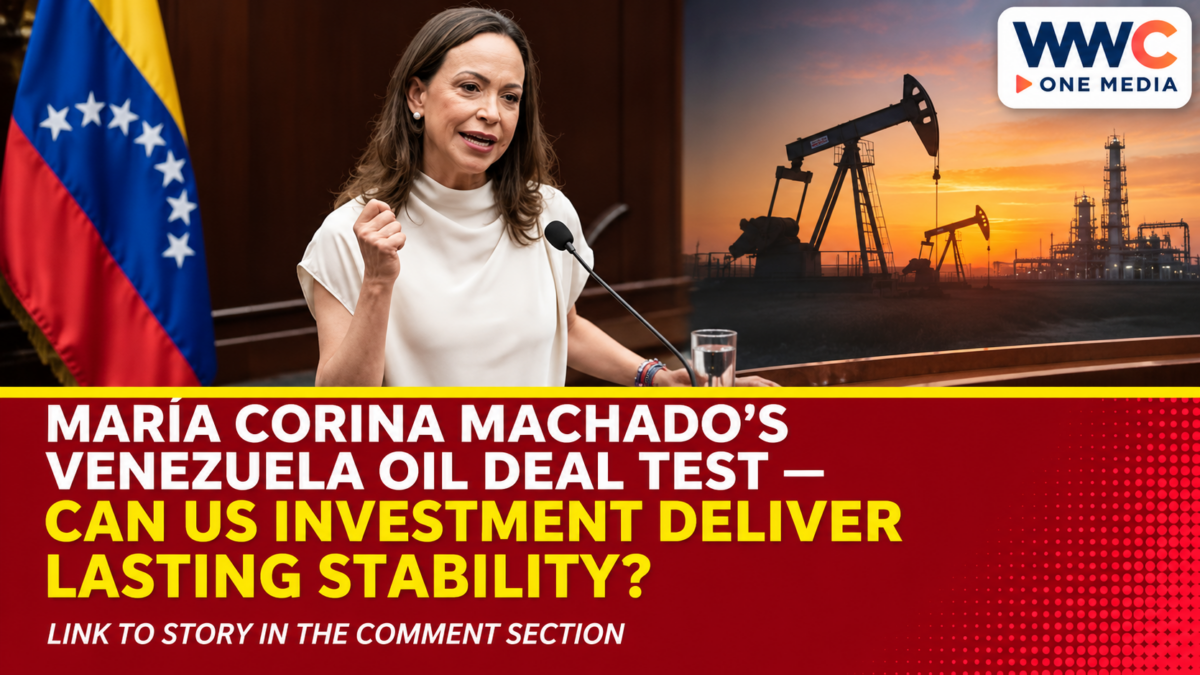
CARACAS, Venezuela — Venezuela’s opposition leader María Corina Machado has placed democratic institutions and an electoral timetable at the centre of her vision for rebuilding the country’s economy, while Washington is pursuing a far-reaching oil investment arrangement with a private Venezuelan operator. US government announcements released in August and September describe a proposed investment programme worth up to US$100 billion and extensive American economic rights, making the durability of those arrangements a central question for future investors.
The deal’s commercial structure is documented, but political agreement over Venezuela’s next elections cannot be inferred from the oil contracts. Planned investments and working oilfields are different stages of recovery.
Venezuela Oil Deal: What Washington Actually Announced
An Aug. 31 White House fact sheet describes 100-year concessions covering 17 fields granted to North American Blue Energy Partners (NABEP), with reserves estimated at approximately 65 billion barrels. Those figures do not establish immediate export capacity.
Under the arrangement, the US Department of War’s Office of Strategic Capital was to receive a 35% equity stake in NABEP’s corporate parent. The State Department was also granted the right to buy 20% of oil output from the company’s fields at production cost and a right of first refusal over the remaining 80%.
The fact sheet additionally describes a US veto over board appointments and a requirement for a majority of directors to be American citizens. These are corporate governance and purchasing rights, not a transfer of Venezuelan sovereignty or ownership of every oilfield in the country.
WWC ONE MEDIA has examined what Washington’s Venezuela oil agreement actually gives the United States. That distinction is especially important when an agreement’s large headline reserve figure risks being confused with proven production capacity.
Machado’s Public Position Puts Elections Alongside Investment
In a publicly available May 2026 discussion, Machado argued that an electoral calendar, the rule of law and an independent judiciary were essential to the country’s economic rebuilding. Her comments identified legal certainty as important for investors and explicitly supported stronger cooperation with the United States.
Those remarks predated the administration’s August oil announcement. They establish her publicly expressed approach to economic and political transition, but they should not be described as her precise response to the later terms of the NABEP arrangement.
The administration’s Sept. 2 statement, for its part, described the transaction as a commercial agreement with a private company rather than a political agreement negotiated with Venezuela’s interim government. It presented economic stabilisation and a later democratic transition as stages of the same strategy.
Analysis: Those positions are not necessarily incompatible. Energy investment can help rebuild infrastructure, while a credible electoral process and predictable legal rules may influence whether investors commit capital over decades. The unresolved question is how commercial commitments and political reforms will proceed in practice.
A US$100 Billion Plan Is Not US$100 Billion Already Spent
The White House said NABEP had developed a plan for investing up to US$100 billion in new Venezuelan oil infrastructure. It also forecast roughly US$200 billion in royalty and tax payments during the first 25 years under the proposed development programme.
Both amounts are prospective. Neither figure demonstrates that the planned capital has been raised or that the projected tax revenue has been received. Achieving them requires investment and operations.
The announced concessions cover substantial underground resources, but reserve estimates, installed equipment, production rates and export shipments measure different things. Concessions alone generate no oil.
WWC previously explored the US government’s proposed 35% stake in the oil venture. For readers comparing those figures, the percentage refers to an equity position in a corporate parent, not an equity share in Venezuela itself.
Other Oil Companies Are Pursuing Separate Projects
A Sept. 2 US Department of Energy announcement described agreements involving Chevron, Eni and GE Vernova. Chevron’s stated programme contemplated more than US$7 billion in investment over five years, with a target of increasing its Venezuela production to 600,000 barrels per day.
The same announcement outlined Eni’s 25-year agreement concerning the Junín 5 field and GE Vernova’s planned improvements to electricity generation and grid infrastructure. These programmes differ in contractual structure, counterparties and development stages from NABEP’s arrangement.
WWC’s examination of Chevron’s proposed expansion in Venezuela provides additional context. Company targets and official announcements are evidence of intended investment, not proof that a future output level has already been reached.
Electricity is part of the commercial equation: reliable generation and transmission can support oil production, processing and transport. Its availability still must be demonstrated at individual operating sites.
Sanctions Rules Make Contract Terms Important
The US Treasury amended several Venezuela-related authorisations on Sept. 28. General License 49B allows specified negotiations and entry into contingent contracts for new investment in oil, gas, petrochemicals and electricity, subject to exclusions.
Crucially, the licence requires performance under those contingent contracts to depend on separate OFAC authorisation. Permission to negotiate is therefore not necessarily permission to implement every project immediately.
What this could mean: Investors need to review the exact licence applying to their counterparties and activities rather than assuming a broader diplomatic agreement removes every legal restriction. Financing, ownership rights and expected returns cannot be evaluated responsibly without those details.
Project announcements can leave permits and implementation unresolved.
What Happens Next
The clearest next evidence will be disclosed financing, binding investment commitments, documented construction progress, oil produced and shipped, and any official electoral timetable. Those records would allow a stronger assessment of whether Venezuela is simultaneously advancing commercial recovery and the institutional changes Machado has advocated.
The available primary documents support a limited but meaningful conclusion: Washington has publicly set out significant commercial rights and investment ambitions, while Machado has argued in her own words that investment certainty and democratic legitimacy belong together. They do not establish that every proposed oil investment is funded or that a future Venezuelan government has accepted all existing contractual terms.
Frequently Asked Questions
What is the US-Venezuela oil agreement about?
The White House described a transaction involving NABEP, an oil operator awarded concessions for 17 Venezuelan fields, alongside US equity, governance and purchasing rights.
Is the United States buying all of Venezuela’s oil?
No. The disclosed rights concern output from fields operated by NABEP, including a 20% purchase entitlement at production cost and first refusal on the remainder.
Has US$100 billion already been invested?
No. The White House described investment of up to US$100 billion as NABEP’s planned programme, not completed spending.
What has María Corina Machado said about foreign investment?
In a May 2026 public discussion, Machado connected investment prospects with judicial independence, rule of law and a defined electoral calendar. That discussion predated the August oil announcement.
Does the Treasury permit every new oil project to proceed?
No. General License 49B authorises specified negotiations and contingent agreements, with separate OFAC authorisation required for performance where its terms apply.