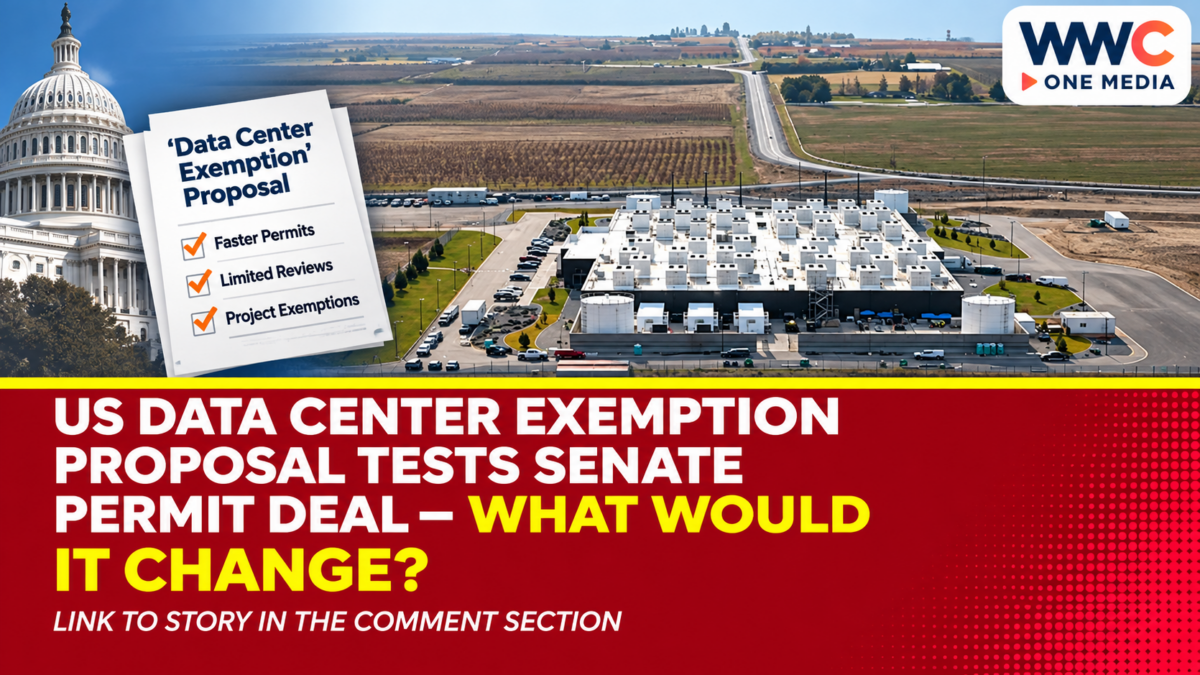
WASHINGTON — Nov. 19, 2026. A proposed data center exemption has added another question to the United States Senate’s negotiations over sweeping energy permitting legislation, as lawmakers weigh faster infrastructure approvals against environmental review and community oversight. The Congressional Record identifies an amendment submitted by Senator Jeff Merkley that would exclude data centres and associated infrastructure from specified provisions of the bipartisan permitting package.
The proposal has not been established as law. It must also be distinguished from the separate bill provisions designed to make major computing facilities pay for grid costs associated with their electricity demand. The distinction is important for companies planning large projects and residents concerned about power bills, water and land use.
Data Center Exemption: What the Amendment Says
The Senate’s Nov. 12 Congressional Record identifies Merkley’s Amendment SA 6921 as intended for the substitute amendment to H.R. 2347, the legislative vehicle for the Bipartisan American Affordability and Jobs Act of 2026. The amendment was submitted and ordered to lie on the table; that procedural description does not establish its adoption.
Its proposed Section 1404 would exclude federal permits and other agency actions involving a data centre or associated infrastructure from Sections 1401 through 1403 and a specified amendment to the National Environmental Policy Act. In plain language, it would withhold certain faster-permitting or permit-protection provisions from those facilities, not exempt data centres from all environmental laws.
The amendment also proposes restrictions on the treatment of wetland fill permits for data centres and would treat gas turbines powering such facilities as stationary sources under the Clean Air Act. Other proposed text addresses federal financial assistance and distributed energy resources. The provisions are amendments, not binding requirements in force today.
Four Senators Wrote the Broader Permitting Package
The original S. 5653 was introduced on Sept. 30 by Senators Shelley Moore Capito, Mike Lee, Sheldon Whitehouse and Martin Heinrich. The four issued a substitute amendment on Nov. 7, describing refinements made after consultation with congressional colleagues and other stakeholders.
Those four senators should not be confused with the sponsor of SA 6921. The legislative record attributes the separate exclusion proposal to Merkley; it does not establish that the four original sponsors jointly endorsed that carve-out.
The broader measure seeks to revise federal approvals for energy and infrastructure projects. Its supporters argue that lengthy procedures delay power generation and transmission development. Opposition to particular provisions may reflect concerns about environmental review, federal authority or community participation, but the position of each senator must be established from that senator’s actual statements or votes.
WWC’s earlier report on the Senate’s procedural vote and proposed grid charges examines the bill’s advancement. A procedural vote to begin or continue debate is not final passage by both chambers, nor presidential enactment.
Electricity Charges Are a Different Legal Question
The four sponsors’ legislative plan also addresses how data-centre operators contribute to transmission infrastructure costs. A Nov. 5 Senate fact sheet proposes requiring facilities to pay for the grid services and upgrades linked to their large electricity needs.
The policy concern is straightforward: when a utility expands infrastructure for a new computing campus, costs can potentially be allocated across existing customers unless tariffs are designed to recover an appropriate share from the facility generating demand. Exactly how that cost is measured remains a technical regulatory question.
The Senate proposal would direct the Federal Energy Regulatory Commission to change aspects of cost allocation and require additional energy-use reporting. Those policies are distinct from whether an individual data-centre development should receive faster federal permits.
WWC separately explained the federal regulatory review of data-centre grid tariffs. A proposed federal law and a pending commission tariff proceeding operate through different legal processes. Neither alone guarantees that household electricity bills will decrease.
Why Environmental Reviews Remain Contested
A new data centre may require more than a computing building. Its supporting infrastructure can involve electric lines, substations, generators, access routes and water systems. Projects differ widely in land footprint, energy requirements and potential environmental effects.
The proposed exclusion therefore raises a narrower policy choice than a blanket approval or ban. Should selected federal fast-track measures cover developments whose energy use or local impacts remain disputed? The answer depends on the final legislation and on the requirements that already apply to individual projects.
The original Senate bill contains provisions addressing permit certainty and review timelines. The Merkley amendment seeks to withhold specified advantages from data-centre-related actions while retaining other portions of the legislative package. It should not be described as a proposal to prohibit all US data-centre construction.
WWC’s earlier examination of federal-land questions surrounding AI data centres illustrates a related issue: a government’s interest in faster development does not eliminate the need to identify land, legal authority and public-review requirements for a particular proposed site.
What This Could Mean for Investors and Communities
Analysis: Developers may prefer predictable federal decisions, because uncertainty can complicate financing, equipment orders and power-connection schedules. Yet a shorter process does not automatically make every proposal economical, environmentally suitable or acceptable to the community where it would be built.
For households, the two legislative debates must be assessed separately. A rule making data centres cover particular transmission expenses addresses cost allocation. An exclusion from specified permitting shortcuts concerns the process through which projects and supporting infrastructure obtain federal approvals.
A project could face stronger grid-payment obligations while still being eligible for certain permitting procedures, depending on the law’s final text. Conversely, excluding a facility from selected fast-track protections would not by itself cancel its ability to apply for permits under existing rules.
It would be premature to calculate a fixed additional cost for a named technology company or a guaranteed saving for electricity customers. The public legislative materials do not provide a completed project-specific assessment.
What Happens Next
The Senate must resolve pending amendments and determine whether it can pass a final text. Any measure would still require the necessary action in the House of Representatives and the president before becoming federal law. Subsequent regulations could also determine how particular provisions work in practice.
For the exemption itself, the decisive evidence would be a recorded vote, adopted amendment text or final enrolled legislation. Until then, SA 6921 is a documented proposal rather than an established new rule for data-centre developers.
Frequently Asked Questions
Have US data centres already been exempted from permitting rules?
No. The identified Senate amendment proposes excluding data centres from specified permitting provisions. The records reviewed do not establish that the amendment has been enacted.
Who proposed the data-centre exclusion?
The Nov. 12 Congressional Record identifies Senator Jeff Merkley as the submitter of Amendment SA 6921. The broader bipartisan bill was introduced by four other senators.
Would the amendment ban new AI data centres?
No blanket construction ban appears in the cited exclusion language. It addresses how specified federal permitting provisions would apply to data centres and supporting infrastructure.
Does the Senate bill already require all data centres to pay new grid fees?
The proposed bill seeks stronger cost recovery, but those provisions are not an enacted nationwide fee. Applicable tariffs and eventual implementation would determine specific obligations.