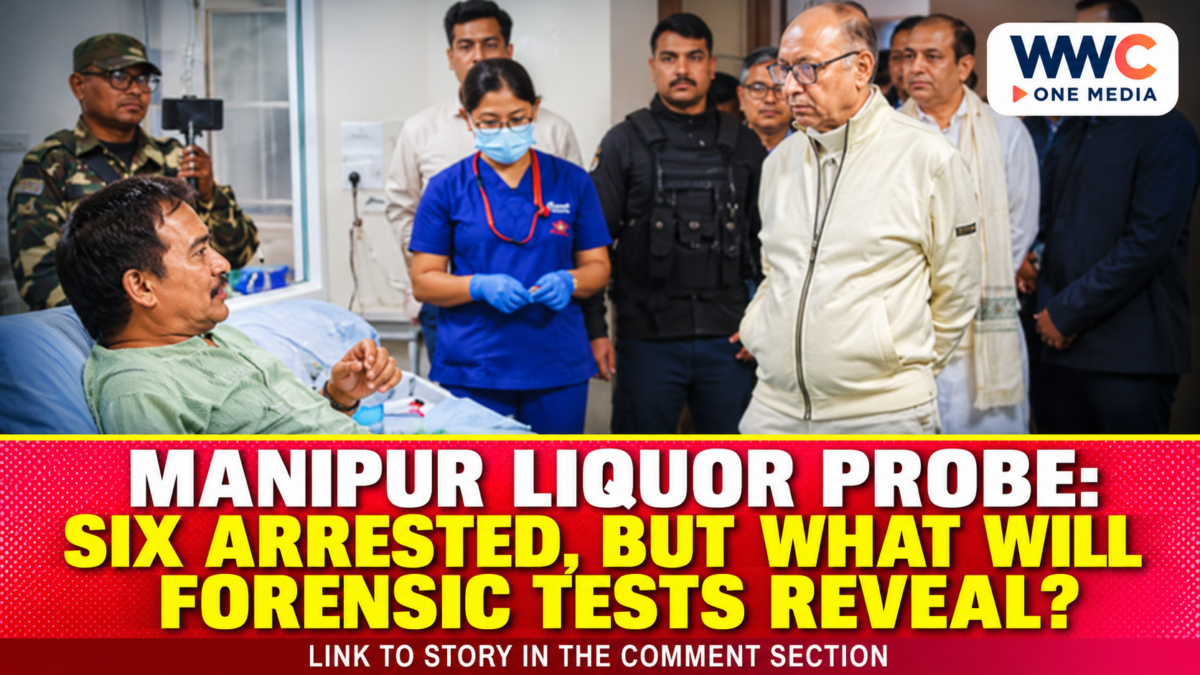
IMPHAL, India — Manipur authorities have arrested six people and established a high-level inquiry committee after suspected spurious liquor consumption was linked to multiple deaths and hospital admissions in Chandel district. The government’s latest reported briefing on Nov. 21 put the death toll at 16, with around 600 people admitted to government and private hospitals.
The immediate challenge is no longer limited to responding to patients. Investigators must establish what substance was consumed, where the suspected liquor came from, how it was distributed and whether any regulatory or administrative failures contributed to the incident.
The investigation is particularly important because the cause of the deaths and illnesses had not been scientifically established when the government provided its update. Laboratory results and the committee’s findings will be central to determining what happened and what action should follow. Akashvani News
Manipur Liquor Probe: What Authorities Have Confirmed
At a press conference in Imphal on Nov. 21, Manipur Commissioner of Excise Hungyo Worshang reported that 16 people had died in the suspected spurious liquor incident in Chandel district.
The same briefing put hospital admissions at around 600 across government and private facilities. Twelve patients were reported to be receiving treatment in intensive care units.
Worshang also confirmed that six people had been arrested in connection with the incident. The announcement did not, in the government broadcaster’s account, establish that those arrested had been convicted of any offence.
That distinction is essential. An arrest indicates that authorities are pursuing a criminal investigation; it does not establish guilt or prove that a particular person supplied a substance that caused the deaths.
The investigation must establish the relevant evidence, including the suspected liquor’s origin and the circumstances surrounding its distribution. Akashvani News
Forensic Testing Could Determine What Was in the Liquor
One of the most consequential parts of the investigation is the laboratory examination of the suspected liquor.
The government briefing said samples had been sent for forensic examination to identify whether toxic substances were present. Until those results are available, it would be premature to identify a particular chemical as the confirmed cause of the reported deaths.
This matters because the phrase “spurious liquor” describes suspected adulterated or illicit alcohol; it does not, by itself, identify the chemical composition of a sample.
The forensic process should help establish whether the samples contain toxic substances and whether the findings can be connected to the illnesses under investigation. Medical records and post-mortem findings will also be important to the inquiry.
The distinction between suspicion and scientific confirmation is not merely technical. It affects the accuracy of public warnings, the direction of criminal investigations and the evidence that may eventually be used in legal proceedings.
WWC has previously examined a similar reporting principle in its coverage of the Phuket fire investigation: an official casualty update does not automatically establish the cause of an incident. Akashvani News+1
The Inquiry Must Examine More Than the Supply Chain
The state government has constituted a high-level inquiry committee to investigate the incident, identify possible lapses and recommend appropriate action.
The committee has been directed to submit its report within one month, the government briefing said.
Its work is important because a complete investigation should not stop after identifying a suspected source of liquor. It must also establish the sequence of events, assess the response of relevant authorities and determine whether existing safeguards were properly applied.
The Excise Commissioner said teams from the district administration, police, excise and health departments had visited affected areas and hospitals to assess the situation and provide assistance.
That response is one part of the record. The inquiry’s findings should help clarify what happened before the emergency response, how the authorities acted once the incident emerged and whether further measures are necessary.
The committee’s existence does not mean administrative negligence has already been established. Nor does the arrest of six people prove that the wider regulatory system failed. Those conclusions require evidence and a completed assessment. Akashvani News
Manipur’s Liquor Rules Put Enforcement Under Scrutiny
Manipur’s excise framework provides important context for understanding the responsibilities of the department now involved in the investigation.
The state’s 2025–2026 Annual Administrative Report says the Manipur Liquor Prohibition Act, 1991, was lifted in certain areas through a government notification dated Dec. 6, 2023. The areas identified include Greater Imphal, district headquarters, tourist locations and registered hotel establishments with at least 20 lodging rooms.
The report describes the change as an effort to regulate liquor sale and consumption in a controlled manner while generating government revenue.
It also identifies the Excise Department’s responsibilities as regulating the import, possession, transport, sale and consumption of liquor, as well as detecting and preventing illegal manufacture, smuggling and sale. AA Report Excise 2025-2026
This background does not establish that the current incident involved a licensed seller or that the policy change caused the deaths. The report does, however, show why the department’s enforcement responsibilities are relevant to the inquiry.
The central question is whether the rules and enforcement arrangements were sufficient to detect and prevent the circulation of the suspected liquor involved in this incident.
For readers, the issue is broader than whether arrests have been made. It concerns how effectively regulation works in practice, particularly when public safety depends on identifying illegal production and distribution.
Public Health Warnings and the Need for Clear Information
The Health Department has issued a public health advisory in response to the suspected liquor-related deaths and illnesses.
Director of Health Services Dr N Hemantakumar urged people who had consumed liquor from suspected sources during the previous 48 to 72 hours to seek immediate medical evaluation, even if they had no symptoms.
The government briefing also said healthcare facilities, both public and private, had been directed to remain alert and ensure prompt treatment, referral and reporting of suspected cases.
Authorities have urged people to preserve suspected liquor bottles and containers, where available, and report illegal sale or distribution to police or excise officials. Akashvani News
These instructions are significant because the response involves both medical care and evidence preservation. Suspected products may help investigators trace distribution routes and identify substances for laboratory examination.
The public should rely on official medical and government advisories rather than unverified claims circulating online. WWC’s India LPG safety guide similarly explains why suspected hazardous-product incidents require careful handling and qualified assessment rather than improvised responses.
The investigation also raises a wider accountability question. In another Indian public-safety context, WWC examined the standards for investigating police encounters, highlighting why official action should be assessed through evidence and established procedures rather than assumptions.
What Happens Next?
The next major developments should come from the forensic examination and the high-level committee’s investigation.
The laboratory results may help establish whether toxic substances were present in the suspected liquor. The inquiry is expected to examine the circumstances surrounding the reported deaths and illnesses, possible administrative or enforcement lapses, and measures to prevent a similar incident.
The committee has been given one month to submit its report. The government briefing did not provide a confirmed date for publication of the findings.
The six arrests are also only one stage of the legal process. Investigators must establish the evidence, and any criminal responsibility must be determined through the appropriate legal proceedings.
For now, the confirmed public record points to three priorities: treatment for affected people, scientific examination of the suspected liquor and a transparent investigation into how the incident occurred.
Frequently Asked Questions
1. How many people died in the Manipur suspected liquor incident?
The government briefing reported 16 deaths as of Nov. 21, 2026.
2. How many people were hospitalised?
Around 600 people had been admitted to government and private hospitals, while 12 patients were reported to be in intensive care units in the Nov. 21 briefing.
3. Have authorities made arrests?
Yes. The Commissioner of Excise reported that six people had been arrested in connection with the incident. Arrests do not establish guilt.
4. Has the exact cause of the deaths been confirmed?
No. Samples of the suspected liquor had been sent for forensic examination to identify possible toxic substances. The scientific findings had not been reported in the briefing.
5. What is the government inquiry expected to do?
The high-level committee is tasked with investigating the incident, identifying possible lapses and recommending appropriate action. It has been asked to submit its report within one month.