
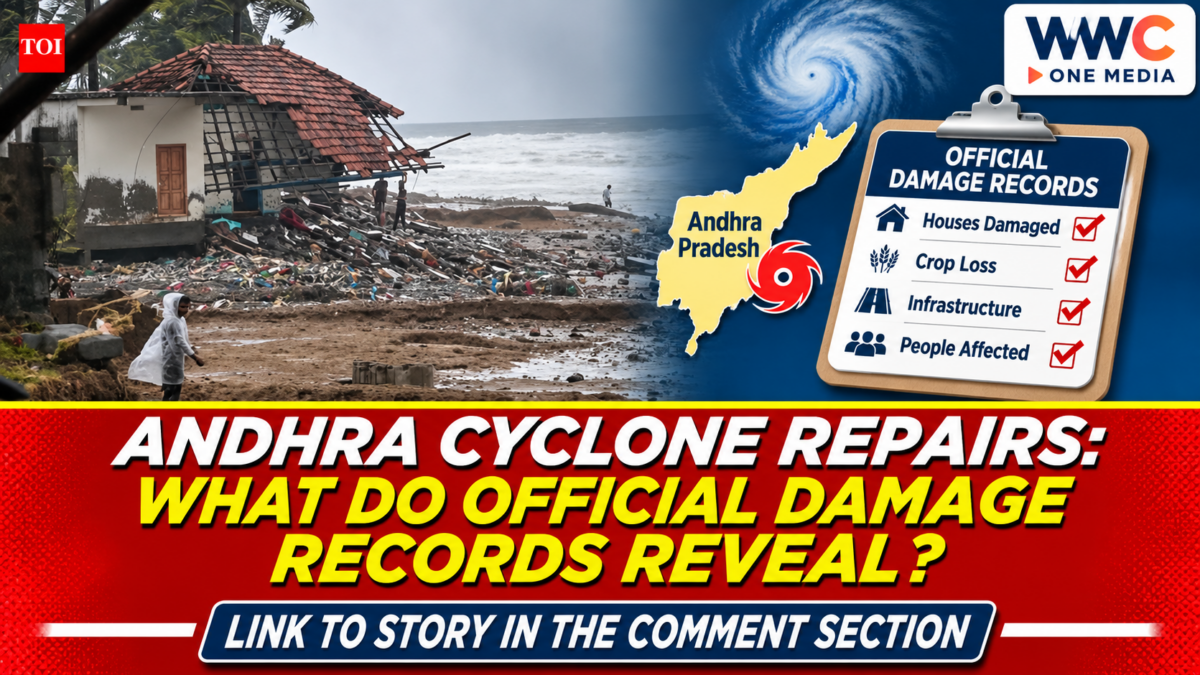
ANDHRA PRADESH, India — Nov. 22, 2026. Andhra Pradesh’s disaster-management records document damaged housing, transport routes and electricity infrastructure after Severe Cyclonic Storm Murasu crossed the state’s coast on Nov. 3. The government’s Nov. 4 damage consolidation describes the scale of disruption but does not establish how much households have paid for repairs or whether a shortage of skilled workers has increased labour charges.
That distinction matters because counting damage is not the same as calculating rebuilding costs. The official record provides a starting point for accountability, while questions about repair quotations, worker availability and household recovery remain open.
Andhra Cyclone Repairs Begin With a Provisional Damage Count
The Andhra Pradesh State Disaster Management Authority’s cyclone information system includes a damage-and-loss section labelled for Murasu. Its consolidated return is dated Nov. 4 at 8 p.m. Indian time and expressly describes the figures as provisional departmental submissions rather than verified final losses.
The housing entries list 929 damaged houses across six reporting districts and 413 damaged huts across four districts. Those categories should remain separate: the published dashboard does not establish that the two counts represent unique households or that every structure requires complete reconstruction.
The dashboard also shows that the state’s Roads and Buildings department recorded 445 kilometres of damaged state highways or major district roads, 24 road breaches or scours and 15 damaged culverts or cross-drainage works. A separate Panchayati Raj engineering return lists 41.9 kilometres of affected roads.
These categories can overlap in location, though they describe different pieces of infrastructure. They should not be turned into a single repair bill without itemised cost estimates and a clear accounting method.
What the Cyclone Record Establishes About the Storm
India’s Meteorological Department recorded Murasu crossing the southern Andhra Pradesh coast between Nellore and Narsapur, near Ongole, during the early hours of Nov. 3. Its post-landfall bulletin reported maximum sustained winds of 100–110 kilometres per hour, gusting to 120 kilometres per hour, at landfall.
The location and strength of the storm establish the hazard context for subsequent damage reports. They do not, however, prove the cause of every individual damaged roof, broken power pole or inaccessible road. Claims concerning a particular property require a local inspection or a relevant incident assessment.
The state dashboard lists 4,176 damaged electric poles, 136 affected feeders and 84 impacted substations in its Nov. 4 consolidation. These figures describe reported damage and interruption, not the number still awaiting repair as of Nov. 22.
For perspective on why disaster recovery demands separate accounting for physical damage and longer-term spending, WWC has previously examined how storm losses in the Philippines can extend beyond the first damage estimates. That Philippine case is contextual comparison, not evidence about Indian repair prices.
The Missing Evidence Behind Higher Repair Costs
Accounts of expensive household repairs and scarce electricians, welders or masons would need evidence different from the disaster dashboard. A credible assessment could compare dated contractor quotations, official schedule-of-rates documents, labour-market observations and actual invoices across affected districts.
The public cyclone consolidation reviewed here contains counts of damaged assets, not monetary loss estimates. It does not publish an independently validated worker-shortage rate, a before-and-after wage series or a representative household repair-cost survey.
Analysis: A sudden concentration of rebuilding demand could place pressure on the supply of specialist tradespeople, but that economic mechanism alone does not demonstrate it has occurred in a particular district. Without a comparable baseline, a high price quotation might reflect materials, travel, urgency, the complexity of damage or labour availability. The causes cannot be separated reliably by inference.
The distinction also applies to the difference between emergency restoration and permanent reconstruction. Replacing a temporary connection or reopening a lane does not mean all damaged components have been rebuilt to their pre-storm condition.
Why Infrastructure Recovery Needs Its Own Measures
The electricity, housing and road figures illustrate why one post-cyclone headline number cannot summarise the recovery. A damaged pole may affect multiple consumers, while a road breach could disrupt access to construction materials and public services. Yet neither the number of poles nor the length of affected roads gives the price or completion date of repairs.
WWC’s earlier report on Philippine infrastructure losses after multiple storms provides a different national example of preliminary damage estimates changing as assessments develop. Figures from different countries, storms and accounting systems must not be added or directly equated.
Andhra Pradesh’s dashboard separates line-department submissions from satellite-based inundation mapping. It cautions that satellite estimates and departmental assessments measure different things. The same principle applies to repair assessments: visible damage, assessed value, awarded contracts and money actually spent are four distinct measures.
Local readers ultimately need to know which roads have reopened, which power assets have been restored and how many households have received assistance—not merely the counts from the initial response period.
What Happens Next
An evidence-based follow-up should look for final district damage assessments, itemised repair tenders, official wage or labour-supply data, and dated reports showing completed restoration. Each would answer a different part of the recovery question.
The state records establish meaningful damage from Murasu, but do not yet allow WWC to state that skilled-worker shortages caused a measurable increase in repair costs. That claim should remain outside the news account unless original records or directly obtained reporting substantiate it.
A comparison with WWC’s reporting on La Union’s recovery and local infrastructure pressures offers a useful reminder: recovery can be tracked through assistance, repairs and financial assessments, but those metrics must be tied to the place and date that produced them.
Frequently Asked Questions
When did Cyclone Murasu cross Andhra Pradesh?
The India Meteorological Department reported landfall near Ongole in the early hours of Nov. 3, 2026.
How many houses did Andhra Pradesh report damaged?
Its provisional Nov. 4 consolidation listed 929 damaged houses and, in a separate category, 413 damaged huts. These are not final, independently verified counts.
Did official data confirm that skilled-worker shortages raised repair costs?
Not in the primary records reviewed. The available damage dashboard does not provide a representative wage survey, contractor-price series or household repair expenditure data.
Are the Nov. 4 damage totals the current number of unrepaired assets?
No. They are a dated damage snapshot and should not be interpreted as the outstanding repair backlog on Nov. 22.










