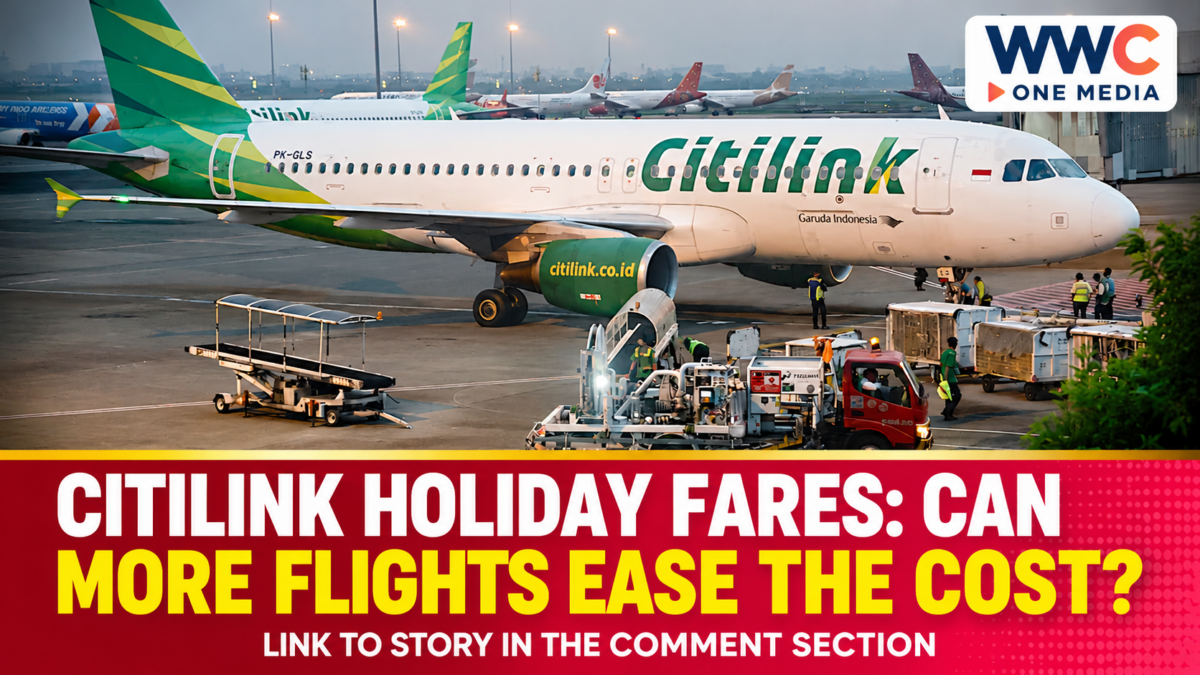
JAKARTA, Indonesia — Nov. 22, 2026. Indonesia has included Citilink in its year-end transport-discount campaign ahead of the Christmas 2026 and New Year 2027 travel period. The low-cost carrier enters the season with stronger first-half passenger traffic, higher average fares and a plan to make more aircraft available by December.
The combination matters because a government-backed discount can lower an eligible ticket’s price without resolving every cost or capacity pressure facing an airline. Citilink’s published operating numbers show that more passengers, more flights and higher fares have existed at the same time; they do not yet show what travellers will pay for any particular December departure.
Citilink Holiday Fares: What the Discount Covers
Indonesia’s economic coordinating ministry announced on Nov. 8 that the year-end airfare programme combines government-paid value-added tax on eligible domestic economy flights with reductions in specified airport service charges. It described the combined ticket-price reduction as approximately 11% to 12%.
The stated travel window is Dec. 22, 2026, to Jan. 10, 2027. The ministry said discounted air tickets had been available for sale since Oct. 26, and specifically included Citilink among the carriers represented at its public information event.
That does not mean every Citilink fare is automatically 12% cheaper. The stated programme relates to eligible domestic economy travel, and the actual checkout amount depends on the flight and the ticket components covered. Travellers should compare the displayed total, conditions and booking channel before paying.
Passenger Growth Came With Higher Average Fares
Garuda Indonesia Group’s first-half 2026 corporate presentation records 5.8 million Citilink passengers, up 18.6% from 4.9 million in the same period of 2025. Its reported average fare increased 15.1%, from US$62.3 to US$71.7.
Citilink’s seat load factor, a measure of how much available seating was occupied, increased from 78.8% to 80.3%. Its flight frequencies rose 14.8%, reaching 40,683 during the six months.
These figures describe the first half, not current December bookings. They are nevertheless useful: passenger growth did not require the carrier to report a lower network-wide average ticket price. A higher average fare can reflect a changing mix of routes and travellers as well as pricing decisions, so it should not be confused with a quote for a specific journey.
Philippine readers have seen a similar need to separate traffic data from profitability. WWC’s analysis of Cebu Pacific’s October traffic filing explains why passenger volumes and fuller aircraft alone cannot establish earnings.
The December Fleet Plan Is About Usable Aircraft
Garuda’s group presentation shows 43 serviceable Citilink aircraft at June 2026, compared with 28 one year earlier. It projects 48 serviceable Citilink aircraft at December 2026, although that year-end figure is a plan, not a completed result.
Serviceable aircraft are planes available to fly, not simply aircraft recorded in an airline’s entire fleet. The same presentation puts Citilink’s total fleet at 64 at June 2026 and projects 57 by December as older aircraft leave the fleet.
There is no contradiction between a smaller total fleet and more planes available for service. Returning grounded aircraft to operation, while removing units that no longer generate passenger flights, could improve useful capacity. But an available aircraft still needs crews, maintenance support, airport slots and a viable timetable.
That distinction also appears in WWC’s coverage of Cebu Pacific’s fleet modernisation, where aircraft investment is treated separately from guaranteed financial gains.
Why Fuel Costs Could Complicate the Recovery
An airline may fill more seats and still face considerable pressure on margins. In its first-half presentation, Garuda Indonesia Group reported US$677.6 million in fuel expenses, up 43.6% from US$471.8 million a year earlier. These are group-wide figures, not a Citilink-only fuel bill.
The group reported a US$113.0 million net loss for the first half of 2026, narrower than US$147.1 million in the comparable period. That improvement does not establish that every route or subsidiary was profitable.
For analysis, the key tension is clear. More serviceable planes can spread some operating costs across additional flights, but extra flying also consumes fuel and other resources. A government tax or airport-charge reduction can help eligible passengers without necessarily lowering the airline’s own underlying operating expenses.
WWC has separately examined the role of pricing adjustments in its report on Philippine airline fuel surcharges. The Philippine regulatory mechanism is different from Indonesia’s holiday incentive, but both illustrate why the amount displayed to travellers has several components.
Holiday Readiness Is More Than a Fare Promotion
Indonesia’s transport authorities held a national coordination meeting on Nov. 2 to prepare for Christmas and New Year services. The official account emphasised safety, extreme-weather awareness and inspections covering nine priority airports.
For airlines, reliability is central to the commercial opportunity. A discounted fare becomes less attractive if passengers face substantial disruption, while a busy schedule offers limited benefit when aircraft cannot be operated consistently.
The available public record does not establish Citilink’s December passenger target, route-by-route seat inventory or a guaranteed holiday load factor. Those figures would be needed to judge whether lower checkout prices and greater aircraft availability translate into a measurable seasonal increase.
What Happens Next
Three things deserve attention as December approaches: whether Citilink reaches its 48-aircraft serviceability plan, how widely eligible travellers can use the government-backed airfare reduction, and whether subsequent operating reports show demand keeping pace with available flights.
The immediate conclusion is narrower than a prediction of cheaper air travel for everyone. Indonesia has announced a defined holiday incentive, while Citilink’s parent has documented rising first-half traffic and a larger planned pool of usable aircraft. The actual outcome will depend on fares, operational execution and the number of people who book and fly.
Frequently Asked Questions
Are all Citilink flights discounted in December 2026?
No blanket discount for every flight has been established. Indonesia announced an approximately 11%–12% combined reduction for eligible domestic economy air travel during the stated holiday window; customers should verify their actual ticket conditions.
When does Indonesia’s year-end airfare programme apply?
The government’s announced travel window is Dec. 22, 2026, through Jan. 10, 2027. It said air-ticket sales under the programme began on Oct. 26, 2026.
Did Citilink carry more passengers in 2026?
Yes, for the first six months. Its parent reported 5.8 million passengers, an 18.6% rise from the corresponding period in 2025. That is not a full-year figure.
Does Citilink plan to operate more aircraft by December?
The group projected 48 serviceable Citilink aircraft at year-end, up from 43 in June. The projection is not confirmation that 48 aircraft are already in service.