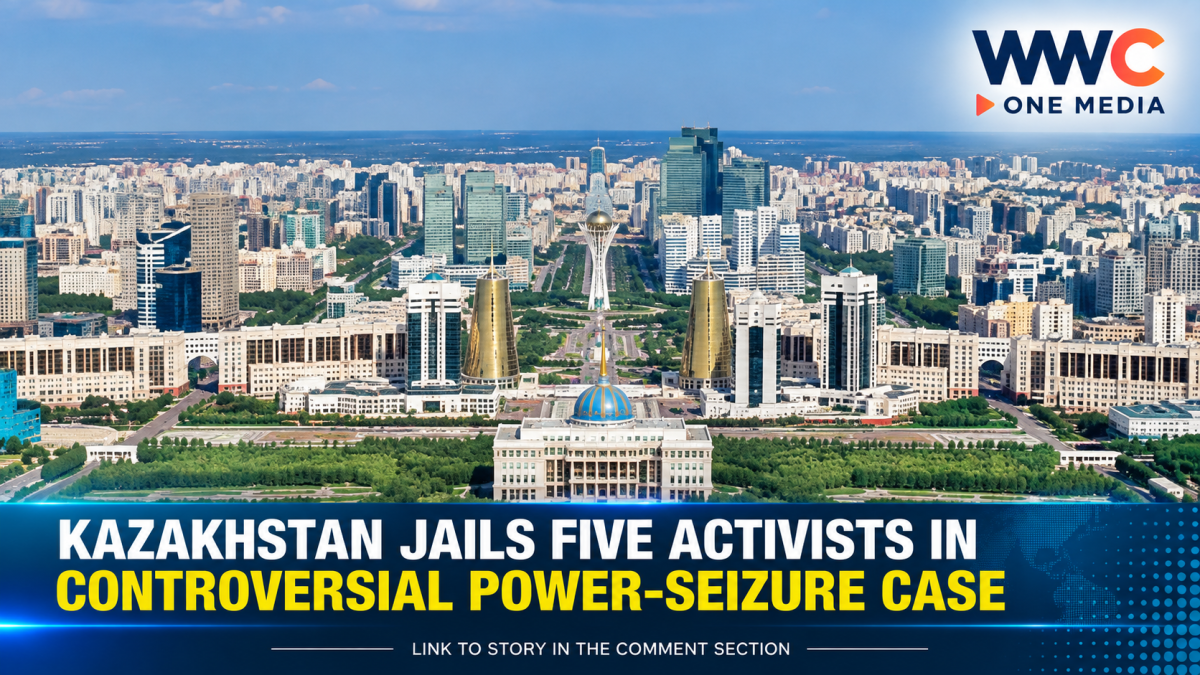
ALMATY — A Kazakhstan court has sentenced five civil activists to between five and five-and-a-half years in prison after finding them guilty of charges connected to alleged plans to seize the presidential residence and organize mass unrest, drawing renewed scrutiny from human-rights groups over the country’s treatment of political activists.
The Almalinsky District Criminal Court in Almaty issued the sentences on September 8, 2026, according to reporting by The Diplomat and Current Time. The defendants had pleaded not guilty when the trial began earlier this year.
Three defendants — Askar Nurmagan, Abduali Tagay and Duisenbek Zhashashev — received five-year prison sentences. Kaisar Ozbek and Talgat Ashirov were sentenced to five and a half years after also being convicted on additional allegations involving the illegal acquisition, storage or handling of weapons and ammunition.
What the Court Said
The case centered on accusations that the five men had advocated mass unrest and discussed a plan involving Akorda, the official presidential residence in Astana.
According to The Diplomat, prosecutors alleged that the activists were involved in efforts to organize mass unrest and seize political power. The court found them guilty of those offenses.
The defendants rejected the allegations.
Lawyers representing some of the men argued that their clients were ordinary activists and that security forces or alleged provocateurs had influenced conversations and activities that later became part of the prosecution’s case. Those claims were reported during the proceedings but remain disputed.
The trial was conducted behind closed doors, a feature that has attracted criticism from lawyers and rights advocates concerned about transparency.
Rights Groups Question the Broader Pattern
The latest convictions have attracted attention because they resemble several previous Kazakh cases involving activists accused of preparing mass unrest or attempting to seize power.
The Kazakhstan International Bureau for Human Rights and Rule of Law said the latest case had similarities with other prosecutions involving opposition-minded activists and questioned differences in how comparable cases have been handled by the justice system.
Human Rights Watch has separately documented broader concerns about restrictions on freedom of expression, association and peaceful assembly in Kazakhstan. Its 2026 country report also noted prosecutions of government critics and activists under broad charges.
Amnesty International likewise says Kazakh authorities have continued prosecuting civil-society activists and others exercising peaceful protest rights, while using broad criminal charges against critical voices.
These organizations’ assessments are criticisms of Kazakhstan’s human-rights environment; they do not establish that the five defendants in this particular case were innocent of the charges.
The “Tractor Case” and Earlier Prosecutions
The verdict is also being compared with the so-called “tractor case,” another Kazakhstan prosecution involving activists accused of planning to use a tractor in an effort connected to unrest and the presidential residence.
The Diplomat reports that the authorities have brought similar allegations against activists in successive years. The latest case therefore fits into a broader series of prosecutions involving alleged attempts to organize mass unrest or seize political power.
Another group of five activists was sentenced in a separate case linked to alleged preparations for mass unrest surrounding Kazakhstan’s 2024 referendum on nuclear power. Human Rights Watch reported in its 2026 country report that five civil activists were sentenced in August 2026 to four years of restricted freedom in connection with allegations of preparing to organize mass riots.
Why the Case Matters
Kazakhstan has undertaken political and legal reforms since the deadly January 2022 unrest, but the government’s approach toward dissent remains closely watched internationally.
Human Rights Watch says authorities have continued restricting political expression and prosecuting government critics, while also noting that some police officers have been convicted over torture linked to the 2022 events.
The government, meanwhile, has maintained that prosecutions involving unrest and public-order offenses concern violations of Kazakhstan’s criminal law rather than political activity itself.
That distinction is central to the debate surrounding the latest convictions: authorities characterize the cases through criminal allegations, while lawyers and human-rights organizations have questioned whether some prosecutions are being used disproportionately against activists and critics.
A Case That Puts Kazakhstan’s Rule of Law Under the Spotlight
The five sentences add another chapter to an increasingly watched debate over political dissent, judicial transparency and civil liberties in Kazakhstan.
For the defendants, the immediate issue is their prison terms. For rights organizations, the case raises a wider question about whether Kazakhstan’s courts are providing sufficiently transparent and independent proceedings when activists face serious charges involving alleged attempts to destabilize the government.
The competing accounts remain significant: the court has issued convictions based on the charges brought by prosecutors, while the defendants and their lawyers have denied wrongdoing and challenged aspects of the case.
As similar prosecutions continue to emerge, Kazakhstan’s handling of political activism and public dissent is likely to remain under international scrutiny.
WWC ONE MEDIA G,A