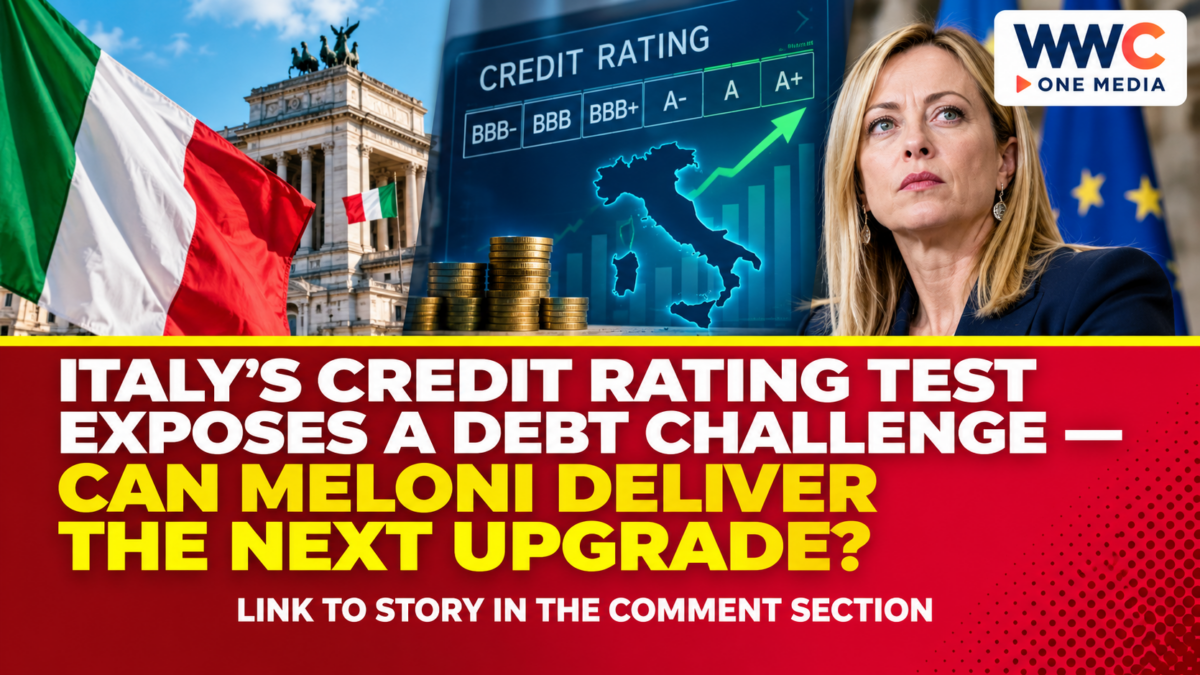
MANILA, Philippines — Nov. 14, 2026. Italy entered its November sovereign-credit review with a positive rating outlook but a debt burden approaching 140% of annual economic output. Public accounts and official economic releases show why a possible move into a higher ratings category remains a test of fiscal credibility, growth and the government’s ability to turn a draft budget into policy.
The distinction matters for bondholders and taxpayers. A positive outlook is a signal about the possible direction of a future rating, not an upgrade itself. Reports of the Nov. 13 decision say the rating was affirmed, but the full original rating-action document was not accessible for direct inspection, so this analysis does not reproduce its rationale as a verified statement from the agency.
Italy Credit Rating: What a Positive Outlook Means
A sovereign credit rating evaluates the credit risk of government borrowing. In general, a higher rating reflects an agency’s assessment of a government’s ability and willingness to meet its financial obligations; it is not a guarantee against future stress.
S&P’s published sovereign rating history documents Italy’s previous movement through the ratings scale, including its A-category ratings in 2011 and a subsequent downgrade to BBB+ in January 2012. That historical context explains why a possible return to A- attracts attention, but a comparison with 2011 cannot establish the precise outlook for the next review.
The original November rating report must be the authoritative record for any fresh action, conditions or agency forecast. Without it, describing an upgrade as already granted—or attributing exact new language to S&P—would exceed the documents verified for this story.
A credit outlook is also different from the government’s borrowing yield. Investors decide the price at which they will buy Italian bonds continuously, while agencies reassess creditworthiness at intervals. Those judgments can move in different directions.
Public Debt Near 140% Creates a Difficult Starting Point
Eurostat’s Oct. 21 release put Italy’s general government gross debt at 139.9% of gross domestic product at the end of the second quarter of 2026. That was below Greece’s 140.8%, but above France’s 119.1% and the euro-area aggregate of 88.8%.
Italy’s ratio had increased by 1.3 percentage points from the preceding quarter. These figures are provisional and represent a specific quarter, not a completed 2026 annual balance sheet.
A large debt ratio does not automatically mean a country is about to default. Debt maturities, interest costs, the investor base, fiscal revenues and growth all affect refinancing conditions. Nevertheless, a bigger stock of obligations leaves the treasury sensitive to the cost of replacing securities as they mature.
WWC has previously examined European government borrowing and bond-market pressure. Italy’s fiscal circumstances differ from those of France or Greece, so regional turbulence should not be treated as a single shared credit event.
Growth Has Yet to Provide Much Relief
Italy’s statistics agency estimated that third-quarter output was unchanged from the previous quarter, while rising 0.8% from a year earlier. Its Oct. 30 preliminary release identified gains in services and agriculture but a decline in industrial value added.
It also recorded a positive contribution from domestic demand, including inventories, offset by a negative contribution from net foreign demand. These preliminary figures describe economic activity, not a prediction that Italy has entered a recession.
Slow growth makes the debt calculation more difficult. Even if the government limits new borrowing, the debt-to-GDP ratio may decline only slowly when the denominator—economic output—grows weakly.
The broader backdrop was covered in WWC’s analysis of the uneven euro-area economic recovery. Italy’s flat quarterly reading highlights why a stronger regional aggregate should not be assumed to reflect every member economy.
The 2027 Budget Still Has to Pass Parliament
Italy’s public-finance database announced on Nov. 5 that the government had approved and submitted its draft budget to the Chamber of Deputies. The proposal contains revenue and spending plans for 2027–2029 and remains subject to parliamentary consideration, including a subsequent Senate reading.
That procedural status is essential. Proposed tax or spending measures are not the same as enacted provisions, and a draft budget does not establish what the final deficit or debt ratios will be.
The previous full-year public accounts give another reference point: Eurostat reported Italy’s 2025 deficit at 3.1% of GDP and its year-end debt at 136.7%. Figures for a completed year should not be confused with the second-quarter 2026 snapshot, whose reference period and calculation differ.
WWC has discussed proposals affecting investors in Italy’s 2027 budget. That is separate reporting about a proposed measure; any claim that it has become law requires an enacted text and cannot be inferred from the existence of the budget bill.
Why This Matters Beyond Rome
Analysis: The interaction of interest costs, spending plans and weak output matters more than the symbolism of one extra rating notch. A government seeking better credit terms has to demonstrate a credible budget path while retaining enough room to respond to unexpected shocks.
For lenders, a favourable rating change might expand the set of eligible bond buyers or affect risk assessments. It would not mechanically deliver a particular reduction in Italian bond yields: European Central Bank policy, inflation, global rates and demand also influence market pricing.
For Philippine businesses, the connection is indirect. Changes in European financing conditions can affect international investors and the euro’s value, but there is no basis to forecast a specific peso movement from Italy’s rating review alone.
An adequate fiscal assessment should therefore track the budget as enacted, economic performance and successive debt readings, rather than treating a positive outlook as a completed repair of public finances.
What Happens Next
The next important primary records are the original S&P November rating action, any later formal review, parliamentary decisions on the 2027 budget and updated economic and debt releases. Those documents will establish whether improved fiscal performance justifies higher credit quality.
Italy’s most recent officially inspected statistics show high debt, stagnant quarterly output and a budget still undergoing the legislative process. A higher sovereign rating remains a possibility to evaluate—not an outcome that these records alone establish.
Frequently Asked Questions
Did Italy receive an S&P upgrade on Nov. 13, 2026?
Reports describe an affirmation of BBB+ with a positive outlook, but the original Nov. 13 rating action was not directly accessible for this review. The article therefore does not certify the decision from a first-party document.
What was Italy’s latest confirmed debt-to-GDP ratio?
Eurostat recorded 139.9% at the end of the second quarter of 2026. It was provisional quarterly data, not a year-end estimate.
Is Italy’s 2027 budget already law?
No. The government’s Nov. 5 public-finance notice says the draft was submitted to parliament for consideration of its 2027–2029 plans.Would a rating upgrade automatically cut Italy’s borrowing costs?