
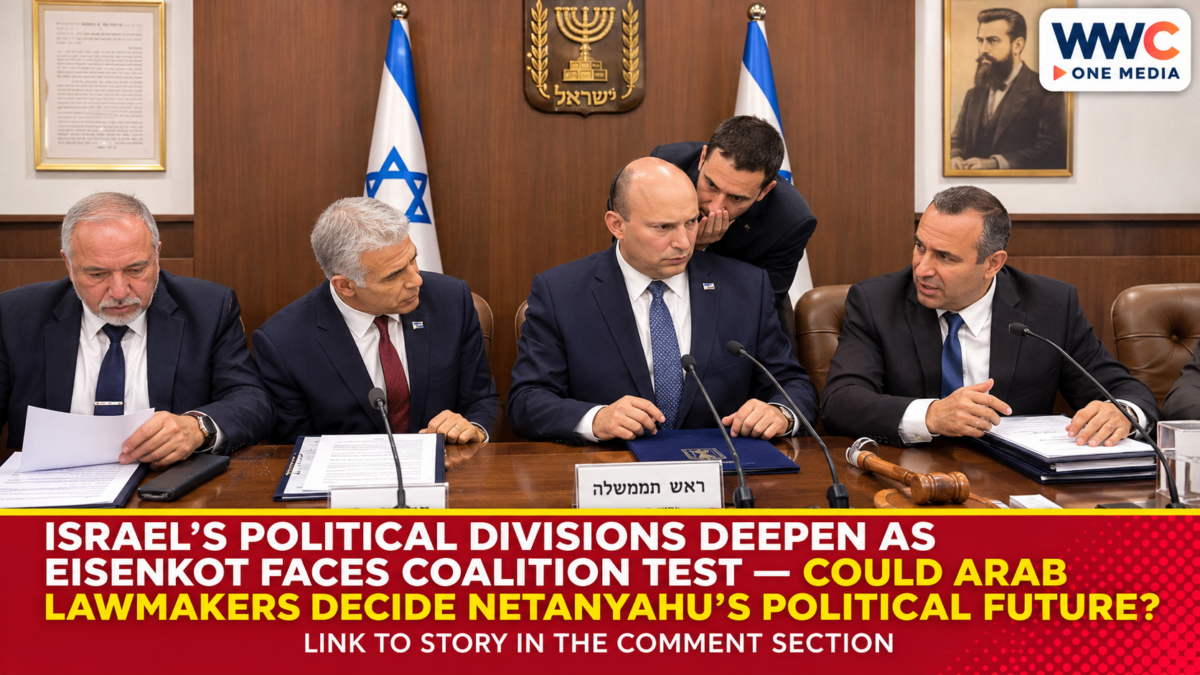
JERUSALEM — Israel’s coalition negotiations have placed the country’s parliamentary divisions under renewed scrutiny as Gadi Eisenkot attempts to assemble a new government while confronting disagreements over national security, political representation and the future of relations with Palestinians.
President Isaac Herzog formally entrusted Eisenkot with forming a government on Nov. 8, 2026, after political factions representing 67 members of the Knesset recommended the Yashar party leader.
Factions representing another 46 lawmakers recommended Prime Minister Benjamin Netanyahu, while a seven-member faction declined to endorse either candidate.
The numbers provide Eisenkot with an important political opportunity, but they do not guarantee that he can establish a functioning administration.
The greater challenge involves reconciling competing political priorities while addressing Israel’s security concerns and the continuing humanitarian emergency in Palestinian territories.
Israel coalition negotiations expose political divisions
Israel’s government formation process highlights the distinction between winning an election, receiving presidential backing and securing sufficient parliamentary support to govern.
Although Netanyahu’s Likud remains the largest individual parliamentary faction, Herzog determined that Eisenkot had a stronger opportunity to assemble a government capable of securing the Knesset’s confidence.
Under Israel’s Basic Law governing the formation of a government, Eisenkot has an initial 28-day period to complete his assignment.
The president may grant an extension of up to 14 additional days if necessary.
However, the political recommendations made during presidential consultations cannot automatically be interpreted as binding commitments to support a particular coalition agreement.
Different parties may endorse the same candidate while maintaining substantially different positions on government policies.
WWC ONE MEDIA previously examined these competing interests in its coverage of Eisenkot’s mandate and why 67 parliamentary recommendations do not automatically translate into a governing majority.
For Eisenkot, the immediate challenge is converting political support into an arrangement capable of sustaining government operations.
Arab lawmakers emerge as important political participants
The government formation process has renewed attention on the role of Arab-led parliamentary factions.
On Nov. 5, representatives of the Joint List attended consultations with Herzog and recommended Eisenkot to form the next government.
The delegation included lawmakers Ahmad Tibi and Ofer Cassif, alongside Yousef Jabareen, Bakr Awawdeh and Maha Sabbah Karkabi.
The United Arab List, commonly known as Ra’am, separately recommended Eisenkot during its presidential consultations.
Its representatives included Mansour Abbas, Yoav Segalovitz, Walid Taha, Walid Alhwashla and Iman Khatib-Yassin.
These recommendations establish that both factions supported giving Eisenkot an opportunity to form a government.
They do not independently establish that either faction has secured cabinet positions or agreed to participate in a final coalition.
The wider political challenge has previously been explored in WWC ONE MEDIA’s coverage of Netanyahu’s leadership contest and the potential influence of Arab parties in forming Israel’s next administration.
The distinction between supporting a candidate and joining a government remains central to understanding Israel’s evolving political landscape.
Herzog calls for parliamentary cooperation
During the opening session of the 26th Knesset on Nov. 10, Herzog urged lawmakers to avoid another election and work towards constructive political cooperation.
He emphasised that the new parliament faced significant responsibilities involving national security, international relations, military service and institutional governance.
The president also condemned racism, intimidation and violence, stressing the importance of maintaining respectful relations throughout Israeli society.
His remarks highlighted the need for cooperation between political rivals without suggesting that ideological differences should disappear.
A functioning parliament must accommodate disagreements while maintaining procedures that allow elected representatives to perform their responsibilities.
Political criticism and peaceful debate remain important democratic activities. Allegations of misconduct, however, require appropriate examination before responsibility can be established.
For lawmakers, the broader challenge is maintaining effective parliamentary operations during a period of considerable political uncertainty.
Palestinian statehood remains a central diplomatic question
The future relationship between Israelis and Palestinians represents one of the most consequential policy questions facing any incoming Israeli government.
During the ceremony granting Eisenkot his government formation mandate, Herzog identified regional diplomacy and implementation of the Gaza peace framework among the country’s major priorities.
The president also highlighted security concerns involving Iran, relations with neighbouring countries and Israel’s relationship with the United States.
These objectives demonstrate the complexity of building a common government programme.
Political leaders must reconcile domestic priorities with international diplomatic commitments, while addressing competing perspectives on security, Palestinian self-determination and regional stability.
A coalition agreement could establish a government’s initial policy direction.
However, it would not independently resolve disputes concerning Palestinian statehood, territorial boundaries or long-term security arrangements.
Those matters would require additional political and diplomatic processes.
Gaza’s humanitarian emergency continues
While Israel’s political leaders negotiate the formation of a government, humanitarian organisations continue addressing urgent civilian needs in Gaza.
On Nov. 18, 2026, the United Nations Office for the Coordination of Humanitarian Affairs published an operational update documenting continuing challenges involving healthcare, food assistance and humanitarian supplies.
Between Nov. 10 and 16, 97 patients, including 34 children, were medically evacuated from Gaza alongside 145 companions.
Humanitarian organisations also reported that, as of Nov. 12, approximately 596,000 cooked meals were being prepared daily through 90 kitchens.
These figures illustrate the continuing scale of humanitarian operations.
Access to adequate shelter, specialised medical supplies and rehabilitation services remained limited.
The wider political and humanitarian dimensions of the situation were previously examined in WWC ONE MEDIA’s reporting on the Gaza ceasefire and obstacles to implementing the broader peace framework.
Changes in Israel’s political leadership could influence future policy decisions, but they would not automatically eliminate existing humanitarian needs.
Practical improvements would require sustained assistance, dependable access arrangements and implementation of relevant commitments.
Why regional stability matters beyond Israel
Political uncertainty in Israel carries implications extending beyond domestic parliamentary affairs.
Herzog has identified strengthening diplomatic relationships with Egypt, Jordan, Morocco, the United Arab Emirates and Bahrain as important priorities.
Maintaining regional relationships while addressing security threats and Palestinian humanitarian concerns will present significant challenges for any incoming administration.
For international governments and businesses, developments in the Middle East also warrant attention because regional instability can influence diplomatic cooperation, commercial confidence and investment decisions.
However, parliamentary disagreements alone do not establish that international trade, energy markets or economic activity will experience specific disruptions.
Such outcomes would depend on subsequent political and security developments.
For Asia-Pacific and APEC audiences, distinguishing between political uncertainty and measurable economic consequences remains essential.
What happens next for Israel?
Eisenkot must use the available government formation period to pursue an arrangement capable of winning parliamentary confidence.
The relevant milestones include formal coalition agreements, commitments from participating factions and the establishment of a common government programme.
The negotiations must also address competing priorities involving national security, military service, economic governance and regional diplomacy.
For Arab-led parties, the process presents an opportunity to influence political decisions affecting their constituents.
For Netanyahu and Likud, the negotiations will help determine their future position within Israel’s political system.
The decisive question is whether the parties can move beyond their initial recommendations and establish a stable government capable of addressing the country’s complex challenges.
Until then, Israel’s political future remains unresolved.
Frequently Asked Questions
Who is Gadi Eisenkot?
Gadi Eisenkot is the leader of Israel’s Yashar party and a former chief of the general staff of the Israel Defense Forces. President Isaac Herzog tasked him with forming a government on Nov. 8, 2026.
How many lawmakers recommended Eisenkot?
Political factions representing 67 Knesset members recommended Eisenkot during presidential consultations. Another 46 recommended Netanyahu, while a seven-member faction made no recommendation.
Does Eisenkot’s presidential mandate make him prime minister?
No. Receiving the mandate gives him an opportunity to form a government. He must still complete the government formation process and secure parliamentary confidence.
Who is Ahmad Tibi?
Ahmad Tibi is a member of Israel’s Knesset associated with the Joint List faction. He participated in presidential consultations on Nov. 5, 2026.
How long does Eisenkot have to form a government?
Israel’s Basic Law provides an initial 28-day period, with a possible presidential extension of up to 14 additional days.










