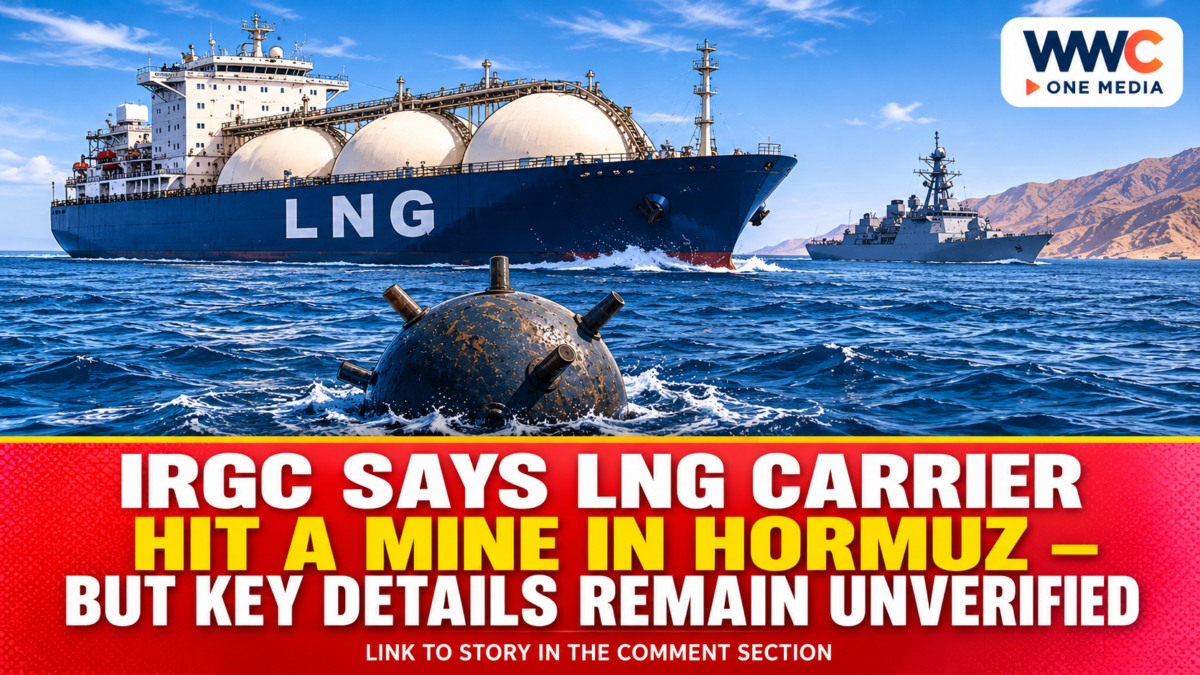
An Iranian Revolutionary Guard Corps (IRGC) naval statement circulated on November 25, 2026, claimed that a liquefied natural gas carrier struck a naval mine while crossing the Strait of Hormuz. The vessel’s name, flag, owner, crew condition and extent of damage were not established in the maritime records independently reviewed for this report.
The claim matters because the Strait of Hormuz is a critical passage for energy shipments, and uncertainty over the safety of commercial vessels can affect operators well beyond the Gulf. But a statement alleging a mine strike is not the same as an independently confirmed maritime incident. The distinction is especially important when the available official notices describe other events involving unidentified projectiles.
LNG carrier mine claim remains short on vessel details
The IRGC Navy’s account, reproduced by Iranian state media, said the carrier had switched off its positioning systems and used a route that Iranian authorities considered unauthorized. The statement attributed the incident to a naval mine and warned vessels against ignoring Iranian transit rules.
The publicly accessible account did not identify the ship, its registered flag, the shipping company, cargo volume or the number and condition of crew members. It also did not provide a verifiable vessel-tracking record or a damage assessment.
Those omissions leave important questions unanswered. Without a vessel identity, independent ship-tracking information and confirmation from a maritime authority or operator, the reported event cannot be treated as a fully verified casualty record.
The distinction is not merely technical. Ship identity and flag state help establish which authorities may investigate, while crew and damage information are essential to assessing the human and environmental consequences of an incident.
Maritime warnings document separate attacks, not proof of this mine strike
The United Kingdom Maritime Trade Operations office issued Warning 219-26 for an incident dated November 23. It said three vessels travelling eastbound in the Strait of Hormuz had been struck by unknown projectiles. The vessels continued their transits and all crew had been accounted for; damage assessments and environmental impact were unknown at the time of the notice.
That warning is important context, but it does not confirm the November 25 LNG-carrier claim. Its incident date is different, and its description identifies unknown projectiles rather than naval mines.
A Joint Maritime Information Center update dated November 22 also listed three tanker attacks in the strait on November 20 and 21. It described the reported weapons as unknown projectiles and said Iranian claims of mine strikes on tankers had not been confirmed by official or national authorities as of the update’s reporting cut-off.
That assessment predates the November 25 LNG-carrier allegation. It should not be used as proof that the newer claim is false, but it demonstrates why each reported event needs to be checked against its own records.
WWC previously examined three separate tanker incidents recorded near Oman’s Khasab area. Those earlier incidents should not be merged with the latest allegation unless investigators establish a connection.
Why the Strait of Hormuz matters to LNG shipments
The Strait of Hormuz connects the Persian Gulf with the Gulf of Oman and provides a major maritime route for energy cargoes moving from Gulf producers to international markets.
Liquefied natural gas is transported in specialized vessels designed to carry natural gas in liquid form at very low temperatures. A disruption affecting an LNG carrier can therefore raise questions about cargo safety, vessel availability, insurance and delivery schedules.
However, the reported mine strike does not establish that LNG deliveries have been interrupted or that energy prices have changed because of this particular event. Those conclusions would require confirmation from shipping operators, port authorities, cargo buyers or market data.
WWC’s earlier coverage of the exposure of Asian oil supplies to Hormuz shipping risks explains why uncertainty in the waterway matters to import-dependent economies. Oil and LNG are different commodities with different supply chains, but both depend on safe and reliable maritime transport.
Navigation rules and competing claims
The IRGC statement placed emphasis on the carrier’s alleged use of a route not authorized by Iran and the reported disabling of its positioning systems.
That is the Iranian military’s account of the circumstances. The material reviewed does not independently establish the vessel’s route, whether its automatic identification system was switched off, or whether it received and ignored a warning.
Commercial vessels operating in a high-risk waterway need reliable navigational information and clear instructions from relevant maritime authorities. Conflicting or changing transit requirements can complicate decisions for shipmasters and operators, particularly when the consequences of a wrong route may be severe.
The International Maritime Organization has separately called on states to enforce maritime rules in the Strait of Hormuz. Its November 11 statement urged concrete measures to ensure compliance with international maritime regulations. That wider position reinforces the importance of predictable rules for commercial shipping, regardless of competing national claims.
What happens next
The next meaningful confirmation would be an identifiable vessel record, a statement from the ship’s owner or flag state, an updated maritime warning, or an official investigation describing the incident.
Until such information becomes available, the reported mine strike should remain attributed to the IRGC and should not be described as an independently verified attack. The same caution applies to claims about the carrier’s route, tracking systems, damage, crew and cargo.
For ship operators, the immediate priority is accurate safety information and verified instructions from recognized maritime authorities. For energy buyers, the question is whether any confirmed incident changes vessel movements or delivery schedules.
The Strait of Hormuz remains strategically important, but reliable reporting depends on separating what an authority claims from what independent maritime records establish.
Frequently asked questions
Did an LNG carrier hit a mine in the Strait of Hormuz?
The IRGC Navy claimed that an LNG carrier struck a mine on November 25. The vessel and incident details have not been independently confirmed in the maritime records reviewed.
Was the LNG carrier identified?
The accessible account did not provide the ship’s name, flag, owner or cargo volume.
Were crew members injured?
The accessible statement did not provide a verified crew casualty report.
Did UKMTO confirm the November 25 mine strike?
The UKMTO Warning 219-26 reviewed here concerns a separate November 23 incident involving three vessels struck by unknown projectiles. It does not confirm the November 25 LNG-carrier claim.
Could the reported incident affect LNG prices?
A confirmed disruption to shipping could affect delivery schedules and market risk assessments. The available evidence does not establish a price impact from this specific allegation.