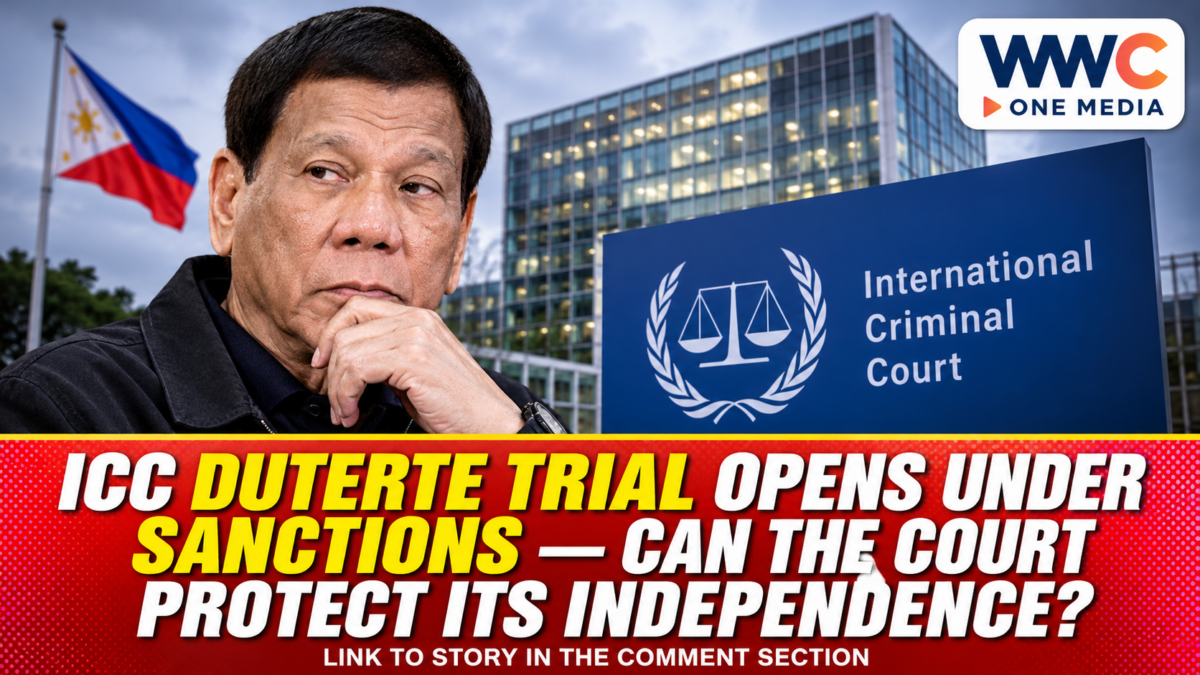
THE HAGUE, Netherlands — The International Criminal Court is scheduled to open former Philippine president Rodrigo Roa Duterte’s trial on Monday, November 30, 2026, even as the tribunal faces an unprecedented escalation in US sanctions targeting its institution and officials. The proceedings will test the court’s ability to conduct a major case while managing political pressure, international cooperation requirements and the practical limits of its enforcement powers.
The timing puts two questions side by side: whether prosecutors can prove the charges against Duterte beyond reasonable doubt, and whether the international institution hearing the case can continue operating independently despite pressure from a major global power.
The court’s challenges extend well beyond the Philippines. Its latest activity report records 41 public cases involving 47 defendants across 18 situations. It also lists 34 publicly known suspects still at large in 12 situations. Those figures illustrate a central limitation of international criminal justice: judicial decisions can be issued, but arrests and cooperation often depend on governments.
Duterte’s case moves from pre-trial proceedings to trial
The ICC has scheduled the opening of The Prosecutor v. Rodrigo Roa Duterte for 10 a.m. in The Hague on November 30 before Trial Chamber III.
Duterte faces three counts of crimes against humanity involving murder and attempted murder. The allegations concern events in the Philippines between November 1, 2011, and March 16, 2019, in the context of the government’s anti-drug campaign.
The charges cover three periods and categories: alleged murders in Davao City during Duterte’s mayoral period; alleged murders of people classified as high-value targets during his presidency; and alleged murders and attempted murders during barangay clearance operations.
Pre-Trial Chamber I unanimously confirmed the charges on April 23, 2026, and committed the case to trial. That decision did not establish guilt. It found substantial grounds to believe that the accused may be responsible for the crimes charged, a threshold that is different from the proof beyond reasonable doubt required for conviction.
On November 30, judges are scheduled to verify that Duterte understands the charges and ask whether he admits guilt or pleads not guilty. The chamber will then hear opening statements from the prosecution and victims’ legal representatives, as well as an outline of the defence case. The first prosecution witness is scheduled to testify after those statements.
The trial chamber is composed of Presiding Judge Joanna Korner, Judge Keebong Paek and Judge Nicolas Guillou.
Why the Philippines’ withdrawal did not end ICC jurisdiction
The case remains within the ICC’s jurisdiction despite the Philippines’ withdrawal from the Rome Statute in 2019.
The Philippines deposited its withdrawal notice on March 17, 2018. It took effect one year later, on March 17, 2019. The court maintains jurisdiction over alleged crimes committed on Philippine territory while the country was still a State Party, from November 1, 2011, through March 16, 2019.
The ICC Appeals Chamber confirmed that position on April 22, 2026, rejecting Duterte’s jurisdictional appeal by majority decision.
This distinction is important for readers following the case. Withdrawal from a treaty does not automatically erase legal questions arising from the period when the treaty applied. The court’s ruling concerns its authority to hear allegations within that defined period; it is not a finding that Duterte committed the crimes alleged.
A separate domestic development also arrived shortly before the trial. On November 24, the Philippine Supreme Court announced the dismissal of consolidated habeas corpus petitions challenging Duterte’s arrest and transfer, ruling that the petitions had become moot because he was already in ICC custody in The Hague.
The domestic ruling and the ICC criminal proceedings address different legal questions. Neither should be treated as a verdict on Duterte’s criminal responsibility.
US sanctions now target the institution itself
The court’s institutional difficulties intensified on October 9, when the US Treasury’s Office of Foreign Assets Control added the International Criminal Court itself to its Specially Designated Nationals and Blocked Persons List.
The measure followed earlier US sanctions against individual judges, prosecutors and other court personnel. In its February 6, 2025 executive order, the US administration said it opposed ICC actions involving the United States and Israel, arguing that the court had asserted authority without their consent.
The ICC rejected the institutional designation, describing it as an attempt to obstruct its work. The court has said that sanctions against judicial officials threaten its independence and can affect the people seeking justice through its proceedings.
There is, however, an important qualification in the US government’s own rules. On the same October 9 date, OFAC issued General Licences 13, 14, 15 and 16.
General Licence 13 authorises certain transactions necessary for maintaining or winding down ICC operations through April 7, 2027. Its permitted activities include certain payments by Rome Statute member states, employee salaries, health insurance, medical services, rent, utilities, taxes, insurance and routine commercial services.
The other licences cover specified telecommunications and enterprise software transactions, pension payments and certain transactions involving ICC detainees.
These licences do not remove the court from the sanctions list or authorise every transaction. General Licence 13 also excludes transactions involving separately blocked persons unless another authorisation applies. The distinction is significant: the sanctions are real, but the US rules also provide defined exceptions for some operational needs.
WWC ONE MEDIA has previously examined the dispute over US sanctions and the Duterte proceedings. The October institutional designation makes the issue more concrete than an argument about possible future restrictions.
A court with broad reach but limited enforcement power
The ICC’s latest activity report, covering September 16, 2025, to September 15, 2026, records 41 public cases, 47 defendants and 18 situations. The Philippines is one of those situations.
The same report identifies 34 publicly known suspects at large in 12 situations. The court explains that its cooperation office works with national authorities and other partners to pursue arrests and surrender suspects.
The ICC does not have its own police force or executive authority to arrest people. It relies on states to execute arrest warrants and assist with judicial requests. This dependence creates a practical gap between the court’s legal authority and its ability to enforce decisions.
That gap is relevant to the Duterte proceedings. A trial can move forward because the accused is already in custody, but the court’s wider work still depends on governments, service providers and international partners.
The court’s 25th Assembly of States Parties is also scheduled to meet in The Hague from November 30 to December 7. The Assembly is the management oversight and legislative body of the ICC. Its session was moved from the United Nations headquarters in New York after concerns were raised about participation restrictions affecting court officials under US sanctions, as well as visa restrictions affecting some delegations and non-governmental organisations.
The overlap between the Assembly and the opening of Duterte’s trial gives the week an institutional significance beyond one courtroom.
Why the proceedings matter beyond Duterte
The trial will test the prosecution’s evidence, the defence’s ability to challenge it and the chamber’s responsibility to protect the rights of all participants.
The court has confirmed that the prosecution, victims’ representatives and defence will have opportunities to present their positions. The judges must assess the evidence through the proceedings rather than treat the confirmation of charges as a final determination.
For victims and their families, the trial offers a formal judicial process in which allegations can be examined. For Duterte, it is the stage at which the prosecution must prove its case and the defence can contest the evidence. For the Philippines, the proceedings will continue to raise questions about accountability, national sovereignty and the country’s relationship with international legal institutions.
The broader issue is whether an international court can maintain the practical independence needed to perform its work when powerful states use financial and administrative tools to pressure it. The answer will depend not only on statements of support but also on whether member states continue to provide cooperation and resources.
What happens next
The immediate next step is the opening hearing on November 30. The judges will address the plea and opening statements before the prosecution begins presenting its evidence through witnesses.
The Assembly of States Parties will meet during the same week, giving member states an opportunity to address the court’s administration, budget and institutional challenges.
No verdict is expected at the opening of the trial. Duterte remains presumed innocent, and the prosecution must prove the charges beyond reasonable doubt.
The central test will therefore unfold on two levels: whether the evidence supports the allegations against the former president, and whether the ICC can preserve the independence and cooperation needed to carry out its mandate.
Frequently asked questions
When will Rodrigo Duterte’s ICC trial begin?
The trial is scheduled to open on November 30, 2026, at 10 a.m. local time in The Hague before ICC Trial Chamber III.
What charges does Duterte face?
He faces three counts of crimes against humanity involving murder and attempted murder, allegedly committed in the Philippines between November 1, 2011, and March 16, 2019.
Why can the ICC hear the case after the Philippines withdrew?
The ICC Appeals Chamber confirmed that the court retains jurisdiction over alleged crimes committed while the Philippines was still a State Party to the Rome Statute.
Has Duterte been convicted?
No. The charges were confirmed and sent to trial, but that is not a conviction. The prosecution must prove the charges beyond reasonable doubt.
What do US sanctions mean for the ICC?
The United States has designated the ICC as a sanctioned entity. However, OFAC has issued general licences authorising certain transactions involving the court, including specified operational payments and services. The licences do not permit every transaction.