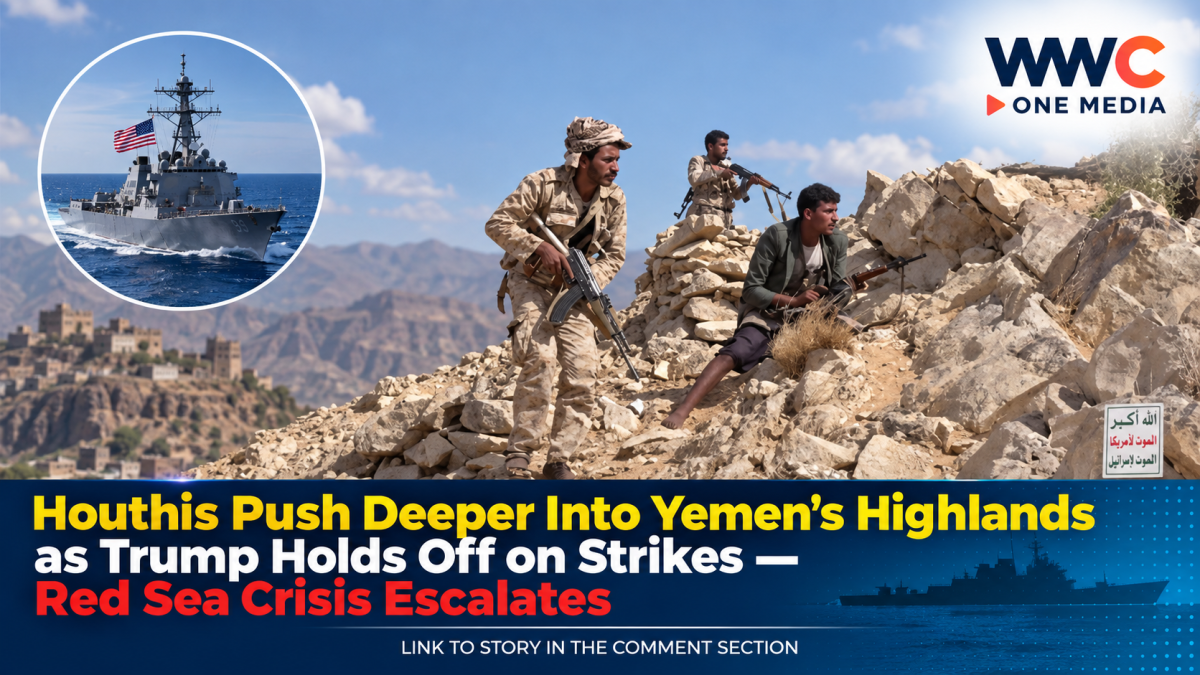
Iran-aligned Houthi fighters are pushing to seize strategic highlands in southern Yemen, seeking to consolidate their rapid territorial gains and cut off the Red Sea coast from areas still held by Saudi-backed government forces.
The latest advance comes as US President Donald Trump has reportedly decided not to launch planned American airstrikes against the Houthis, despite repeated requests from Saudi Arabia for greater military support.
According to Reuters, five Yemeni military sources said Houthi forces are targeting the strategically important Kahboub Mountains in Taiz and Lahij provinces. The mountain range separates the Red Sea coast from government-held territory farther south, making control of the area potentially important to the next phase of the conflict.
Fighting has reportedly intensified around Al-Wazi’iyah district in Taiz and Ras al-Ara near the coast. The developments follow a rapid Houthi offensive that has significantly changed the balance of power in western Yemen.
The Houthis have already captured large sections of Yemen’s Red Sea coastline, including the port city of Mocha, and have strengthened their position around the Bab el-Mandeb Strait, one of the world’s most important maritime chokepoints. Reuters reported that the group is now trying to maintain momentum despite heavy Saudi airstrikes.
The situation has placed Saudi Arabia under increasing pressure.
Saudi forces have launched hundreds of strikes against Houthi positions, according to the Houthis, while Riyadh has sought additional assistance from its allies. Britain has since announced limited military support for Saudi Arabia, including Royal Air Force air-to-air refuelling for Saudi aircraft.
Washington, however, has so far stopped short of re-entering the conflict directly.
The New York Times reported that the Trump administration had prepared to conduct airstrikes against the Houthis on Sunday after renewed appeals from Saudi Crown Prince Mohammed bin Salman. Trump reportedly called off the operation at the last moment, even as US forces were preparing aircraft and munitions.
Reuters said it could not independently verify the report. The White House did not immediately respond to requests for comment, while US Central Command referred questions about the reported decision to the White House.
Trump also spoke by phone with Yemen’s internationally recognised President Rashad al-Alimi. According to people familiar with the conversation, the Yemeni leader sought US military assistance, but Trump did not make a direct pledge of military support.
The US decision comes after Washington previously fought the Houthis directly. Trump ordered an American bombing campaign against the group in early 2025, but those strikes ended after the United States and the Houthis reached a ceasefire.
The latest crisis threatens to pull Washington back toward a conflict the Trump administration had previously sought to avoid.
There is also a much larger economic concern: oil.
The Houthi advance around the Bab el-Mandeb Strait threatens a major alternative route for Saudi oil exports. With that route increasingly exposed, Saudi Arabia has reportedly increased shipments through the Strait of Hormuz instead.
Reuters reported that Saudi exports through Hormuz have recently reached about 2.9 million barrels per day, compared with roughly 700,000 barrels per day in August. The shift is significant because Hormuz itself is already facing heightened security risks amid the wider conflict involving Iran.
The pressure is being felt beyond the Middle East. Disruptions to major shipping routes can increase transportation costs, threaten energy supplies and put additional pressure on fuel prices around the world.
The humanitarian consequences are also mounting.
The United Nations estimates that nearly 700 people have been killed and thousands injured in the latest escalation, while nearly 130,000 Yemenis have been displaced inside the country. More than 3,000 others have reportedly crossed the Red Sea by boat into Africa.
The conflict is therefore developing on several fronts at once: the Houthis are seeking to consolidate territorial gains, Saudi Arabia is attempting to push them back, Britain is providing limited support, and Washington is weighing how far it is willing to become involved.
The immediate battle for the Kahboub Mountains could become particularly important. Control of the highlands could help determine whether the Houthis can consolidate their recent gains along Yemen’s western coast or whether Saudi-backed forces can establish positions from which to launch a counteroffensive.
At the same time, the fight for Yemen’s coastline and the Bab el-Mandeb Strait is creating a direct risk for global shipping and energy markets.
With the Houthis continuing their advance and Trump holding off on direct US strikes for now, the next moves by Washington, Riyadh and the Houthi leadership could determine whether Yemen’s latest escalation remains a regional conflict — or develops into another major front in the wider Middle East war.