ANTALYA, Türkiye — International proposals for global climate levies have gained fresh attention during the COP31 negotiations in November 2026, as governments search for ways to raise funding for climate resilience. The United Kingdom has reaffirmed its climate-finance commitments, while a UK climate representative was listed to participate in a discussion about solidarity levies on Nov. 13.
The question is whether polluter charges can raise revenue without overburdening vulnerable households. Neither the task force’s proposals nor Britain’s participation in the discussion establish that a new international tax has entered into force.
Global climate levies: What is actually being considered?
The Global Solidarity Levies Task Force was launched in November 2023 and is co-chaired by Barbados, France and Kenya. It works on possible revenue measures to support climate action and development, with an emphasis on cooperation among willing governments.
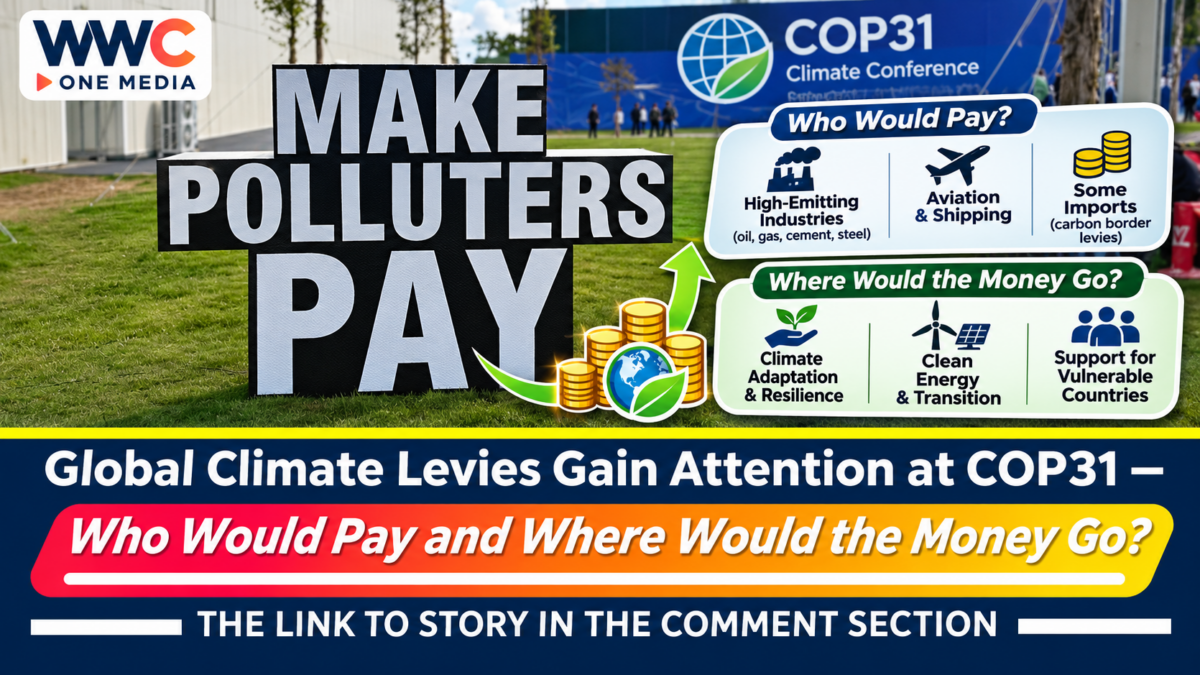
Its published areas of inquiry include a fossil-fuel levy or carbon-damages levy, a windfall-profits levy on fossil-fuel businesses, a financial-transactions levy, a private-air-passenger levy and a maritime-fuel levy. It also studies the phase-out of fossil-fuel subsidies.
These are different policy instruments. Some might be collected from producers, others from travellers, shipping activity or financial transactions. Proposals do not mean uniform charges or costs.
The task force’s Nov. 13 report argues for nationally determined but internationally coordinated approaches. That wording matters: it describes cooperation and policy development, not a single global tax authority that could automatically bill companies everywhere.
What the UK’s official climate position confirms
In a Nov. 13 joint statement, the United Kingdom and Canada renewed their commitment to international climate finance. The statement recalled the goal of mobilising at least US$300 billion annually for developing countries by 2035, with developed countries taking the lead, alongside a wider ambition of at least US$1.3 trillion a year from all sources.
Those figures are financing goals, not expected receipts from solidarity levies. The joint statement does not establish that Britain has adopted a specific new levy or committed a fixed share of its proceeds to an international fund.
The published agenda for a Nov. 13 COP31 event on solidarity levies included the UK’s Special Representative for Climate, Rachel Kyte. That shows participation in the policy discussion; it does not, by itself, establish membership of the levy coalition or enactment of a tax.
Analysis: For businesses, there is a substantial difference between a government discussing a tax, supporting further technical work and passing legislation that creates a payable obligation. Until rates, covered activities and collection rules are set, potential financial effects remain uncertain.
Who might pay — and could costs reach consumers?
A fossil-fuel-related charge could be designed to target producers or profits. A premium-flight levy might instead be designed around a particular type of passenger journey. A maritime-fuel measure would affect a different market, where costs could be distributed among shipowners, cargo customers and eventually consumers.
The task force says its studies consider revenue potential, equity, economic effects and political feasibility. It explicitly includes the need to avoid disproportionate harm to vulnerable economies when assessing options.
Those tests are essential because the person legally responsible for paying a levy is not necessarily the person who ultimately bears its full economic cost. For example, a charge on a transport service might be absorbed partly by operators and passed on partly through prices. Outcomes depend on design.
No universal rate, worldwide implementation date or binding allocation formula for all the instruments has been confirmed in the primary records reviewed.
Why climate finance needs more than pledges
The UK–Canada statement points to large financing goals for 2035, but turning those goals into projects requires a reliable means of raising and distributing money. Countries need investment in flood defences, resilient infrastructure, public services and recovery after climate-related disasters.
The Nov. 13 task-force report presents levies as one possible way to expand the funding available for resilience when public budgets are constrained. It does not establish that every proposed instrument will be adopted, or that projected revenue is already available for disbursement.
This issue connects directly with WWC’s report on the loss-and-damage fund’s financing gap. That article addresses the difference between funding requests and available resources; levy proposals address one possible route for expanding future revenue.
A second distinction concerns adaptation. WWC has examined the wider cost of climate adaptation at COP31. Adaptation, emissions reduction and recovery following unavoidable losses are related, but separate, financing needs.
What this could mean for the Philippines
Analysis: For Philippine businesses, possible maritime or transport levies would be worth monitoring because they could change costs along international supply chains if enacted. But no primary record reviewed establishes a new levy already being imposed on Philippine exporters or consumers under the task force’s proposals.
The Philippines also has an interest in reliable access to climate finance as it develops national coordination for climate-related loss and damage. WWC’s report on the Philippine loss-and-damage strategy explores the domestic planning work involved.
Revenue collection and access to assistance are distinct steps. Even a successful international levy would still require rules identifying who receives the proceeds, what projects qualify, how decisions are audited and how swiftly financing reaches communities.
A fair system would also need to consider countries that contribute relatively little to historical emissions but face significant climate risks. The task force includes equity among its assessment criteria.
What happens next
The next meaningful developments would be government announcements selecting particular levy designs, published estimates of their distributional effects and legislation or agreements specifying how money would be collected and used.
Britain’s ongoing climate-finance diplomacy provides a setting for these discussions, but its public statements cannot be treated as proof that an international polluter tax has already been implemented. The proposals remain proposals unless governments create enforceable arrangements.
The practical test is whether participating countries can turn technical ideas into transparent funding streams while limiting unintended costs for vulnerable people and economies.
FAQ
What are global climate levies?
They are proposed charges on selected activities, such as fossil-fuel production, premium air travel, shipping fuel or financial transactions, designed to raise money for climate and development goals.
Has the UK introduced a new global polluter tax?
The official records reviewed do not establish that Britain has enacted such a tax. They confirm climate-finance commitments and UK participation in a discussion about solidarity levies.
Who leads the Global Solidarity Levies Task Force?
Barbados, France and Kenya are its co-chair countries. The initiative began in November 2023.
Would Philippine companies have to pay these levies?
No automatic payment obligation is established by the proposals. Future effects would depend on which measures governments adopt and the rules governing them.
Where would the money go?
The task force explores funding for climate resilience and development, but individual proposals still require decisions on collection, allocation, oversight and eligible recipients.