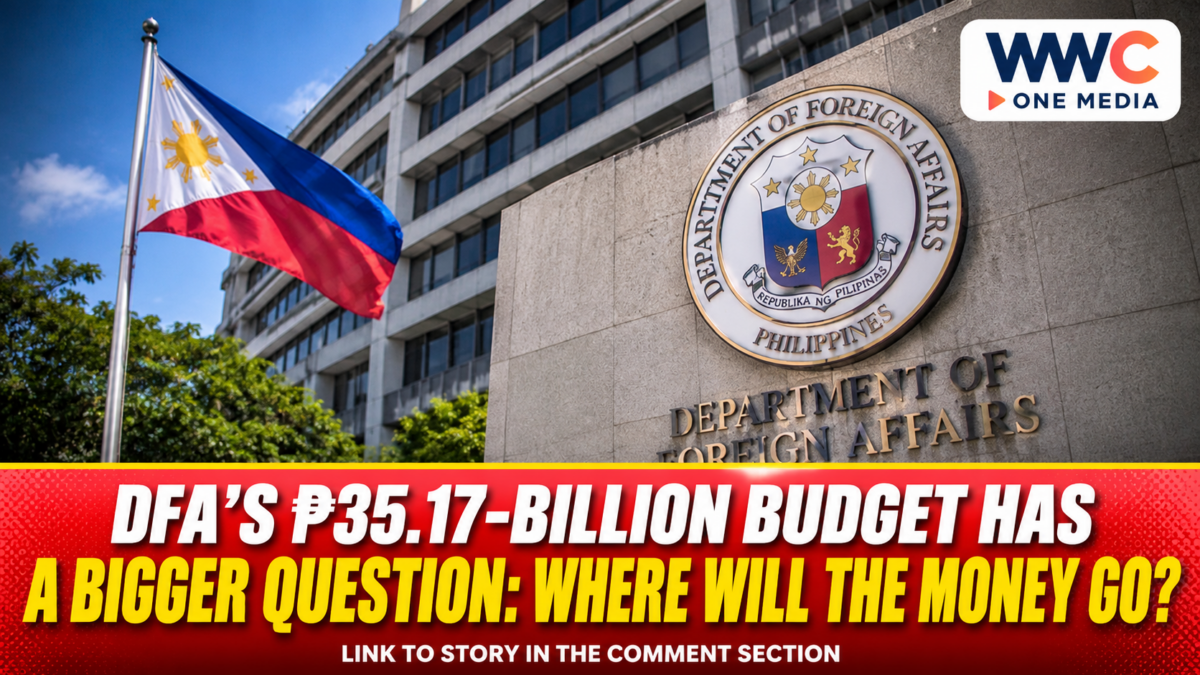
The Department of Foreign Affairs is seeking a proposed 2027 budget package of about ₱35.17 billion, with major spending provisions covering diplomatic operations, passport production and the upkeep or acquisition of government facilities. The proposal is now part of Congress’ review of the national spending plan, meaning the requested amount is not yet the final appropriation.
The figures reveal a practical side of Philippine foreign policy that often receives less attention than diplomatic statements: the cost of keeping embassies and consulates operating, issuing travel documents, supporting Filipinos overseas and maintaining the country’s presence abroad.
What the DFA 2027 budget actually covers
The DFA’s budget presentation for the House of Representatives placed its proposed 2027 budget at ₱35.173 billion, equivalent to 0.49% of the proposed ₱7.2-trillion national budget.
The Department of Budget and Management’s National Expenditure Program provides a more detailed breakdown for the DFA Office of the Secretary. It lists a proposed new appropriation of ₱34.616558 billion and automatic appropriations of ₱286.179 million, bringing the office’s total agency budget to ₱34.902737 billion.
The broader ₱35.173-billion figure includes the attached agencies identified in the DFA presentation: the Foreign Service Institute, the UNESCO National Commission of the Philippines and the Presidential Commission on Visiting Forces. The presentation lists allocations of ₱166.940 million, ₱52.032 million and ₱51.384 million, respectively.
These figures should not be treated as interchangeable. The Office of the Secretary’s proposed appropriation, its total agency budget and the wider department-and-attached-agencies package describe different parts of the spending plan.
The passport allocation is one of the largest specific commitments
One of the most substantial provisions in the proposed budget is ₱5.79937 billion for the purchase of passport booklets and personalization, including the next-generation passport.
That amount matters because passport services depend on more than appointment availability. The government must also procure booklets, maintain the systems used to personalize travel documents and support the infrastructure behind passport issuance.
The DFA’s budget presentation describes the next-generation Philippine passport as a redesigned booklet with additional pages, enhanced security features and the latest contactless chip technology. It gives June 2028 as the project’s indicative launch date.
That date is important for public expectations. The proposed budget supports preparations and procurement, but the presentation does not establish that the redesigned passport will be released in 2027. An indicative launch date is also not the same as a guaranteed rollout schedule.
Diplomatic buildings receive a separate ₱1.4-billion provision
The proposed spending plan also contains a ₱1.4-billion Building Fund. Its authorised uses cover the acquisition or construction of properties for Philippine foreign service posts, renovation of deteriorating government-owned facilities, furniture and equipment, long-term leases and temporary office space during major construction or renovation.
This provision is relevant to the practical condition of Philippine representation overseas. Embassies and consulates are not simply symbols of diplomatic relations; they are workplaces where officials conduct government business and provide services to Filipino citizens.
The provision does not mean every proposed building project will automatically proceed. The budget document directs the DFA to consider previous commitments and the available balance of the fund when programming expenditure. It also gives preference to acquiring or constructing properties abroad and renovating government-owned properties.
The distinction between a budget authority and a completed project is essential. Actual work still depends on implementation, procurement, available funds and compliance with government rules.
Diplomacy and assistance to Filipinos remain core programmes
The DFA’s proposed operations are organised around two major programme headings: the Diplomacy Program and the Consular/Assistance-to-Nationals Program.
The National Expenditure Program lists ₱14.478625 billion for the Diplomacy Program and ₱13.629713 billion for the Consular/Assistance-to-Nationals Program in its proposed 2027 programme breakdown.
The first covers the work of formulating and coordinating foreign policy and conducting bilateral and multilateral relations. The second reflects the department’s consular and assistance responsibilities, including services that affect Filipinos who need help from Philippine posts abroad.
These functions are connected. Diplomatic relationships can support trade, security cooperation and international engagement, while consular services provide direct assistance to citizens dealing with documentation needs, emergencies and other difficulties outside the country.
WWC’s coverage of regional maritime cooperation and the Philippines’ diplomatic priorities illustrates why foreign policy work extends beyond formal meetings. The country’s international relationships also involve continuing discussions about maritime issues, regional stability and cooperation.
For overseas Filipinos, the service dimension is equally tangible. Philippine posts may be called upon to coordinate assistance when citizens face emergencies abroad. WWC has previously examined the role of Philippine agencies and posts in monitoring and assisting Filipinos in Saudi Arabia.
International commitments and overseas voting are also funded
The proposed budget includes ₱3.044877 billion for contributions to international organisations and ₱48.625 million for hosting regional or international conferences, subject to the review and approval conditions stated in the budget document.
Such spending supports the Philippines’ participation in international institutions and its role in hosting diplomatic events. These commitments are part of the country’s engagement with multilateral organisations and foreign partners.
The budget also sets aside ₱44.491 million for overseas absentee voting. The provision covers continuing registration, information campaigns, and the development and maintenance of databases under the overseas voting law.
These items show that the DFA’s work reaches beyond embassy operations. It includes international obligations and administrative support for Filipinos exercising their voting rights while abroad.
The proposed ASEAN Maritime Centre, which WWC has covered in its report on the Philippines’ planned regional maritime hub, is another example of the wider diplomatic environment in which the department operates. The centre’s development should not, however, be confused with a specific allocation in the DFA budget unless a corresponding budget line is identified.
What the figures mean for public accountability
A large department-wide figure can obscure the different purposes competing for public funds. The detailed provisions make it possible to ask more useful questions: Are passport booklets procured on time? Are consular facilities accessible? Are overseas posts adequately maintained? Are international commitments producing measurable diplomatic value?
Those questions matter because a proposed appropriation is only the beginning of the spending process. Congress can scrutinise, adjust or approve the proposal, while implementation and financial reporting determine how the money is eventually used.
The DFA’s own budget document also includes reporting requirements for quarterly financial and physical accomplishments. Those reports provide a basis for comparing planned spending with actual implementation.
Analysis: The strongest measure of the 2027 DFA budget will not be the headline amount alone. It will be whether the funding translates into reliable passport services, functional diplomatic facilities, effective assistance for Filipinos abroad and clear evidence that public money is supporting the country’s foreign-policy priorities.
What happens next
The DFA proposal remains part of the FY 2027 General Appropriations Bill process. The Senate’s budget calendar listed the department and its attached agencies for interpellation during the Committee on Finance’s November 24 proceedings. The national budget must still complete the legislative process before the proposed allocations become final.
The next important steps are the review of agency spending provisions, any proposed amendments, and the approval of the final appropriations measure. Until then, the ₱35.17-billion package should be described as a proposal, not money already approved for spending.
Frequently Asked Questions
How much is the DFA proposing for its 2027 budget?
The DFA’s presentation gives a proposed package of ₱35.173 billion, including its attached agencies. The DBM’s National Expenditure Program lists ₱34.902737 billion as the total agency budget for the DFA Office of the Secretary.
How much is allocated for Philippine passport booklets?
The proposed provision is ₱5.79937 billion for passport booklets and personalization, including the next-generation passport.
When is the next-generation Philippine passport expected to launch?
The DFA presentation gives June 2028 as the indicative launch date. It should not be presented as a confirmed 2027 release.
How much is set aside for diplomatic buildings?
The proposed DFA budget includes a ₱1.4-billion Building Fund for acquisition, construction, renovation, leasing and related facility requirements.
Has Congress approved the DFA’s 2027 budget?
The figures remain part of the proposed FY 2027 national budget. They are subject to congressional review and the completion of the budget approval process.