
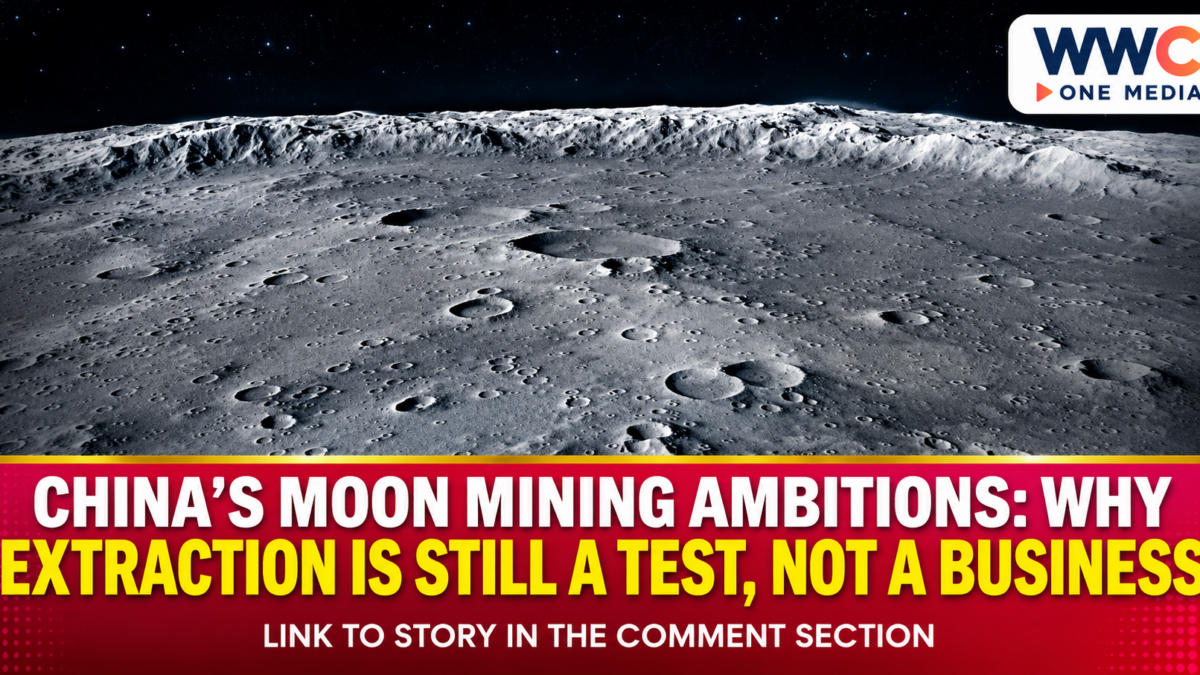
China’s lunar programme is moving beyond collecting photographs and samples towards testing whether materials found on the Moon could eventually support exploration operations. Its planned Chang’e-8 mission includes experiments in using lunar resources in place, an important step towards reducing dependence on supplies launched from Earth.
But the distinction between experimenting with lunar materials and operating an actual space mine remains significant. China’s official mission plans describe research, demonstrations and resource-utilisation tests—not an established commercial extraction industry on the Moon.
The long-term prize is potentially substantial: resources that could support spacecraft, astronauts and future lunar infrastructure. Yet the hardest question is not simply whether material exists. It is whether engineers can locate it, extract it, process it and use it reliably in an environment where every machine, spare part and energy source presents a logistical challenge.
Moon Mining Is Still at the Technology-Demonstration Stage
China’s lunar resource plans focus on testing technologies that could eventually make the Moon more useful as a destination for sustained exploration. The Chang’e-8 mission is designed to investigate the lunar environment and test resource-utilisation technology at the surface.
The mission’s published objectives include analysing lunar material in place, conducting resource-utilisation experiments and testing technologies that could support future lunar operations. Its planned equipment includes an in-situ resource-utilisation testing device.
That is an important technological milestone, but it is not equivalent to commercial mining. A small experiment that demonstrates a process under lunar conditions is different from a system that repeatedly excavates, separates, stores and transports materials at industrial scale.
China’s programme is therefore best understood as preparation for possible future resource use. The technology must prove itself before lunar extraction can be treated as an established industrial activity.
Why Lunar Water Could Be More Valuable Than Transporting Supplies
Water is one of the most discussed potential lunar resources because it could serve more than one purpose. If deposits can be located and processed, water could potentially support astronauts and be separated into hydrogen and oxygen for other applications.
However, scientists still need to understand where usable deposits exist, how much material can be recovered, what form it takes and how difficult it would be to extract under actual lunar conditions.
The lunar south pole is a major exploration target because some permanently shadowed areas may preserve water ice. China’s planned Chang’e-7 mission was designed to investigate the Moon’s south-polar environment and resources, including areas that may contain water ice.
China’s Chang’e-7 launch was subsequently delayed, and its official mission timeline has changed. The delay is relevant because resource prospecting comes before extraction: a mining system cannot operate effectively without knowing where deposits are, how concentrated they are and whether they can be accessed.
WWC previously examined China’s Chang’e-7 delay and the importance of the Moon’s permanently shadowed craters, a related part of the country’s broader resource-exploration effort.
Chang’e-8 Is Designed to Test What Future Lunar Infrastructure May Need
Chang’e-8 is planned as a robotic mission involving a lander, rover and an operational robot. The mission’s scientific objectives include geological investigation, experiments with lunar material and resource utilisation.
Its resource-testing equipment matters because future lunar infrastructure would need to rely on more than scientific observation. Systems would have to interact with the lunar surface, handle material and test processes in the actual environment.
China has also presented Chang’e-8 as part of a larger cooperative lunar research effort. The mission is intended to contribute to the development of the International Lunar Research Station concept, which combines scientific exploration, technology testing and longer-term infrastructure planning.
The planned International Lunar Research Station is not a fully operational lunar industrial base today. It is a future programme whose components would require development, testing and mission success before they could support sustained activity.
The Hard Part Is Processing Lunar Material
Mining on Earth already involves complex systems for excavation, transport, separation and processing. On the Moon, engineers face those same basic challenges while dealing with vacuum, extreme temperature swings, dust, limited power and the difficulty of repairing machinery remotely.
A resource may be present but still prove too difficult or costly to recover. Its concentration, location, physical properties and accessibility all matter.
For lunar resource utilisation to become practical, technology would need to demonstrate not only that it can extract material, but also that it can operate reliably and use less energy and logistical support than transporting equivalent supplies from Earth.
That is why resource experiments are valuable. They help determine whether a future operation could work, while allowing engineers to identify technical limitations before committing to larger systems.
The Moon’s resources are not automatically profitable simply because they are extraterrestrial. A viable operation would need equipment, power, transport, maintenance and a destination for the material it produces.
China Is Building a Lunar Infrastructure Strategy
China’s resource-utilisation experiments form part of a broader programme that looks beyond individual missions. The International Lunar Research Station concept includes scientific exploration, communications, navigation, energy and surface operations.
Those capabilities could become mutually dependent. Resource extraction would require reliable power, robotic systems and transport. A long-term surface facility could potentially provide the environment in which resource experiments progress from isolated demonstrations into more complex operations.
China has also indicated that its lunar exploration programme will involve international cooperation. Chang’e-8 was opened to international payload participation, allowing other partners to contribute scientific instruments and experiments.
The broader lunar competition is not limited to China. The United States and its partners are also pursuing lunar exploration and infrastructure through programmes such as Artemis. WWC’s coverage of SpaceX’s role in future Moon missions and the Starship programme provides additional context on how private companies are becoming part of the infrastructure needed for future lunar activity.
The competition is not only about reaching the Moon. It is also about developing technologies, operational capabilities and partnerships that could make repeated missions possible.
The Legal and Economic Questions Are Still Unresolved
Lunar resources raise questions about how countries and private organisations can conduct activities, coordinate operations and avoid conflict over areas of interest.
China’s written submission to the United Nations on space-resource activities identifies lunar soil, lunar rock and water ice as examples of resources under discussion. It also emphasises that resource activities must operate within existing international space law, including principles involving peaceful use, international cooperation and non-appropriation.
The legal debate matters because the future of lunar resource utilisation will not be determined by engineering alone. Governments and operators will also need rules and procedures addressing coordination, oversight, safety, sustainability and how resource activities affect other missions.
Economic viability is another major barrier. Before a lunar resource becomes commercially useful, someone must demonstrate that the cost of recovering and processing it is justified by its value to a mission or customer.
What Happens Next
The next major step is proving that resource-utilisation experiments can operate under lunar conditions. Chang’e-8’s planned testing will be important, but one demonstration will not establish a commercial mining system.
China’s lunar programme is gradually building the groundwork for future resource exploration and possible utilisation. The critical milestones will be whether future missions can identify useful deposits, extract material, process it and demonstrate repeatable operations.
For now, Moon mining remains a technological ambition rather than a functioning industry. The difference between finding a resource and turning it into something useful may ultimately determine how far lunar exploration can expand.
Frequently Asked Questions
Is China already mining the Moon?
No publicly verified industrial lunar mining operation has been established. China’s mission plans currently focus on exploration and resource-utilisation technology demonstrations.
What resources could be extracted from the Moon?
Potential resources include water ice, oxygen-bearing minerals, metals and lunar soil that may be useful for construction or other applications. Their practical recoverability remains a subject of research.
What is Chang’e-8 supposed to do?
Chang’e-8 is planned to conduct scientific exploration and experiments involving lunar materials and resource utilisation, helping test technologies for future lunar activity.
Why is lunar water important?
Water could potentially support astronauts and, if processed, produce hydrogen and oxygen for other uses. Recovering it locally could reduce the amount of supplies that future missions need to transport from Earth.
When will Moon mining become commercially viable?
There is no confirmed date. Commercial viability will depend on successful extraction and processing demonstrations, infrastructure, energy availability, transportation costs, demand and legal frameworks.










