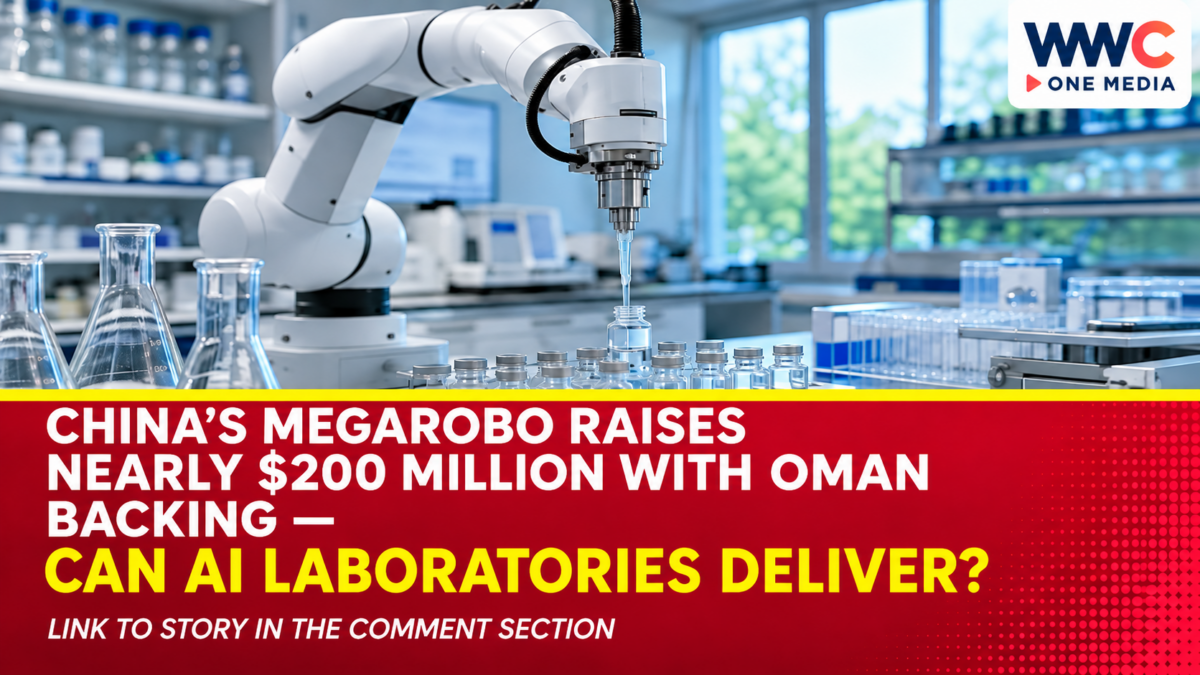
SUZHOU, China — Nov. 19, 2026. MegaRobo Technologies has announced nearly US$200 million in new financing, with Oman Investment Authority joining investors in the Chinese artificial intelligence and robotics company. The company said in its Nov. 18 announcement that the money will support its technology development, scientific laboratory automation and expansion in international markets.
The deal draws attention to a different part of the AI investment boom: systems designed not merely to predict scientific results, but to run physical experiments and collect real-world evidence. The financing is confirmed by MegaRobo’s own statement, but the announcement does not establish a new valuation, investor ownership percentages or returns from the capital raised.
MegaRobo AI Funding: What the Company Confirmed
MegaRobo identified Oman Investment Authority, the Sultanate of Oman’s sovereign investment fund, as a participant in the financing. Existing investors Asia Investment Capital, Granite Asia and Sinovation Ventures continued their support, while CMB International participated as a new investor.
The company described the amount as nearly US$200 million, not exactly US$200 million. It did not disclose the precise investment made by Oman, the price paid per share or how much each other institution contributed. Nor did the announcement identify an independently verified post-financing valuation.
MegaRobo said it has raised approximately US$600 million through multiple rounds. That cumulative financing figure is not revenue, profit or its present cash balance. Its earlier funding included a nearly US$300 million Series C round co-led by Goldman Sachs Alternatives, Asia Investment Capital and Granite Asia.
The Business Is More Than AI Drug Prediction
MegaRobo describes an integrated technology framework called One Intelligence Stack. It connects AI models and agents with scientific instruments, laboratory robotics, software workflows and experimental feedback.
The purpose is to connect a research decision to an actual laboratory procedure and then return measured results that can guide the next experiment. This differs from software that produces only a prediction about a molecule’s properties, without physically testing the prediction.
The company says its technology has reached more than 500 customers, including pharmaceutical groups, biotechnology businesses, research organisations and scientific institutions. Those are company-reported customer figures; they do not reveal how much each customer spends, how many systems are actively deployed or the company’s recurring revenue.
MegaRobo’s wider corporate website also presents applications in manufacturing as well as laboratories. Its strategy therefore extends beyond pharmaceutical research to the broader problem of helping software control and learn from physical equipment.
Why Automated Laboratories Matter for Research
The company’s Megalaxy Lab allows researchers and AI agents to arrange experiments, connect work to automated equipment and receive structured results. MegaRobo says the platform has served more than 200 customers.
It has also launched Poreva Open with collaborators including Tencent Cloud and Twist Bioscience. MegaRobo says Megalaxy Lab will support laboratory validation for more than 10,000 protein-design sequences submitted through the initiative.
Those are announced capabilities and planned tests, not completed proof that 10,000 designs are biologically effective or useful as medicines. Laboratory measurements must be interpreted and reproduced before a research programme can establish a meaningful result.
WWC previously explored this crucial difference in its analysis of Isomorphic Labs’ financing and research programme. AI models may help design promising candidates, but producing a clinically useful medicine requires many additional experiments, safety tests and regulatory decisions.
Why an Omani Sovereign Investor Matters
Oman’s participation brings a state-backed international investor into MegaRobo’s latest round. The Oman Investment Authority’s own Nov. 12 announcement separately described a broad package of Chinese partnerships covering technology, investment funds, industrial projects, logistics and infrastructure.
That earlier investment package included an agreement for a US$800 million joint fund with China’s Silk Road Fund and a separate US$300 million arrangement involving China Merchants Bank. These are distinct agreements and must not be added to MegaRobo’s company funding or treated as individual commitments to the company.
The new participation is consistent with a wider interest in technological investment, but MegaRobo’s statement does not identify a specific Omani laboratory, factory, research centre or contract that will result from this financing.
For context, WWC has examined the role of international capital in China’s biotechnology industry. The MegaRobo deal is different: it concerns enabling scientific experiments through hardware and software, rather than licensing an identified therapeutic product.
What Investors Still Need to Measure
A private financing can finance engineers, equipment, commercial expansion and research, but the capital raised does not establish customer profitability or the economic return on an automated laboratory.
What this could mean: MegaRobo could benefit if pharmaceutical companies and industrial researchers increasingly need laboratory systems capable of executing AI-generated experiments. Yet its economics will depend on installation costs, service requirements, customer retention, utilisation and the quality of experimental data produced.
There is also an important distinction between a technology supplier and a medicine developer. MegaRobo’s statement describes tools supporting stages of drug research, not a newly approved treatment attributable to its platform.
That distinction also underpins WWC’s earlier examination of AI drug design and the human-trials challenge. Faster laboratory work could improve research efficiency, but claims about patient benefit must ultimately rest on appropriate clinical evidence.
What Happens Next
MegaRobo says the financing will support further investment in core technologies and international business across China, Europe, North America, the Middle East and Southeast Asia. Future announcements could clarify which markets receive new facilities, partnerships or deployed systems.
For an evidence-based assessment, useful milestones would include audited financial information, customer renewals, working laboratory deployments and independently interpretable research results. Disclosures about round valuation and specific investor stakes would also improve understanding of the transaction.
The verified development is substantial new private financing for AI-enabled scientific infrastructure. Whether it delivers durable commercial results remains a question for the company’s future operating performance, rather than something the funding announcement alone can answer.
Frequently Asked Questions
How much did MegaRobo raise in its latest financing round?
MegaRobo announced that it raised nearly US$200 million in a new round. The exact completed amount was not stated in its release.
Did Oman’s sovereign wealth fund invest in MegaRobo?
Yes. MegaRobo identified Oman Investment Authority as a participant, but did not disclose the amount it invested or its resulting ownership stake.
What does MegaRobo’s AI technology do?
Its technology links AI models, robotics, laboratory instruments and data so scientific experiments can be planned, executed and evaluated through integrated workflows.
Has MegaRobo’s technology produced an approved new medicine?
The company announcement reviewed does not establish a newly approved medicine developed through its platform. Laboratory automation and drug approval are separate stages of scientific and medical development.