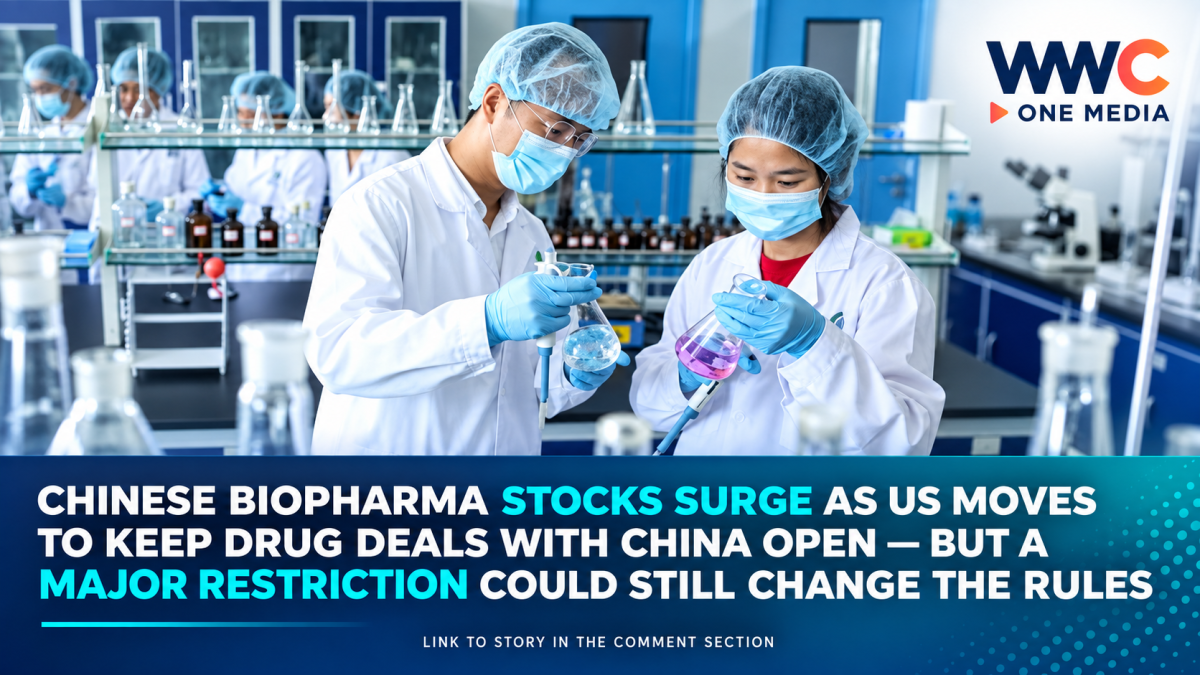
HONG KONG — Chinese biotechnology and pharmaceutical stocks rallied on Monday, September 21, as reports that Washington may allow American drugmakers to continue licensing most medicines developed in China sparked renewed investor interest in the sector.
The rally followed a September 18 Reuters report that the US Treasury Department was drafting investment rules expected to preserve most pharmaceutical licensing agreements between American companies and Chinese drug developers, while maintaining restrictions on sensitive biotechnology linked to potential national security threats.
The development comes as China’s biotechnology industry attracts billions of dollars in international partnerships, particularly in cancer treatments and other innovative medicines.
Unlike semiconductors and artificial intelligence, where US-China technology competition has prompted extensive restrictions, pharmaceutical research could retain significant opportunities for cross-border cooperation under the proposed framework.
However, the rules have not been finalized. Their scope could change before implementation, leaving pharmaceutical companies and investors facing uncertainty over which transactions Washington will ultimately permit.
Chinese biotech shares climb as Hong Kong investors respond
The prospect of continued access to the American pharmaceutical market lifted several major Chinese healthcare stocks during Monday’s trading session.
CNBC reported the following share-price movements:
| Company or index | Reported movement |
|---|---|
| Akeso | Up 8% |
| Sino Biopharmaceutical | Up 8% |
| Innovent Biologics | Up 6% |
| CSPC Pharmaceutical Group | Up more than 6% |
| HUTCHMED | Up 3% |
| Hang Seng Biotech Index | Up more than 5% |
The figures reflect the market movements reported on September 21, rather than verified final closing prices.
The gains highlighted the importance investors attach to Chinese drug developers’ ability to secure international licensing agreements.
Such partnerships can provide research funding and access to overseas markets while allowing multinational pharmaceutical companies to expand their development pipelines without building every new medicine from the earliest research stage.
For Chinese companies, continued access to American partners could preserve an important source of financing. For US pharmaceutical groups, it could maintain access to experimental medicines being developed by China’s rapidly expanding biotechnology sector.
However, the proposed policy framework remains under consideration, and Monday’s market gains do not guarantee that the companies involved will secure additional agreements or generate higher earnings.
Washington considers a narrower approach to pharmaceutical restrictions
According to Reuters, the US Treasury Department is preparing regulations governing American investment in Chinese biotechnology as part of broader national security legislation.
The proposed framework would reportedly permit most conventional drug-licensing transactions while restricting investments involving pathogens or biotechnology considered capable of being weaponized.
Three people briefed on the regulatory process told Reuters that the rules remained unfinished and could change before being formally announced.
The distinction is important because licensing a cancer treatment is not necessarily equivalent to investing in research involving sensitive biological technologies.
A pharmaceutical licensing agreement typically gives one company permission to develop, manufacture or commercialize a medicine created by another company. In exchange, the original developer may receive an initial payment, additional payments tied to development milestones and royalties from future sales.
Such arrangements allow companies to share development costs and commercial risks, although they do not eliminate the possibility that a medicine will fail during clinical trials or fail to receive regulatory approval.
The reported US approach would preserve many of these arrangements while allowing restrictions to focus on defined areas of national security concern.
Nevertheless, the precise boundaries of permitted and restricted biotechnology transactions will depend on the final regulatory language.
China’s drug-licensing deals reach $110 billion in just six months
The latest market rally comes against the backdrop of rapid growth in China’s international pharmaceutical partnerships.
According to a July 13 Reuters report citing China’s National Medical Products Administration, Chinese companies signed 81 overseas licensing agreements for innovative medicines during the first half of 2026.
The combined potential value of those deals reached approximately $110 billion, setting a record for a six-month period and representing around 80% of the reported total for the whole of 2025
The agreements covered several therapeutic areas, including cancer, metabolic disorders, immunology and neurological diseases.
American, British, French and Italian pharmaceutical companies were among the international partners involved.
CHINA’S INTERNATIONAL DRUG-LICENSING BOOM
$110 billion
Combined potential agreement value, January–June 2026
81
Overseas licensing agreements
80%
Of the reported full-year 2025 deal value
Source: Reuters, July 13, 2026, citing China’s National Medical Products Administration.
The $110-billion figure represents the potential value of the agreements, not cash already received by Chinese pharmaceutical companies.
Many licensing arrangements include payments that become due only if a medicine passes clinical trials, receives regulatory approval or meets commercial targets.
This distinction matters because the announced value of a pharmaceutical agreement can be substantially higher than the money initially paid to the developer.
An additional September 18 report by Shanghai-based City News Service highlighted the gap between headline licensing values and upfront payments, reporting that disclosed initial payments accounted for only a small portion of China’s total potential deal value during the first half of 2026.
The growth in announced agreements therefore indicates stronger international commercial interest, but it does not mean that all the promised revenue will ultimately be realized.
Pfizer’s $10.5-billion agreement shows what is at stake
One of the clearest examples of the expanding relationship between American and Chinese drugmakers is Pfizer’s partnership with Innovent Biologics.
On May 28, 2026, the companies announced a global research and licensing agreement covering 12 early-stage cancer treatment programs.
The collaboration involves eight programs originating from Innovent and four discovery programs proposed by Pfizer.
Under the agreement, Pfizer committed to an initial payment of $650 million, with Innovent eligible for up to $9.85 billion in additional payments tied to development, regulatory and commercial milestones.
That brings the agreement’s maximum potential value to $10.5 billion.
The partnership includes research involving antibody-drug conjugates, which are designed to deliver cancer-fighting medicines to specific cellular targets, and multispecific antibodies, which are engineered to interact with more than one biological target.
The companies agreed to share responsibilities for research, clinical development and commercialization across the 12 programs.
However, the medicines covered by the agreement remain subject to research, clinical testing and regulatory requirements. The partnership does not establish that all 12 programs will produce approved treatments.
Bristol Myers Squibb signs another multibillion-dollar deal
Pfizer is not the only major American pharmaceutical company expanding its research partnerships with Chinese firms.
On May 12, Bristol Myers Squibb and Jiangsu Hengrui Pharmaceuticals announced agreements covering 13 early-stage drug development programs in oncology, hematology and immunology.
The collaboration carries a maximum potential value of approximately $15.2 billion, including a $600-million upfront payment and additional conditional payments.
The agreements also provide for potential royalties from commercialized products.
The partnerships demonstrate how Chinese pharmaceutical research has become a significant source of potential medicines for international companies.
They also illustrate why restrictions on cross-border drug licensing could affect both Chinese developers and American pharmaceutical businesses.
Why US pharmaceutical companies and lawmakers disagree over the restrictions
The proposed regulatory framework has generated differing views among American pharmaceutical businesses, smaller biotechnology companies and members of Congress.
According to Reuters, major drugmakers, including Pfizer, have urged the US government to avoid broad investment restrictions that could prevent them from accessing Chinese-developed medicines.
Pfizer CEO Albert Bourla has argued that ordinary pharmaceutical licensing should not automatically be treated as a national security threat. He maintains that international drug-development partnerships can support the discovery of new medicines.
Other industry representatives have raised concerns about the longer-term implications of American companies increasingly relying on overseas biotechnology research.
Jason Kelly, CEO of Ginkgo Bioworks, has argued that continued investment in Chinese biotechnology could contribute to a growing dependence on foreign drug innovation.
Republican Representative John Moolenaar and Democratic Representative Debbie Dingell have also supported stronger scrutiny of biotechnology transactions involving China.
They have backed legislative proposals seeking tighter oversight of investments, licensing agreements and joint ventures involving Chinese biotechnology companies.
Meanwhile, Democratic Representative Jake Auchincloss has questioned whether restricting US investment would meaningfully slow China’s pharmaceutical industry.
The differing positions reflect an ongoing debate over how Washington should balance national security considerations, domestic pharmaceutical research and international collaboration.
The eventual regulations will determine which activities remain permitted and which become subject to additional restrictions.
What the rally means for Asian markets
The rise in Chinese pharmaceutical shares coincided with broader gains across several Asian equity markets on September 21.
Reuters reported that investors were also responding to developments in artificial intelligence, semiconductor demand and ongoing US-China economic discussions.
For Hong Kong’s biotechnology sector, the proposed licensing framework is particularly relevant because many publicly traded Chinese drug developers rely on overseas partnerships to finance research and expand their international operations.
The implications extend beyond the pharmaceutical companies themselves.
Contract research organizations, laboratory service providers, drug manufacturers and other businesses connected to pharmaceutical development could also be affected by changes in cross-border investment and licensing activity.
However, the extent of any commercial impact will depend on the final regulations, individual companies’ agreements and the progress of the medicines involved.
What happens next for Chinese biotechnology?
The next significant development will be the publication of the US Treasury Department’s proposed rules and the clarification of which biotechnology-related investments will be covered.
Reuters reported on September 18 that the regulations were unlikely to be unveiled before the scheduled meeting between US President Donald Trump and Chinese President Xi Jinping later in September.
Investors will also be watching for new licensing agreements, clinical trial results and regulatory decisions involving Chinese-developed medicines.
These developments could influence the value of existing pharmaceutical partnerships, the timing of future payments and companies’ longer-term revenue prospects.
For now, the September 21 rally demonstrates how sensitive Chinese biotechnology stocks are to developments in US investment policy.
China’s pharmaceutical companies have secured substantial international licensing agreements, while American drugmakers continue to pursue access to new medicines developed overseas.
But until Washington finalizes its rules, the future scope of US-China pharmaceutical cooperation remains uncertain.
The question is no longer simply how many billions of dollars Chinese biotechnology companies can attract. It is how much of that international business can continue under the final US regulatory framework.