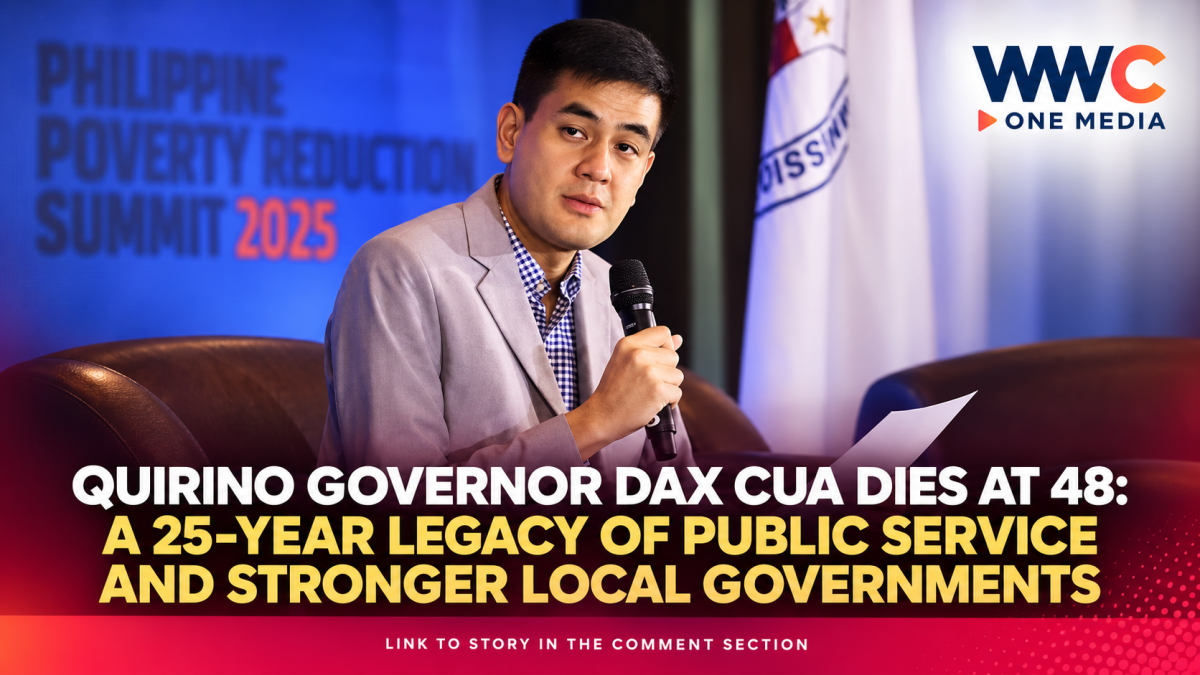
MANILA, Philippines — Quirino Governor Dakila Carlo “Dax” Cua, who spent 25 years in public service and became a prominent advocate for strengthening local governments, has died at the age of 48, leaving behind a legacy that extends from his home province to the national government and the wider Asia-Pacific region.
Cua died on September 15, 2026. His passing was confirmed by the House of Representatives and several organizations with which he worked, including the United Cities and Local Governments Asia-Pacific (UCLG ASPAC).
His death brought renewed attention to a central cause of his political career: giving provinces, cities, municipalities and barangays greater resources and authority to address the needs of their communities.
On September 21, the House of Representatives held a necrological service in his honor, recognizing his years as Quirino’s governor, a former congressman and a leader of local government organizations.
From a 23-year-old vice governor to a national LGU advocate
Cua’s political career began in 2001, when he was elected vice governor of Quirino at just 23 years old. He became governor in 2007 before serving as representative of the province’s lone congressional district from 2010 to 2019.
After nearly a decade in Congress, he returned to the provincial capitol in 2019, where he continued serving as governor until his death.
His responsibilities eventually extended beyond Quirino. He became national president of the Union of Local Authorities of the Philippines (ULAP), chairperson of the League of Provinces of the Philippines and president of UCLG ASPAC.
In September 2025, Cua was reelected to lead UCLG ASPAC for a second consecutive term covering 2025 to 2027. He was the first Filipino to hold the organization’s presidency, representing local government interests across the Asia-Pacific region.
These leadership positions provided him with platforms to advocate for greater local government participation in national development, including public infrastructure, disaster resilience, healthcare and economic programs.
The ₱44-billion proposal that put LGU funding in the spotlight
One of Cua’s major initiatives involved a push to expand financial assistance for local governments.
In December 2025, Cua joined San Juan City Mayor Francis Zamora and representatives of several local government leagues in appealing to the Senate for an additional ₱44 billion for the Local Government Support Fund (LGSF).
Their proposal came as local officials sought to address infrastructure needs and maintain essential public services amid disruptions in national public works construction.
Cua argued that local governments could implement smaller infrastructure projects if provided with adequate financial and technical support.
The leagues wanted additional resources for farm-to-market roads, water systems, healthcare facilities, classroom rehabilitation and disaster recovery.
Their recommendations also included expanding eligible projects to cover education infrastructure, digitalization and livelihood programs, while providing additional assistance to poorer and disaster-prone communities.
The proposal reflected Cua’s position that local governments should have the resources necessary to carry out responsibilities transferred to them under the country’s decentralization framework.
There was a subsequent development in the funding debate.
Senate records from December 2, 2025, documented a proposed ₱25.09-billion increase in the LGSF, including allocations for financial assistance, barangay development and support for underserved municipalities and communities.
However, the ₱25.09-billion proposal should not be confused with the leagues’ original ₱44-billion request. The Senate proposal did not establish that the entire amount sought by Cua and his colleagues had been approved or released.
By July 2026, LGUs were reporting greater access to national funding
In a July 20 report by the Philippine News Agency, Zamora said the country’s 149 cities were receiving allocations under the LGSF based on their populations, with funding provided directly by Malacañang.
According to Zamora, half of the allocations went toward purchasing rice for free distribution to residents, while the remaining half was designated for priority infrastructure projects.
He also reported that approximately 92% of member cities had completed their free-rice distribution programs, based on the League of Cities’ monitoring.
The funding arrangements were consistent with Cua’s broader advocacy for stronger local governments, although the available reporting does not establish that his December proposal alone caused the subsequent funding measures.
For local communities, the significance of the issue is practical: how quickly government resources can reach communities needing roads, schools, health facilities and disaster assistance.
His congressional record included tax reform and public internet access
Beyond his work in provincial government, Cua participated in national legislation as a member of the House of Representatives during the 15th, 16th and 17th Congresses.
As chairperson of the House Committee on Ways and Means during the 17th Congress, he played a role in the passage of the Tax Reform for Acceleration and Inclusion (TRAIN) Law, which was signed in December 2017.
TRAIN changed the country’s income tax structure while introducing or increasing certain consumption taxes.
House Resolution No. 1459, adopted in Cua’s honor, also cited his principal authorship of Republic Act No. 10929, the Free Internet Access in Public Places Act.
The resolution recognized his co-authorship of other legislation, including the Philippine Competition Act, the Iskolar ng Bayan Act and the Ladderized Education Act.
His legislative record covered fiscal policy, education, connectivity and economic regulation, alongside his later work representing local government interests.
Beyond politics: His work with the Philippine Red Cross
Cua also participated in humanitarian work through the Philippine Red Cross.
According to InsiderPH, he served on the organization’s Board of Governors for 16 years, beginning in 2008, supporting its humanitarian activities and capacity-building efforts.
The Philippine Red Cross’s official board roster, dated June 2025, also lists Cua among its members.
In a tribute following his death, Philippine Red Cross chairman and CEO Richard Gordon recalled Cua’s contributions to the organization and the communities it serves.
His humanitarian involvement added another dimension to a public-service career that included provincial governance, national legislation and regional cooperation.
House pays tribute as colleagues remember Cua’s years of service
During the September 21 necrological service, House Speaker Faustino “Bojie” Dy III recalled Cua’s advocacy for the people of Quirino.
According to the Philippine News Agency, Dy pledged to continue the projects and causes Cua had championed, while recognizing his work on behalf of local governments.
The House also adopted Resolution No. 1459, expressing its condolences to Cua’s family and recognizing his contributions to provincial and national public service.
Cua is survived by his wife, Quirino Representative Midy Nacague Cua, and their three children. His parents, former Quirino Representative Junie Cua and Angela Cua, also survive him.
As of the published reports reviewed for this article, his family had not publicly confirmed his cause of death.
What happens to Cua’s advocacy for empowered LGUs?
Cua’s death comes as local governments continue to seek greater financial resources and administrative authority to carry out infrastructure and public-service programs.
His work with ULAP, the League of Provinces and UCLG ASPAC brought together local officials around issues ranging from government funding to disaster preparedness and regional cooperation.
As the organizations he helped lead continue their work, questions remain about how his proposals for strengthening local governments will be advanced and how the funding arrangements established during his tenure will develop.
For the province of Quirino, his passing marks the end of a public-service career that began in 2001 and continued through his final term as governor.
For the wider local government sector, his legislative record, organizational leadership and proposals for greater local autonomy will remain part of the country’s continuing debate over how national resources and responsibilities should be distributed.