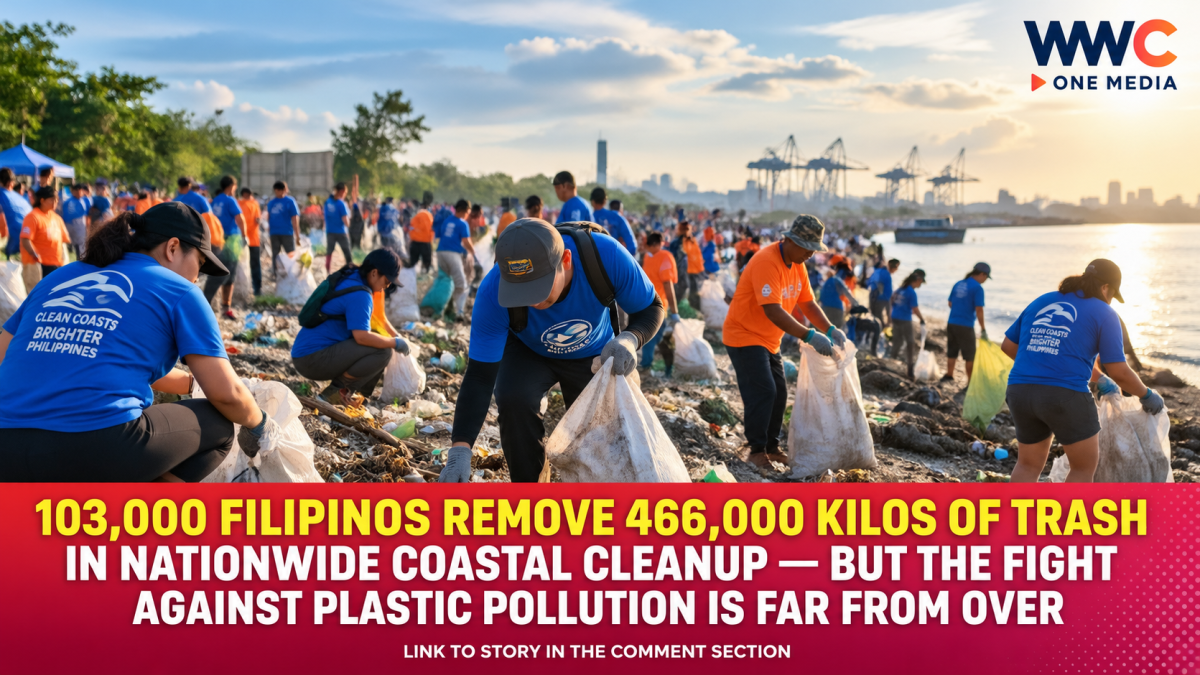
MANILA, Philippines — More than 103,000 volunteers mobilized across the Philippines for a massive coastal cleanup, collecting over 466,000 kilograms of waste from hundreds of locations in a nationwide effort to protect the country’s seas, rivers and marine ecosystems.
The Department of Environment and Natural Resources (DENR) reported that the September 19 International Coastal Cleanup (ICC) covered 369 coastal, river, waterway and underwater sites across all 17 administrative regions.
Government agencies, local government units, schools, private companies, civic organizations and community volunteers joined forces to remove discarded materials from shorelines and waterways.
The initiative brought together Filipinos from different sectors in one of the country’s largest coordinated environmental volunteer activities of the year.
But beyond the enormous volume of garbage collected, the event raised a bigger environmental question: How can the Philippines prevent waste from reaching its waters in the first place?
2026 INTERNATIONAL COASTAL CLEANUP | PHILIPPINES
103,000+
Volunteers nationwide
466,000+
Kilograms of waste recovered
369
Cleanup locations
17
Participating regions
Reported nationwide totals from the DENR, as published by InsiderPH and Daily Tribune on September 20–21, 2026.
Metro Manila Mobilizes More Than 36,000 Volunteers
Metro Manila emerged as a major center of the nationwide campaign, with more than 36,000 participants joining cleanup operations at 11 designated sites.
These locations included Baseco Beach, Manila Bay Dolomite Beach, Manila Ocean Park, the Pasig and Marikina rivers, Las Piñas-Parañaque Wetland Park and Tanza Marine Tree Park.
Volunteers recovered a wide range of discarded materials, including food wrappers, disposable cups and plates, polystyrene food containers, plastic straws and stirrers.
The DENR said the collected garbage was weighed, sorted and documented according to waste type. The resulting data can help authorities identify marine litter patterns and determine where targeted waste-management programs are needed.
The operation was not limited to improving the appearance of beaches. It also aimed to document the materials accumulating along the country’s coastal areas and inland waterways.
6,000 Volunteers Gather at Baseco Beach
One of the largest individual cleanup operations took place at Baseco Beach in Tondo, Manila, where approximately 6,000 volunteers gathered to remove garbage and debris along the shoreline.
According to The Philippine Star, the DENR designated Baseco Beach as its flagship cleanup location for this year’s International Coastal Cleanup.
Manila Mayor Isko Moreno also expressed support for the activity, highlighting the importance of proper waste management and reducing the use of disposable plastics.
He warned that garbage entering the sea affects not only the natural environment but also public health, livelihoods and the future of children.
A separate GMA News report highlighted the need for sustained coastal protection at Baseco.
DENR-National Capital Region official Jo Riego acknowledged that the area had undergone significant improvements but said continued efforts were necessary to prevent waste from accumulating again.
The cleanup served as a reminder that restoring a coastline is only part of the challenge. Keeping it clean requires consistent waste management and community participation long after the volunteers leave.
More Than 4,000 Join Coastal Cleanup in Laoag
The nationwide movement also reached Ilocos Norte, where more than 4,000 volunteers from approximately 300 public and private organizations participated in cleanup activities at Gabu Sur in Laoag City.
The Philippine News Agency reported that the September 19 event brought together schools, local government units, businesses and community organizations to address marine litter.
Joegie Jimenez, senior environment program officer of the Ilocos Norte Environment and Natural Resources Office, emphasized that coastal cleanup activities should encourage people to develop responsible waste-management habits rather than simply focus on how much garbage they collect.
Local organizers also encouraged households to segregate their waste at the source, underscoring the importance of preventing pollution before it reaches waterways.
DENR Says Responsibility Is Key to Cleaner Oceans
Environment Secretary Juan Miguel “Mitch” Cuna stressed that protecting the country’s marine environment requires more than conducting large cleanup events.
Speaking during the nationwide activity, Cuna emphasized personal and collective responsibility as the foundation of effective waste management.
The DENR is encouraging households and communities to refuse unnecessary disposable items, segregate their garbage properly, reuse materials whenever possible and ensure that remaining waste is disposed of responsibly.
The agency also called for stronger systems covering waste collection, recycling, resource recovery, treatment and environmentally sound disposal.
The broader message was clear: removing garbage from beaches provides immediate environmental benefits, but preventing additional waste from entering the ocean is essential to achieving lasting improvements.
Why the 466,000-Kilogram Waste Collection Matters
The amount of garbage recovered during the nationwide cleanup illustrates the substantial volume of discarded material accumulating in Philippine coastal and inland waterway environments.
The reported collection of more than 466,000 kilograms is equivalent to more than 466 metric tonnes of waste.
However, the total includes materials collected from coastal, river, waterway and underwater locations. It should not be interpreted as 466 tonnes of plastic alone or as a measurement of all marine pollution nationwide.
The DENR’s waste documentation can help distinguish the types of debris being recovered and identify locations where litter-prevention measures are needed.
The findings also support a broader environmental priority: reducing the amount of waste generated and improving its collection before it escapes into drainage systems, rivers and coastal waters.
Philippines Targets 60% Plastic Packaging Recovery by End of 2026
The coastal cleanup comes as the Philippines continues implementing Republic Act No. 11898, also known as the Extended Producer Responsibility (EPR) Act of 2022.
The law requires covered large enterprises to establish programs for recovering or offsetting plastic packaging waste associated with their products.
Under the law’s phased requirements, covered enterprises must meet a plastic packaging recovery target of 60% by December 31, 2026, based on their plastic packaging footprint from the preceding year.
The target will increase to 70% in 2027 and 80% in 2028 and subsequent years.
The Environmental Management Bureau also requires independent third-party audits to validate reported recovery and diversion accomplishments.
The participation of companies covered by the EPR law in this year’s cleanup highlights the role of businesses alongside government agencies and individual consumers in addressing plastic pollution.
However, cleanup participation alone does not demonstrate that a company has fulfilled its statutory recovery obligations.
Nearly Matching the 2025 Cleanup Effort
This year’s cleanup followed another large-scale nationwide campaign in 2025, when more than 104,000 volunteers participated and over 466,000 kilograms of solid waste were recovered.
The 2026 turnout of more than 103,000 volunteers and collection of more than 466,000 kilograms of waste were therefore close to the previous year’s reported results.
The figures demonstrate continued public participation in the International Coastal Cleanup, although they do not, on their own, establish whether marine pollution across the Philippines has increased or decreased.
The DENR maintains that a more meaningful long-term measure of progress is how much garbage can be prevented from entering waterways in the first place.
The Bigger Challenge: Keeping Philippine Waters Clean
The September 19 cleanup demonstrated how volunteers, communities, government agencies and private organizations can work together to address visible environmental problems.
But removing hundreds of thousands of kilograms of garbage in a single day is only one part of protecting the country’s marine ecosystems.
Sustained progress requires reliable garbage collection, effective waste segregation, responsible production and consumption, and consistent implementation of existing environmental laws.
For coastal communities, cleaner shorelines also mean reducing the environmental pressures that threaten local livelihoods and the natural resources on which many families depend.
The Philippines has removed more than 466,000 kilograms of garbage in one coordinated nationwide cleanup. The longer-term challenge is ensuring that similar volumes of waste do not continue accumulating along its beaches and waterways.