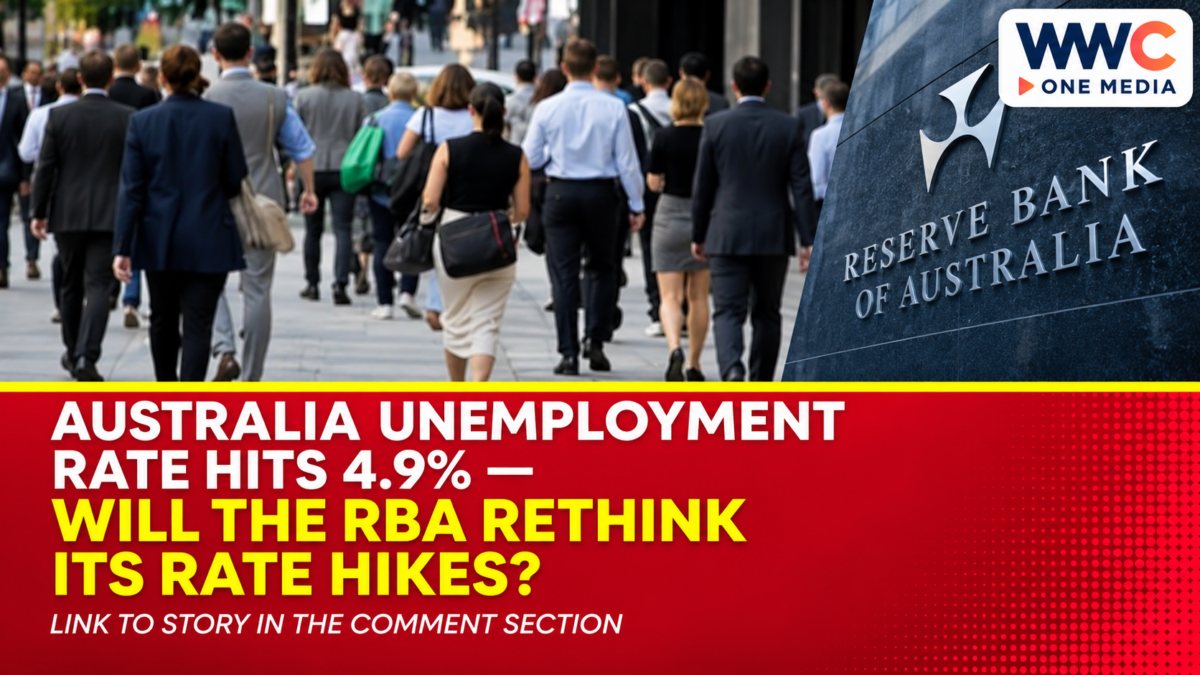
SYDNEY, Australia — Australia’s unemployment rate climbed to 4.9% in October 2026, its highest level in five years, as employment declined by 43,500 people and the labour market showed further signs of weakness. Figures released by the Australian Bureau of Statistics (ABS) on Nov. 19 have intensified the policy dilemma facing the Reserve Bank of Australia (RBA), which raised its benchmark interest rate to 4.85% earlier this month.
The latest figures put the central bank’s inflation-fighting strategy under closer scrutiny. Policymakers must determine whether further increases in borrowing costs remain necessary when employment is weakening but consumer prices are still rising too quickly.
Australia Unemployment Rate Reaches Five-Year High
Australia’s seasonally adjusted unemployment rate reached 4.9% in October, the highest reading since October 2021.
The number of unemployed Australians increased by 17,800 to 753,700, while total employment dropped to approximately 14.74 million.
Part-time employment accounted for most of the monthly decline, falling by 40,600 positions. Full-time employment decreased by a smaller 2,900.
The employment-to-population ratio slipped to 63.3%, while labour-force participation declined to 66.6%.
Total monthly hours worked also fell by 0.2%, suggesting that the deterioration extended beyond the headline unemployment rate.
However, the underlying picture was less severe than the seasonally adjusted employment decline alone suggests. Trend employment remained broadly unchanged, while the trend unemployment rate increased to 4.8%.
The distinction matters because monthly labour-force surveys can experience sampling fluctuations. A single weak reading does not necessarily establish the speed or duration of an economic downturn.
Young Workers Face Growing Employment Pressure
The latest labour-market figures point to particular difficulty among younger Australians.
Unemployment among people aged 15 to 24 increased to 11.3%, its highest level since October 2021.
The youth unemployment rate has averaged 9.2% during the post-pandemic period beginning in May 2022, making October’s reading notably elevated.
Young workers are often more exposed to changes in recruitment and entry-level opportunities. As an economic interpretation, weaker hiring could make it harder for recent graduates and first-time jobseekers to enter the workforce.
The broader underemployment rate, however, declined slightly to 6.2%.
This means the rise in unemployment was not accompanied by an increase in the measured share of employed Australians seeking and available for additional working hours.
For policymakers, the contrast reinforces the need to examine unemployment, participation, hours worked and underemployment together rather than relying on one headline figure.
RBA Rate Hikes Face a New Employment Test
The Reserve Bank increased its cash rate target by 25 basis points to 4.85% at its Nov. 3 meeting, with the new target taking effect on Nov. 4.
The decision was not unanimous. Six Monetary Policy Board members supported the increase, while three preferred to retain the previous 4.60% rate.
The disagreement reflected competing concerns about persistent inflation and the possibility that tighter financial conditions could weaken economic activity more than necessary.
WWC ONE MEDIA previously examined the divided RBA rate-hike decision and its implications for Australian borrowers.
The October employment survey was conducted before the November decision. Consequently, the newly released labour-market figures cannot establish that the latest rate increase caused October’s job losses.
Nevertheless, previous interest-rate increases can influence household spending, mortgage repayments and business financing with a delay.
What this could mean: The latest unemployment reading strengthens the case for assessing how much existing monetary restraint is already affecting economic activity before deciding whether another increase is justified.
It does not establish that the RBA has decided to pause, reverse course or reduce rates.
Inflation Remains the Central Bank’s Biggest Obstacle
Despite the weakening labour market, inflation remains above the RBA’s target range.
Australia’s annual consumer price inflation reached 4.3% in September, up from 4.0% in August. Trimmed mean inflation, which helps identify underlying price pressures, stood at 3.6%.
Meanwhile, the Wage Price Index increased by 1.1% during the September quarter and 3.5% over the year.
Those figures complicate the case for an immediate easing of monetary policy.
Faster wage growth can support household purchasing power, but it may also contribute to business costs when productivity does not increase sufficiently.
WWC ONE MEDIA’s examination of Australia’s accelerating wage growth explores this difficult balance between income gains and inflation control.
The RBA’s November monetary-policy outlook indicated that inflation could remain elevated for longer, with the midpoint of its 2%–3% target range not expected to be reached until mid-2028.
Analysis: The central bank faces two risks. Tightening too little could prolong above-target inflation, while tightening too aggressively could deepen employment losses and weaken domestic demand.
Neither outcome is inevitable. Future inflation and labour-market data will be critical in determining which risk becomes more pressing.
Why Australia’s Jobs Slowdown Matters Beyond Employment
Employment conditions influence more than household incomes.
When fewer people are employed, consumer spending may weaken, businesses may reconsider expansion plans, and demand for credit can soften.
Higher interest rates add another potential constraint by increasing financing costs for borrowers whose repayments respond to changes in lending rates.
WWC has also examined weakness in Australia’s housing-auction market, another area sensitive to household confidence and borrowing conditions.
For Philippine businesses and investors, Australia’s labour-market developments also matter because monetary-policy expectations can influence international capital flows and currency valuations.
WWC’s coverage of the Australian dollar amid restrictive RBA interest rates provides additional context for the currency side of this discussion.
However, Australia’s unemployment reading alone does not determine the direction of the Australian dollar, the Philippine peso or regional financial markets.
Currency movements depend on numerous factors, including relative interest rates, economic expectations and global risk sentiment.
What Happens Next
The RBA’s next monetary-policy meeting is scheduled for Dec. 7–8, 2026, with its next interest-rate decision expected on Dec. 8.
Before that decision, the October consumer price inflation release scheduled for Nov. 25 will provide another measure of price pressures.
The ABS will publish its November labour-force figures on Dec. 17, after the next scheduled policy meeting.
This timetable means the December decision will need to consider October’s employment deterioration alongside more recent inflation indicators and other available economic information.
The central question is whether inflation remains sufficiently persistent to justify another rate increase despite a weakening employment market.
The October labour-market report adds weight to concerns about economic slowing, but the official records do not support a prediction that the RBA will necessarily stop tightening.
For Australian workers, borrowers and businesses, the next decision will help clarify how the central bank balances price stability against the emerging employment risks.
Frequently Asked Questions
What is Australia’s unemployment rate in October 2026?
Australia’s seasonally adjusted unemployment rate was 4.9% in October 2026, the highest since October 2021. The number of unemployed people reached approximately 753,700.
Why is unemployment rising in Australia?
October’s official figures show falling employment, particularly in part-time positions. Higher interest rates and slower spending may contribute to weaker labour demand, but the figures do not establish a single cause for the increase.
Will the RBA cut interest rates because unemployment has risen?
A rate cut has not been announced. The RBA’s cash rate target remains 4.85%, and policymakers must also consider inflation, which remains above the central bank’s target.
When is the next RBA interest-rate decision?
The next decision is scheduled for Dec. 8, 2026, following the Monetary Policy Board’s Dec. 7–8 meeting.
Is Australia heading into a recession?
The latest employment figures suggest weaker labour-market conditions but do not establish that Australia is in recession. A broader assessment requires economic activity, output, spending and employment data over time.