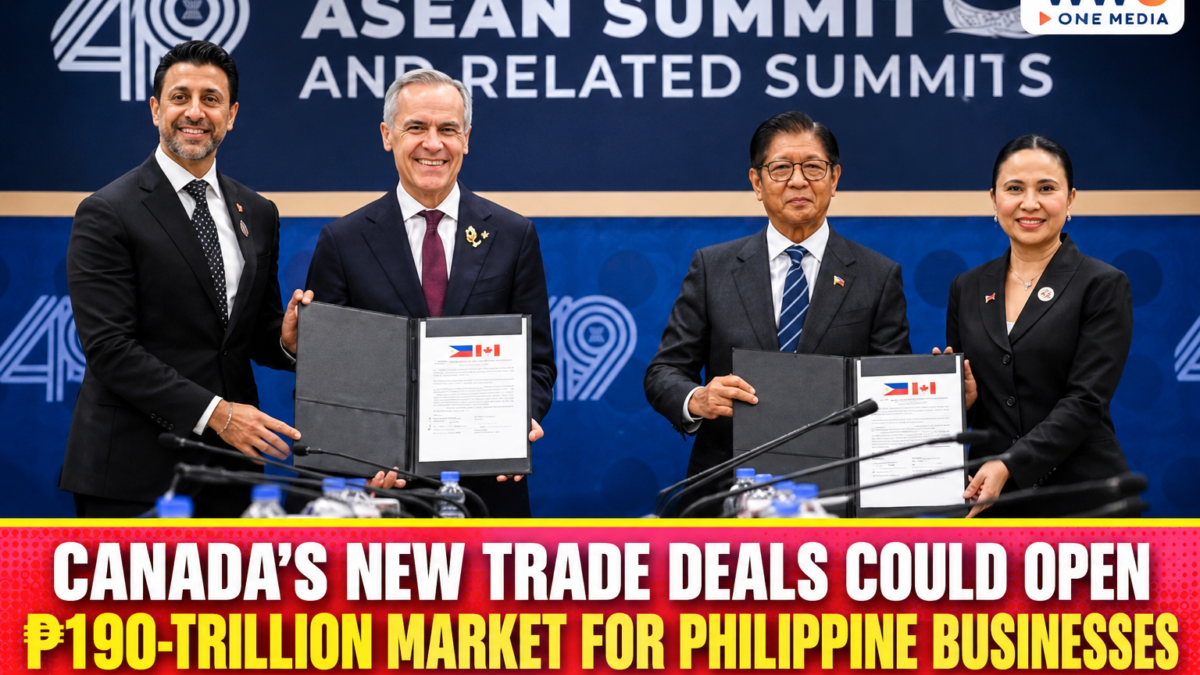
Canada has concluded negotiations on two major free trade agreements involving the Philippines and the Association of Southeast Asian Nations (ASEAN), marking a significant development in the country’s efforts to expand international trade and attract foreign investment.
The announcements were made on November 14, 2026, during Canadian Prime Minister Mark Carney’s visit to Manila, where he met President Ferdinand Marcos Jr. and participated in the 49th ASEAN Summit.
The agreements could reshape commercial opportunities between Canada and Southeast Asia, particularly for Philippine exporters seeking greater access to international markets. However, the next challenge will be turning the negotiated agreements into enforceable trade arrangements that businesses can actually use.
Canada-Philippines Trade Agreement Reaches a Major Milestone
The most immediate development for the Philippines is the conclusion of negotiations for a bilateral free trade agreement with Canada.
The announcement follows the establishment of the Canada-Philippines Strategic Partnership in July 2026, when Carney and Marcos committed to pursuing a trade agreement by the end of the year.
The November announcement means the negotiating stage has been completed. Both governments are now working towards signing the agreement in 2027.
This distinction matters: concluding negotiations does not automatically mean that the agreement is already in force. The remaining legal and domestic procedures must be completed before businesses can claim benefits under its provisions.
Canada identified agriculture, forest products, mining, energy services, aerospace and artificial intelligence as areas where commercial opportunities could expand.
For Philippine companies, improved access to Canadian markets could create opportunities to strengthen exports, attract investment and develop commercial relationships with Canadian businesses.
The potential benefits will depend on the final agreement’s tariff schedules, rules of origin, market-access commitments and implementation requirements.
The Bigger Development: Canada Is Expanding Its ASEAN Trade Network
Beyond the bilateral agreement, Canada has also substantially concluded negotiations for the ASEAN-Canada Free Trade Agreement, known as ACAFTA.
The regional agreement covers an economic bloc comprising 11 countries and nearly 700 million people, with a combined economy approaching US$6 trillion.
For Canada, the arrangement represents a major step towards diversifying its international trade relationships.
For ASEAN members, including the Philippines, it could provide another framework for accessing Canadian markets and strengthening regional supply chains.
The agreement is particularly important because Southeast Asian economies have different production capabilities, export industries and levels of economic development.
A regional framework could make it easier for businesses to establish cross-border commercial relationships, provided the final rules are practical and consistently implemented.
The Canadian government expects the ASEAN agreement to increase its exports to the region by more than US$2 billion, add more than US$1.5 billion to its economy and support approximately 14,000 jobs.
These are projected benefits for Canada, not guaranteed economic gains for individual ASEAN countries.
The Philippines Could Gain From a Wider Canadian Trade Strategy
The bilateral agreement is part of a broader Canadian effort to reduce dependence on a single major trading partner.
Canada’s government has identified trade diversification as a national economic priority, with stronger commercial relationships across Asia forming an important part of its strategy.
The country’s official figures show that two-way merchandise trade between Canada and the Philippines reached US$3.4 billion in 2025, representing a 7.4% increase from 2024.
Canadian direct investment stock in the Philippines also reached approximately US$1.7 billion in 2025, up 44% from the previous year.
These figures suggest that the economic relationship was already expanding before the latest trade announcement.
The proposed agreement could build on that foundation by providing businesses with a more predictable framework for investment and cross-border commerce.
The development also connects with the Philippines’ broader effort to attract international investors and strengthen its position as a regional business destination. Existing opportunities involving foreign investors exploring Mindanao demonstrate the importance of converting international interest into actual projects.
Trade Diversification Is Becoming a Strategic Priority
Canada’s approach is not limited to Southeast Asia.
Its government has identified trade relationships with the European Union, India, Indonesia, the United Arab Emirates and other Indo-Pacific economies as part of its broader diversification programme.
In August 2026, Carney announced the suspension of trade negotiations with the United States after determining that the proposed terms did not meet Canada’s objectives.
That decision provides important context for Canada’s push to develop additional markets.
The United States remains a major trading partner, but expanding commercial relationships elsewhere could give Canadian businesses more options when international trade conditions become uncertain.
Carney has also identified a longer-term objective of doubling Canada’s non-US exports by 2035.
For the Philippines, this creates an opportunity to strengthen its position as a commercial partner in a region that Canada increasingly considers important to its economic future.
The same diversification question is relevant to Philippine exporters, who have been encouraged to expand their markets beyond traditional trading partners.
What the ASEAN Agreement Could Mean for Regional Businesses
The ASEAN-Canada agreement could provide a broader commercial framework than a bilateral trade arrangement alone.
Regional integration matters because products manufactured in Southeast Asia often depend on suppliers, components and services originating in multiple countries.
A more predictable trading environment could help companies coordinate sourcing, production and distribution across borders.
Canada’s government expects the agreement to expand its integration into Asian supply chains and create more predictable conditions for Canadian workers and businesses.
However, the commercial value for Philippine companies will depend on the final treaty provisions.
Tariff reductions, rules of origin, customs requirements and the treatment of services will determine whether smaller exporters can benefit alongside larger corporations.
This is particularly relevant as ASEAN continues developing its digital and economic integration agenda. The region’s efforts to improve cross-border commerce are also reflected in the ASEAN digital trade agreement signed in Manila.
For Philippine MSMEs, the challenge will be ensuring that international market access translates into practical opportunities rather than remaining a benefit available mainly to established exporters.