MANILA — The Asian Development Bank is putting geothermal development at the center of its Philippine energy project pipeline, with a planned financing facility designed to reduce one of the biggest barriers facing new geothermal projects: the high cost and uncertainty of exploration drilling.
The proposed Geothermal Resource De-Risking Facility is intended to help private developers share the financial risk of drilling exploratory wells before geothermal resources are proven commercially viable. The facility is part of a broader ADB pipeline supporting the Philippines’ transition toward cleaner and more reliable energy.
Geothermal projects require substantial investment before developers can determine whether an underground resource can support commercial power generation. Exploration drilling can therefore become a major financial hurdle, particularly for greenfield projects where the resource potential has yet to be confirmed.
The planned facility seeks to address that problem by providing financing that can cover up to 50% of eligible exploration and drilling costs. Earlier project plans called for the support to be structured through loans that could be converted into grants if drilling fails to establish a viable resource, reducing the downside risk for participating developers.
The overall facility has been discussed at around $250 million, with $190 million expected from the ADB’s ordinary capital resources and another $60 million from the ASEAN Catalytic Green Finance facility. Earlier government discussions indicated that the first tranche could be around $100 million, depending on the ability of private developers to absorb the financing.
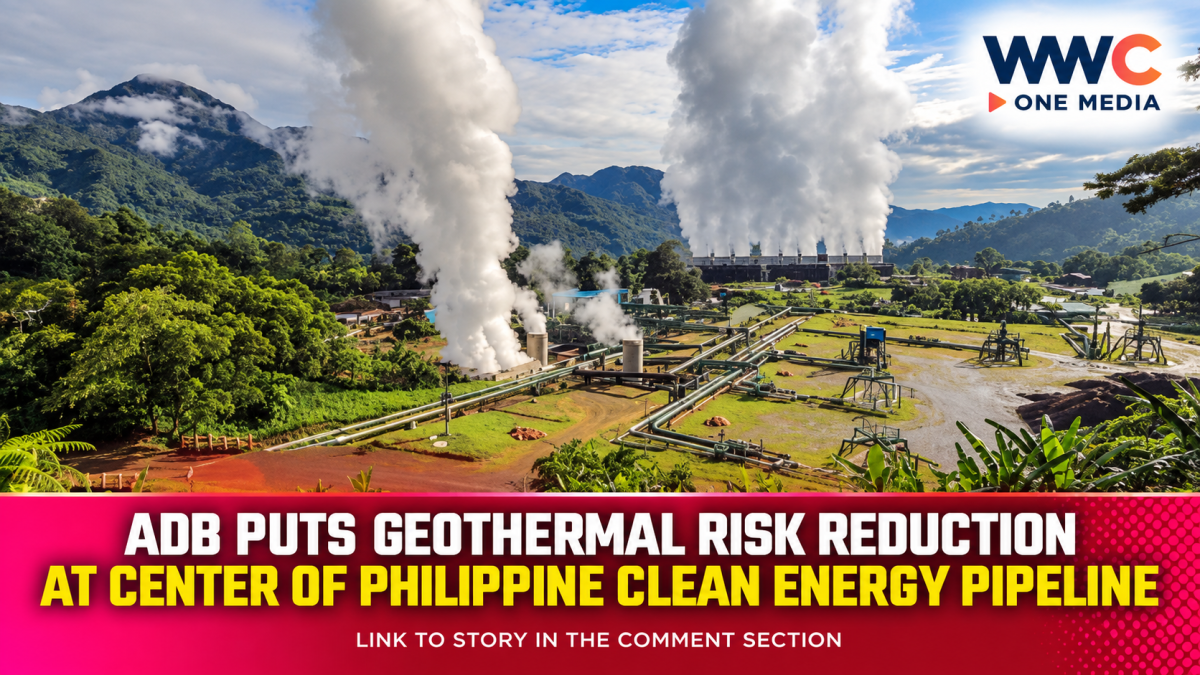
The initiative is significant for the Philippines because geothermal power can provide electricity continuously, unlike renewable sources whose output depends directly on sunlight or wind conditions. The country had about 1,952 megawatts of installed geothermal capacity as of 2023, making it the world’s third-largest geothermal producer at the time.
The government has also been expanding its pipeline of potential geothermal resources. As of July 2025, 31 geothermal service contracts had been awarded with combined potential capacity of more than 1,077 MW, according to government figures reported previously. Many of those projects remain in the exploration or pre-development stage.
The financing facility is therefore aimed at the point where many potential projects face their greatest uncertainty. By sharing exploration costs, the government and development-finance institutions hope to encourage private companies to investigate areas that could otherwise remain undeveloped because of the financial risk.
Geothermal is not the only clean-energy area receiving ADB support. The bank’s Philippine pipeline also includes assistance for offshore wind development, energy efficiency in public buildings and programs intended to expand electricity access in underserved areas.
The offshore-wind program includes technical assistance for developing port infrastructure that could support future offshore wind farms, while the energy-efficiency program is designed to support technologies such as efficient lighting, high-efficiency air conditioning, rooftop solar systems and smart-metering infrastructure.
The broader push comes as the Philippines seeks to increase renewable energy’s share of electricity generation. The country’s energy plan targets a 35% renewable share by 2030 and 50% by 2040, creating pressure to develop additional generation capacity while maintaining reliability as electricity demand grows.
Geothermal could play a particularly important role because it can provide firm renewable generation that complements intermittent solar and wind projects. However, developing new geothermal fields can take years and requires successful exploration, permitting, financing and construction before additional power reaches the grid.
The government has also identified permitting and financing as continuing obstacles for geothermal developers. A de-risking mechanism addresses the financial uncertainty surrounding exploration, but other project-development challenges will still need to be resolved before new resources become operating power plants.
For the Philippine power sector, the ADB-backed initiative represents an attempt to move geothermal development beyond existing producing fields and encourage exploration of new resources.
The bigger issue now is whether reducing exploration risk will be enough to unlock a new wave of geothermal investment and convert the country’s remaining underground resources into additional dependable renewable power.