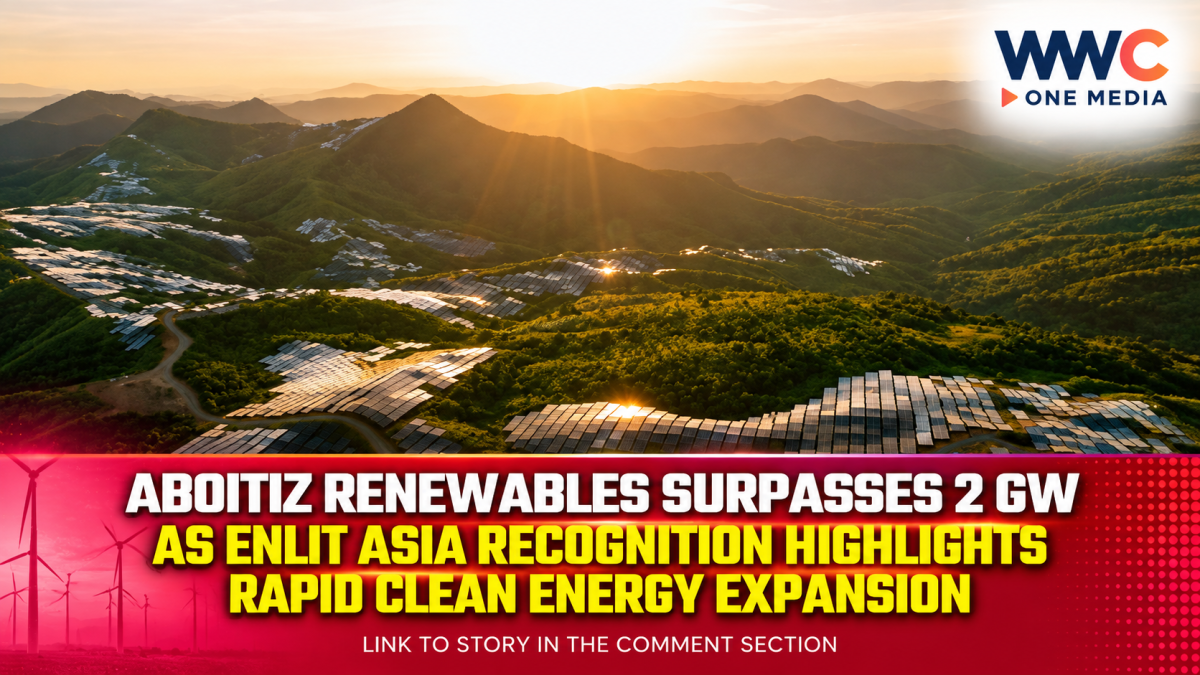
MANILA — Aboitiz Renewables, Inc. has more than doubled its attributable renewable energy capacity in just four years, reaching more than 2 gigawatts (GW) as the company expands its solar, hydro, geothermal, wind and battery storage portfolio across the Philippines.
The milestone comes after the company was named Independent Power Producer of the Year at the Enlit Asia Power & Energy Awards 2026 in Jakarta, recognizing its project completions, acquisitions and broader contribution to renewable energy development in the country.
Aboitiz Renewables’ attributable capacity has grown from roughly 900 megawatts (MW) in 2022 to more than 2 GW today. Over the past four years, the company added 846 MW of new renewable capacity through six solar projects, a renewable-energy-integrated battery storage facility and a geothermal binary plant.
A major part of the expansion came from the acquisition of the Caliraya-Botocan-Kalayaan hydropower complex in Laguna. The transaction, valued at about ₱36.3 billion, added a large established renewable generation asset to the company’s portfolio and strengthened its position in the country’s hydroelectric sector.
The company is also moving beyond completed projects. Four battery energy storage projects have advanced into construction, while Aboitiz Renewables is targeting the commercial operation of its first wind project before the end of 2026. Its development pipeline contains more than 1 GW of additional solar, hydro and wind projects.
Aboitiz Renewables currently operates 45 renewable energy facilities nationwide, reflecting a portfolio that has expanded considerably from its position four years ago. The company’s investments span multiple technologies rather than relying on a single renewable source, allowing it to develop generation from solar, hydro, geothermal and wind while incorporating energy storage.
The rapid expansion comes as electricity demand in the Philippines continues to increase and the country seeks to raise the share of renewable energy in its power generation mix. National targets call for renewables to account for 35% of the generation mix by 2030 and 50% by 2040.
Energy storage is becoming particularly important as the renewable portfolio grows. Battery systems can help manage the variability of solar and wind generation and provide additional flexibility to the electricity system as more intermittent renewable capacity is connected to the grid.
The company’s growth also reflects the increasing role of private-sector investment in the country’s energy transition. Government data show that renewable energy projects accounted for the overwhelming majority of investments certified under the Philippines’ Green Lane initiative during the first half of 2026, highlighting the scale of capital flowing into clean-energy development.
The Enlit Asia award adds regional recognition to that expansion. The annual event brings together utilities, independent power producers, technology companies, policymakers and other participants across the ASEAN power sector, with this year’s program focusing on renewable generation, energy storage, grid modernization, digitalization and other emerging technologies.
For Aboitiz Renewables, the award comes at a point when its renewable business is shifting from a relatively smaller portfolio into a large-scale generation platform. The combination of acquisitions, newly energized projects and projects still under development gives the company multiple avenues for further capacity growth.
But the expansion also comes with the broader challenges facing the Philippine power sector, including grid constraints, project permitting, financing requirements and the need to keep electricity reliable and affordable while adding more renewable generation.
The company’s rapid capacity growth therefore puts Aboitiz Renewables among the private-sector players helping reshape the country’s electricity mix — with more than 1 GW still in its development pipeline and additional battery and wind projects moving toward operation.
The bigger question now is how quickly that pipeline can be converted into operating capacity as the Philippines pushes toward its 2030 and 2040 renewable-energy targets.