
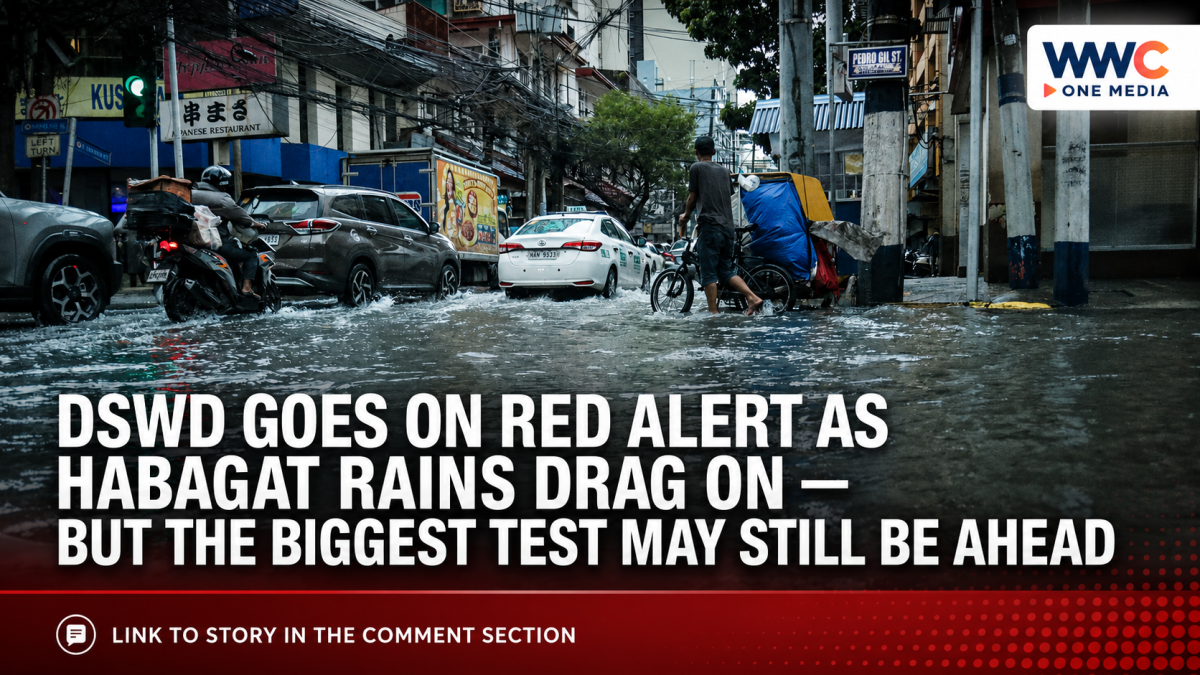
MANILA, Philippines — The Department of Social Welfare and Development has shifted to red alert as relentless southwest monsoon rains continue to threaten communities across Luzon and parts of the Visayas, putting disaster-response teams and millions of emergency food packs on standby for another possible wave of flooding and evacuations.
The heightened alert comes as the Philippines continues to deal with the cumulative impact of weeks of severe weather, with millions of people already affected by the Habagat and a succession of tropical cyclones.
The DSWD raised its alert level in compliance with National Disaster Risk Reduction and Management Council Memorandum No. 237, series of 2026, which elevated the national disaster-response posture from blue to red beginning 5 p.m. Friday, August 28.
The move signals intensified preparedness as authorities brace for the possibility that prolonged rainfall could trigger additional flooding, landslides and displacement.
3.4 Million Family Food Packs Positioned Nationwide
DSWD Assistant Secretary Irene Dumlao said field offices remain on heightened alert and are coordinating with local governments in communities vulnerable to flooding and other rain-related emergencies.
According to the agency’s Disaster Response Operations Monitoring and Information Communication report as of 6 p.m. Friday, more than 3.4 million family food packs had been prepositioned in warehouses and strategic locations around the country.
The DSWD Central Office also had ₱558.77 million in Quick Response Fund available for immediate disaster-response operations.
That stockpile could prove crucial if the Habagat continues to force families from their homes.
DSWD field offices are coordinating with local government units so additional food packs, non-food items and other assistance can be moved quickly to communities experiencing flooding or displacement.
The agency has urged residents to follow advisories from PAGASA and their local governments and to cooperate with evacuation orders when necessary.
More Than ₱1.2 Billion in Aid Already Released
The red alert follows weeks of large-scale relief operations.
As of August 25, the DSWD said it had already distributed more than ₱1.2 billion worth of assistance to people affected by the Habagat and Tropical Cyclones Luis, Maymay and Neneng.
That assistance included more than 1.9 million family food packs, ready-to-eat food, non-food items and over ₱14.3 million in financial assistance, according to GMA News’ report citing DSWD officials.
At that point, the department reported having more than 3.6 million food packs in its national stockpile, with production continuing daily.
The latest figure of more than 3.4 million prepositioned packs should not necessarily be read as a simple decline from that earlier stockpile number: relief inventories are continuously produced, distributed and repositioned as operations continue.
Millions Already Hit by Weeks of Severe Weather
The scale of the crisis extends far beyond the latest round of rain.
As of the morning of August 25, the Office of Civil Defense reported that more than 7.6 million people, representing roughly 2.2 million families, had been affected by the combined effects of Habagat and Tropical Cyclones Luis, Maymay and Neneng.
Affected communities were reported across the Ilocos Region, Cagayan Valley, Central Luzon, Bicol, Western Visayas, Zamboanga Peninsula, CALABARZON, the Cordillera Administrative Region, Metro Manila and MIMAROPA.
At that time, authorities had recorded 29 deaths, 19 injuries and three missing persons, while 102 areas had been placed under a state of calamity.
Those figures provide important context for the DSWD’s decision to return to its highest response posture: the government is not preparing for an isolated rain event, but responding to communities that have already endured repeated flooding, evacuations and storm-related damage.
Why the Habagat Threat Isn’t Over
Weather conditions on Saturday, August 29, offered little immediate relief.
PAGASA said the southwest monsoon, together with a low-pressure area north-northeast of Batanes, would continue bringing rain over large portions of Luzon and the Visayas.
As of PAGASA’s early-morning bulletin, the LPA was estimated about 520 kilometers north-northeast of Itbayat, Batanes.
Monsoon rains were forecast over Ilocos Sur, Pangasinan, La Union, Benguet, Bataan, Zambales, Tarlac and Pampanga, where heavy to intense rainfall could trigger flash floods and landslides.
Metro Manila, Ilocos Norte, Abra, Ifugao, Mountain Province, Nueva Vizcaya, Nueva Ecija, Bulacan, Rizal, Cavite, Laguna, Batangas, Occidental Mindoro and Oriental Mindoro were also expected to experience occasional rains.
PAGASA’s weekend outlook had also warned that the weather disturbance near Extreme Northern Luzon could continue enhancing the Habagat through the weekend, maintaining the threat of significant rainfall over western sections of Luzon.
From Blue Alert Back to Red
The return to red alert also illustrates how quickly the country’s disaster situation has shifted.
Earlier in the week, the DSWD Disaster Response Command Center was operating under blue alert, after the national alert level had been downgraded effective August 20. The agency nevertheless continued monitoring communities affected by previous tropical cyclones and the enhanced Habagat.
Eight days later, the national posture was elevated again.
That reversal underscores the central concern facing disaster officials: even when individual storms move away, the southwest monsoon can continue feeding moisture into the country, prolonging rainfall over already saturated communities.
For areas repeatedly hit by flooding, another prolonged downpour can mean rivers rising again, evacuation centers reopening and families who have barely begun cleaning their homes being displaced once more.
DSWD Tells Communities: Don’t Wait Until Floodwaters Rise
The DSWD is urging residents in vulnerable areas to remain alert, follow official PAGASA bulletins and coordinate immediately with local authorities when evacuation becomes necessary.
With millions of food packs already positioned nationwide and hundreds of millions of pesos available for emergency response, the government’s immediate challenge is no longer simply preparing supplies.
It is getting assistance to the right communities quickly enough if another round of heavy Habagat rains triggers widespread flooding.
And with PAGASA still forecasting monsoon rains across several flood- and landslide-prone provinces, the decision to raise the country back to red alert suggests authorities are preparing for the possibility that the worst of this prolonged weather emergency may not yet be over.




Leave a Reply