
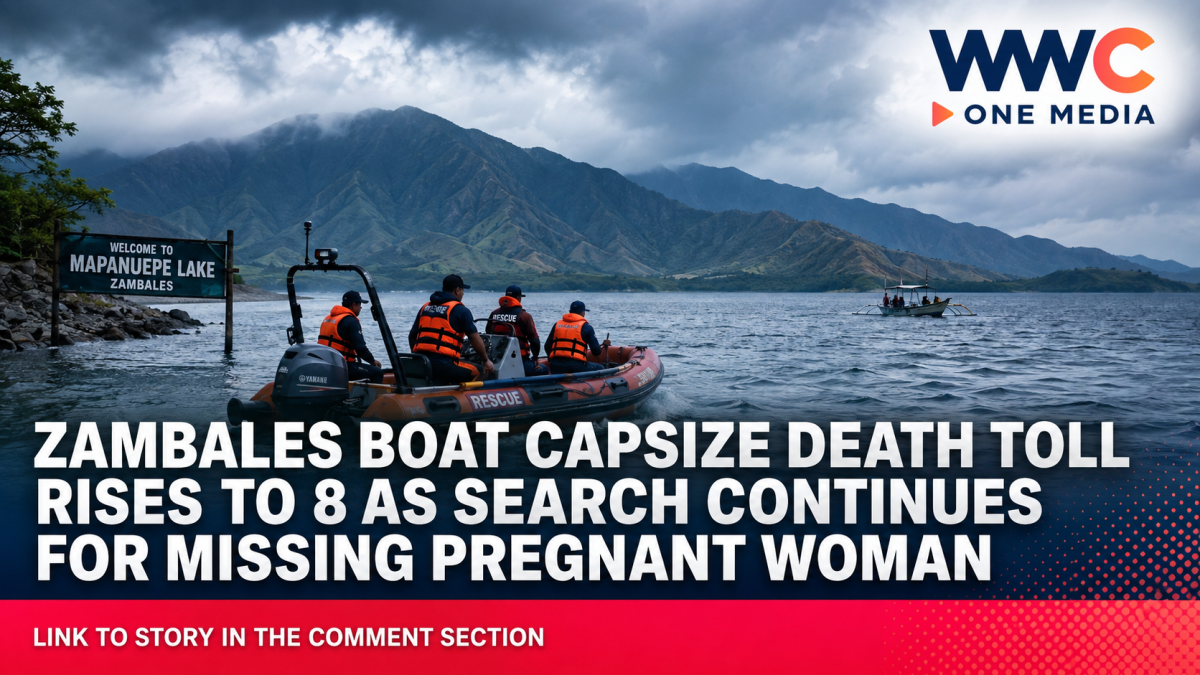
SAN MARCELINO, Zambales — What began as a routine trip home for members of an Aeta community has become one of Zambales’ most devastating recent water tragedies, after authorities recovered the bodies of two missing children from Mapanuepe Lake on Saturday, raising the confirmed death toll from a motorbanca capsizing to eight.
One passenger — a 26-year-old pregnant woman — remained missing as search and rescue teams continued operations on August 29.
The Philippine Coast Guard said the two children recovered Saturday had been among three passengers reported missing after the motorized banca overturned on August 27 near the well-known Sunken Church in Barangay Buhawen, San Marcelino.
The boat was carrying 13 members of the Aeta community.
Six passengers had already been confirmed dead following the accident, while four survived. The recovery of the two children brought the number of fatalities to eight, leaving only one passenger still unaccounted for.
Children Found Near Capsizing Site
According to the Coast Guard, the body of a female minor was recovered at around 10:10 a.m. Saturday approximately 50 meters west of the capsizing site.
About an hour later, at around 11:05 a.m., search and rescue personnel recovered the body of a male minor roughly 30 meters southeast of where the boat overturned.
Both children were identified by their fathers.
The Philippine Daily Inquirer identified the children, citing the Coast Guard, as Chandnea Serrano dela Cruz, 3, and Anqelito Serrano Liwanag, 8.
Authorities continued searching the lake for the remaining missing passenger despite unpredictable weather that has complicated operations.
Police officials said rain and strong winds have repeatedly intensified and eased in the area, creating difficult conditions for rescuers.
Victims Were Returning Home From Barangay Center
The passengers were residents of Sitio Lumibao and were traveling back to their community after visiting the barangay center in Buhawen.
According to the Coast Guard and other reports, members of the group had gone to the community health center to receive food and medicine and participate in a vaccination activity before beginning their journey home.
Other local reports said some members of the group had also attended a Pantawid Pamilyang Pilipino Program, or 4Ps, meeting.
Their motorbanca capsized while crossing Mapanuepe Lake near the Sunken Church at about 2 p.m. on Thursday.
The lake crossing is particularly important for residents of remote communities in the area because reaching services such as the barangay health center can require traveling across the water.
Strong Winds and Rough Water Eyed — But Exact Cause Remains Under Investigation
The Philippine Coast Guard said initial information showed that the motorbanca encountered strong winds and rough water conditions before it overturned.
Survivors similarly reported sudden strong winds and rough lake conditions.
However, authorities have not yet announced a final determination on what caused the accident.
Separate reporting by BusinessMirror, citing the Zambales Provincial Police Office, said investigators were also looking into whether the banca may have been overloaded. The report said the boat operator had been detained for possible charges involving reckless imprudence.
That allegation remains part of the investigation and should not yet be treated as the officially established cause of the capsizing.
The Coast Guard has said the circumstances surrounding the incident remain under investigation.
Bad Weather Complicates Search
Finding the missing passengers has been difficult from the beginning.
Search and retrieval operations were temporarily halted on Thursday evening because of deteriorating weather conditions.
Operations resumed Friday, involving personnel from several agencies, including the Philippine Coast Guard, Philippine National Police, Bureau of Fire Protection, local disaster response teams and other rescuers.
Heavy rain also reduced underwater visibility, making diving operations more difficult.
Search efforts continued Saturday despite changing conditions, eventually leading to the recovery of the two children.
Authorities are now concentrating efforts on finding the final missing passenger.
Mapanuepe Lake Carries a History Shaped by Mount Pinatubo
Mapanuepe Lake itself is a product of one of the Philippines’ most consequential natural disasters.
The lake developed following the 1991 eruption of Mount Pinatubo, when massive lahar deposits altered waterways and eventually submerged parts of communities in the area.
One of its most recognizable landmarks is the partially submerged Santa Barbara Church — commonly known as the Sunken Church — whose remaining structure became a visual reminder of the communities affected by Pinatubo’s eruption.
In recent years, the lake and its surrounding grasslands have also attracted visitors and earned comparisons to New Zealand because of their dramatic mountain scenery.
But for nearby indigenous communities, the lake is far more than a tourist attraction. It is part of everyday transportation between remote settlements and essential government services.
Questions Remain After Eight Lives Lost
For the families involved, Saturday’s recovery brings confirmation but not closure.
Eight people are now confirmed dead, including five children, according to the latest reporting. Four people survived.
One woman remains missing.
Investigators must still determine exactly why the banca capsized — whether severe weather alone caused the accident or whether other factors, including the boat’s passenger load and safety conditions, contributed to the tragedy.
Until that investigation is completed, authorities continue to face two urgent tasks: finding the final missing passenger and determining whether this disaster could have been prevented.
As search teams continue combing Mapanuepe Lake, the tragedy is also raising a larger question: how safely can residents of remote communities reach essential government and health services when crossing the lake remains part of everyday life?



Leave a Reply