
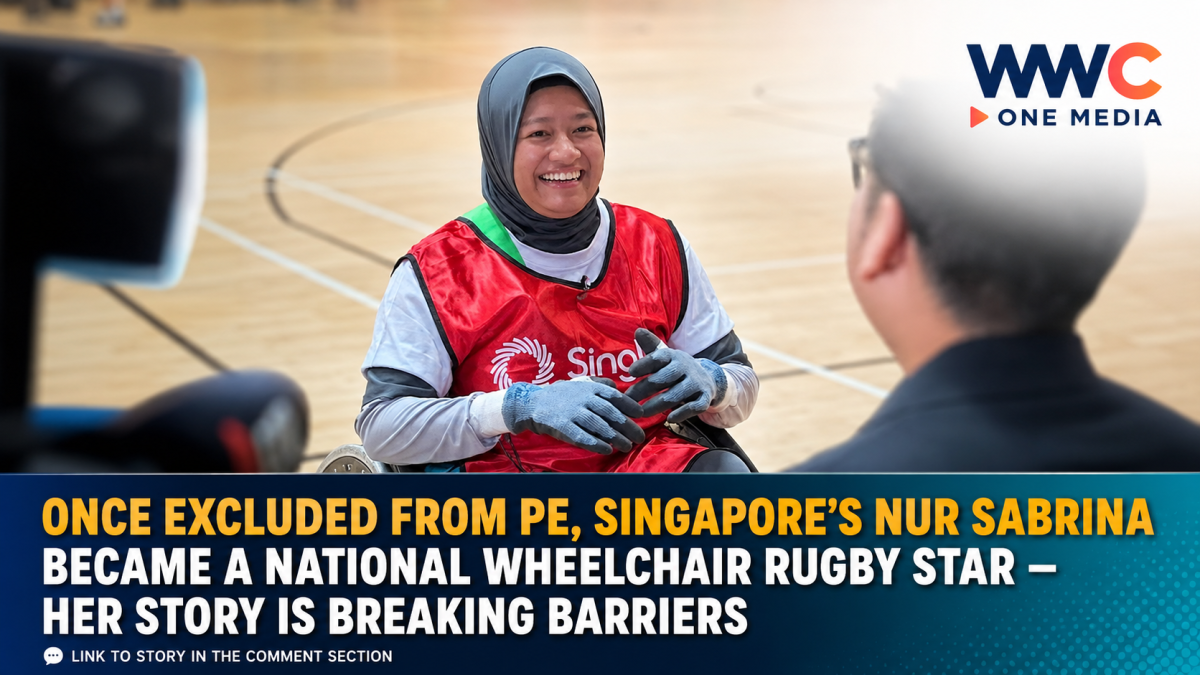
SINGAPORE — She once believed sports were no longer part of her life. Today, Nur Sabrina Suhaimi is crashing into opponents on a wheelchair rugby court while representing Singapore at international competition.
The 25-year-old is Singapore’s only female national wheelchair rugby player, a remarkable transformation for someone who was advised as a schoolgirl to stay away from physical education because of her declining mobility.
Sabrina lives with Charcot-Marie-Tooth disease, a rare genetic neurological disorder that damages peripheral nerves and can cause progressive muscle weakness and loss of sensation.
She began experiencing difficulties walking as a young child. By secondary school, climbing stairs had become increasingly difficult, while foot drop affected her ability to lift the front of her feet.
Eventually, her physiotherapist advised her not to take part in PE classes for safety reasons.
For Sabrina, that decision had an emotional impact.
She felt different from her classmates and believed she might never be able to participate in sport again. Doctors eventually diagnosed her with Charcot-Marie-Tooth disease when she was 16, after the condition began affecting her hands as well.
Then came another major setback.
In May 2024, Sabrina fractured her ankle after missing a step while getting into her mobility scooter. The injury left her using a wheelchair for about a year.
She described that period as the lowest point of her life, saying she became dependent on her mother for everyday activities and feared that her condition might eventually take away her ability to walk.
But the setback unexpectedly opened the door to something new.
From swimming class to wheelchair rugby
Looking for a way to regain strength, Sabrina joined an inclusive swimming class.
One of her swimming coaches happened to have experience in wheelchair rugby and introduced her to the sport.
What began as a way to get out of the house soon became a passion.
Wheelchair rugby is a fast-paced, mixed-gender para sport played by teams of four. Athletes use specially designed wheelchairs built for speed, manoeuvrability and physical contact. The sport is known for its hard collisions and was once widely nicknamed “murderball.”
For Sabrina, the intensity was part of the attraction.
She eventually discovered that the wheelchair she once felt self-conscious about could become a tool for competition, independence and confidence.
Her transformation mirrors the broader evolution of wheelchair rugby in Singapore. The Wheelchair Rugby Association Singapore currently has around 27 members, including athletes with spinal cord injuries, muscular dystrophy, neurological conditions and amputations.
From newcomer to national athlete
Sabrina quickly progressed after taking up the sport.
She trains three times a week, focusing on strength and conditioning, technical drills and developmental skills. She plays as an offensive high-pointer, a role generally associated with carrying, passing and scoring the ball.
Her rapid rise eventually earned her a place on Singapore’s national team.
In January 2026, Sabrina was among 10 Singapore wheelchair rugby players selected for the 13th ASEAN Para Games in Thailand.
Official Team Singapore records confirm that Sabrina was part of Singapore’s mixed wheelchair rugby squad at the Games. Singapore ultimately finished with the silver medal, after facing host Thailand in the final.
For Sabrina, reaching that stage was about far more than winning matches.
It represented a complete reversal of the limitations she once believed defined her.
The woman challenging wheelchair rugby stereotypes
Sabrina’s story has also placed a spotlight on the lack of female representation in wheelchair rugby.
Her World Singapore previously reported that she became the only female wheelchair rugby player representing Singapore at the ASEAN Para Games and described how the sport helped her develop confidence, independence and a stronger sense of identity.
Being a woman in a physically demanding, traditionally male-dominated environment has not always been easy.
But Sabrina has embraced the challenge.
She has spoken about moments when opponents initially underestimated her because she was a woman. Eventually, her performance on court changed those perceptions.
The sport has also helped her become more comfortable with using a wheelchair.
In 2025, she switched from a mobility scooter to a lightweight manual sports wheelchair. Rather than viewing the wheelchair as something to hide, she now sees it as part of her identity as an athlete.
A silver medal — and a bigger ambition
Sabrina’s international journey did not end with the ASEAN Para Games.
In June 2026, she took part in the four-day World Wheelchair Rugby Super Week in Singapore, an event jointly organised by Wheelchair Rugby Association Singapore and World Wheelchair Rugby.
Players from Singapore, Malaysia, Indonesia and Thailand received intensive coaching from international coaches, giving emerging athletes an opportunity to train alongside more experienced competitors.
Now, Singapore’s wheelchair rugby team is looking ahead.
The national squad is working toward the 2027 WWR Asia-Oceania Championship and hopes to represent Singapore at the 2029 ASEAN Para Games, which will be held in Singapore.
Sabrina also wants greater awareness and funding for wheelchair rugby so more people can discover the sport.
Her message extends beyond the court.
She hopes people will see athletes with disabilities not through the limitations of their conditions, but through what they can accomplish.
And perhaps the most powerful part of Sabrina’s journey is the fact that she no longer sees herself as the girl who had to sit out PE.
She is now the athlete driving across the court.
The girl who once worried that sport had disappeared from her life has found a place where she can compete, collide, belong — and represent her country.
Her future remains uncertain because Charcot-Marie-Tooth disease can progress over time.
But Sabrina says she intends to keep giving her best, whatever that future looks like.
For someone who once thought a wheelchair represented everything she was losing, it has become something entirely different:
a symbol of how far she has come.




Leave a Reply