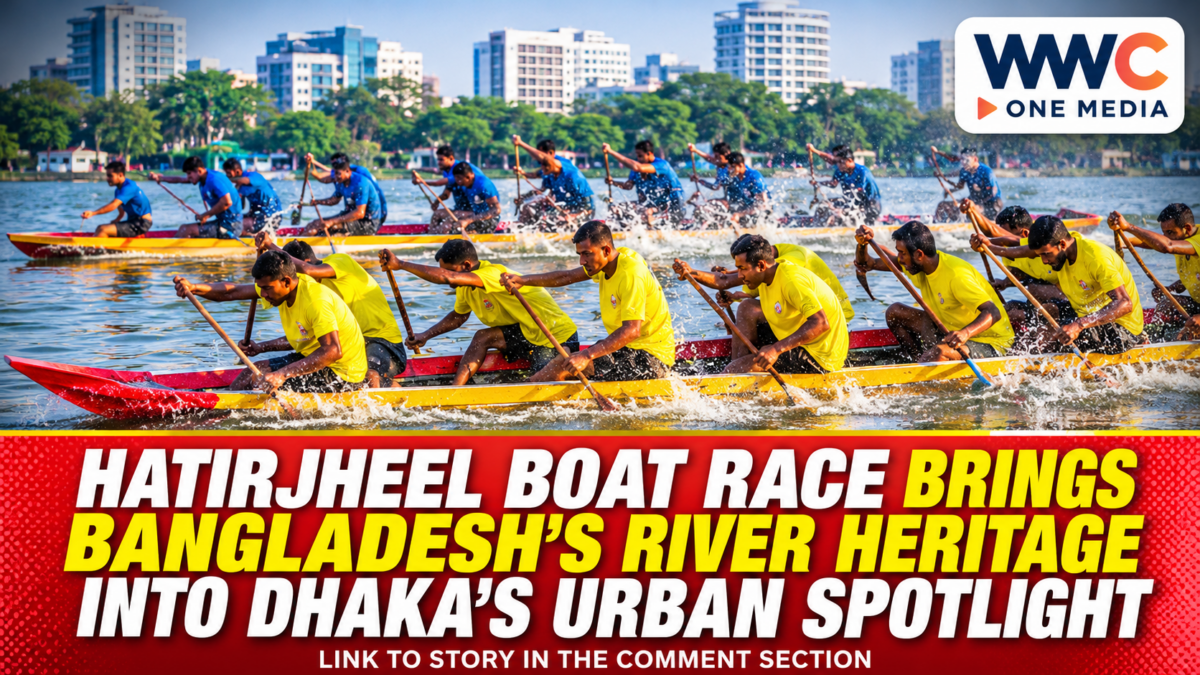
DHAKA, Bangladesh — Ten boats took to the waters of Hatirjheel on November 28 as Dhaka North City Corporation marked its 15th anniversary with a traditional boat race. The competition brought a form of river-based sporting culture into one of the capital’s prominent urban recreational spaces.
The event offered more than a spectacle for spectators along the lake. It placed a traditional activity associated with Bangladesh’s riverine communities within a modern city setting, raising a wider question about how urban authorities can keep cultural heritage visible as cities expand and change.
The Hatirjheel boat race was organised as part of DNCC’s anniversary activities. Participating boats represented different parts of the country, while the teams carried names drawn from Bangladesh’s rivers. The event’s stated cultural purpose was to introduce younger generations to a traditional form of Bengali sport and heritage.
Hatirjheel becomes a stage for traditional competition
The race began at the Police Plaza end of Hatirjheel. The boats travelled towards the Bangladesh Film Development Corporation area before turning back to the starting point.
The route placed the competition within a familiar urban landscape, with spectators gathering along the water to watch the crews row. Images from the event show boats moving close together as rowers worked in rhythm, while people watched from the banks.
Ten boats participated. Their names included Padma, Meghna, Jamuna, Kaliganga, Karnaphuli, Surma, Balu Nadi, Teesta, Ichamati and Turag.
The river names gave the competition a recognisable national theme. Rather than presenting the boats as anonymous competitors, the naming connected the event to waterways that have shaped communities, transport, livelihoods and cultural life across Bangladesh.
The race therefore carried a symbolic message: a city does not have to abandon its cultural traditions simply because its surroundings have become increasingly urban.
The cultural value of Bangladesh’s boat-racing tradition
Boat racing is closely associated with Bangladesh’s riverine identity. In communities where waterways have long influenced daily life, boats have served practical purposes while also becoming part of local recreation and collective celebration.
Traditional races bring together crews, spectators and communities. The sport depends on coordination, stamina and timing, making the collective effort of the rowers as important to the spectacle as the competition itself.
Moving such an event into Dhaka also changes its audience. People who may not regularly encounter traditional boat racing in their own neighbourhoods can watch it in a central urban location. Children and young people, in particular, can experience the activity directly rather than encountering it only through photographs, stories or cultural presentations.
That educational value matters. Cultural traditions are more likely to remain familiar when they are experienced and practised, rather than treated only as historical material.
However, a single anniversary event cannot by itself guarantee the continuity of a tradition. Regular opportunities for participation, community involvement and support for the people who practise the sport would be necessary to give the activity a lasting place in urban cultural life.
Why the location matters
Hatirjheel provides a distinctive setting for an event built around water. The lake is a recognised recreational and urban space in Dhaka, and its surroundings allow residents to gather without travelling to a rural river community.
Its role in the city also illustrates the broader relationship between public spaces and quality of life. Urban infrastructure is often discussed through roads, drainage, waste management, transport and public utilities. Those services are essential, but the experience of a city also depends on whether residents have places to gather, exercise, relax and take part in shared activities.
The Department of Environment’s published assessment of Hatirjheel describes the lake as a recreational destination as well as part of the city’s transport and urban landscape. That makes the condition of the water body important not only for its appearance but also for the public activities it supports.
The race should not be taken as evidence that the lake’s environmental challenges have been resolved. A successful public event and the long-term management of an urban water body are separate matters. Keeping such spaces usable requires continued attention to water quality, waste disposal and the surrounding environment.
Anniversary events and the role of city government
DNCC’s 15th-anniversary programme placed the boat race within a wider series of public activities. The anniversary celebrations also included a marathon, with additional cultural and civic programmes announced as part of the observance.
Such events give local governments an opportunity to bring residents into public spaces and highlight activities beyond routine municipal services. They can also help connect civic institutions with communities through shared experiences.
But public celebrations are most meaningful when they complement everyday responsibilities. Residents ultimately judge a city corporation not only by the events it organises but also by the quality and consistency of services delivered in neighbourhoods.
For Dhaka, the challenge is to balance the visible appeal of special events with the less visible work of maintaining public spaces, managing waste, improving mobility and protecting the environment.
WWC ONE MEDIA has previously examined Bangladesh’s wider development and urban challenges, including housing approaches that respond to the pressures of city living and the country’s efforts to strengthen technical skills. These issues sit within the same broader question: how can development improve the everyday experience of people living in a rapidly changing country?
What the race can — and cannot — achieve
The Hatirjheel competition demonstrated that traditional sports can attract public attention in a modern urban setting. It also provided a platform for a cultural activity associated with communities beyond the capital.
Its longer-term impact will depend on whether similar activities are supported beyond anniversary celebrations. Schools, community organisations, sporting groups and local authorities could help keep traditional competitions accessible to younger participants.
There is also a practical consideration: events held around urban lakes must be organised with appropriate safety, crowd management and environmental safeguards. The appeal of a public celebration should not come at the expense of the water body or the people using the surrounding area.
The strongest legacy of the race would not simply be the number of spectators who watched it. It would be whether the event helps create continued interest in traditional sports and encourages public institutions to treat cultural preservation as part of city life.
What happens next
The immediate competition formed part of DNCC’s 15th-anniversary activities. The next measure of its significance will be whether the city corporation or community groups organise further opportunities for traditional boat racing and other heritage-based activities.
Any future programme would benefit from transparent information about participation, safety arrangements, environmental safeguards and the support available to competing communities.
For now, Hatirjheel has shown how a traditional sporting activity can find an audience in the middle of a modern capital. Whether that moment becomes a recurring part of Dhaka’s cultural calendar remains an open question.
Frequently asked questions
What was the Hatirjheel boat race?
It was a traditional boat-racing competition organised in Dhaka as part of the 15th-anniversary activities of Dhaka North City Corporation.
When was the competition held?
The race took place on Saturday, November 28, 2026.
How many boats participated?
Ten boats from different parts of Bangladesh took part in the competition.
Where did the race take place?
The competition was held at Hatirjheel, following a route from the Police Plaza end towards the Bangladesh Film Development Corporation area and back.
Why was the event organised?
The event was presented as a way to promote traditional Bengali sporting culture and introduce younger generations to an important part of Bangladesh’s riverine heritage.