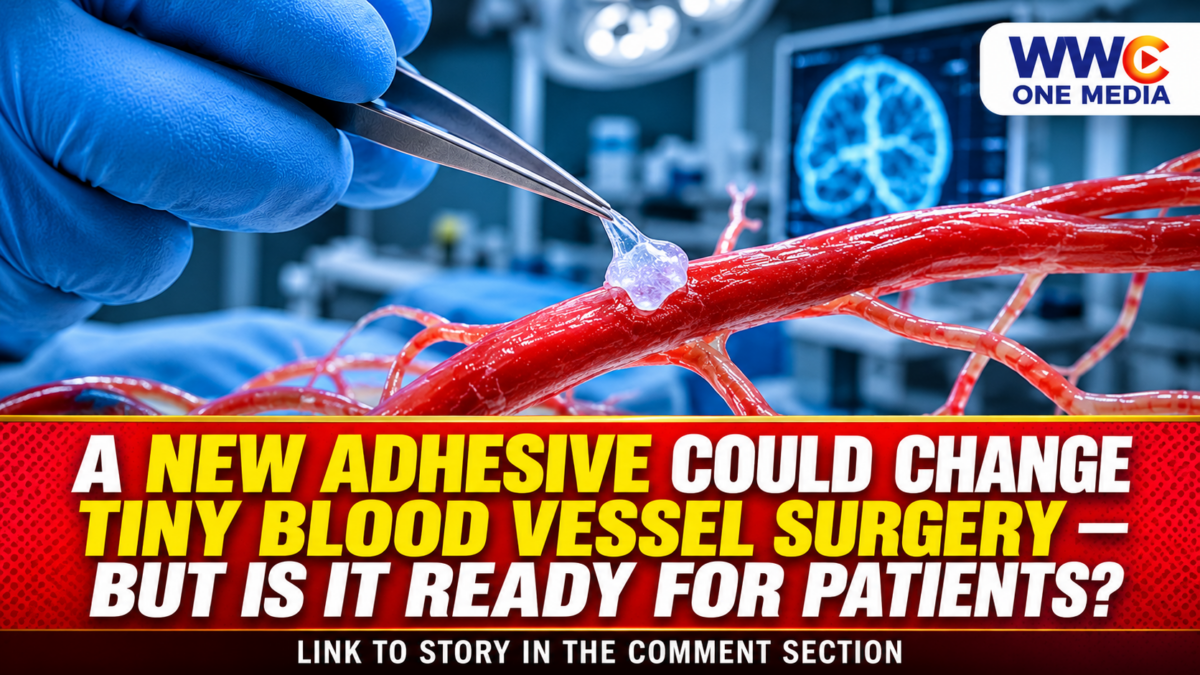
Researchers have developed an experimental adhesive system designed to connect tiny blood vessels without conventional stitches, combining microscopic mechanical anchors with an artificial intelligence-assisted wireless monitoring device. The research, published in Science on November 12, 2026, reported a 78% reduction in procedural time in rat models compared with conventional methods.
The work addresses two separate challenges in delicate surgery: creating a reliable connection between small blood vessels and monitoring whether that connection remains functional afterward. Although the findings offer a promising direction for microsurgery and transplantation research, the evidence currently reported is based on animal models, not established results in human patients.
Why microvascular surgery needs another approach
Microvascular anastomosis is the surgical process of connecting small blood vessels. It is used in procedures where surgeons must restore blood flow through delicate vascular structures, including selected reconstructive operations and transplantation procedures.
The challenge is that these vessels are small, flexible and constantly exposed to changes in blood pressure. Their walls must be joined securely without creating an obstruction or damaging the tissue.
Conventional microsurgery uses fine sutures to connect the vessel ends. This requires considerable technical precision and can take time, particularly when the vessels have very small diameters.
The research team identified several limitations associated with existing adhesive materials. Conventional tissue adhesives can struggle to maintain a reliable connection in wet surgical environments, where blood and tissue fluids interfere with bonding.
The problem is not simply making two surfaces stick together. A successful vascular connection must remain stable while blood moves through the vessel and its walls experience repeated mechanical movement.
This makes microvascular repair a particularly demanding application for materials engineering.
How the new blood vessel adhesive works
The researchers introduced an integrated microneedle-interlocking adhesive system, known as iMAS.
Its design takes inspiration from the way plant roots anchor themselves in soil. Rather than relying entirely on a chemical bond between two wet surfaces, the system combines an adhesive material with microscopic structures that provide mechanical attachment.
The platform consists of a hydrophobic polymeric matrix and tetrahedral microneedles. The matrix provides the adhesive component, while the small structures create a three-dimensional interlocking connection.
In principle, combining these mechanisms addresses a weakness of conventional adhesives: maintaining a stable attachment under wet and dynamic conditions.
The design is significant because it approaches vascular joining as both a materials problem and a mechanical engineering problem.
A material that adheres strongly to tissue is not automatically suitable for blood vessel repair. Its placement, mechanical behaviour and ability to preserve the vessel’s internal passage also matter.
The study’s reported results suggest that the integrated system can make the joining procedure faster in experimental settings. However, further investigation is needed to establish how it performs across different vessel sizes, surgical conditions and patient populations.
Rat experiments reported a 78% reduction in procedure time
The research team tested the system in rat models and reported that iMAS reduced procedural time by 78%.
The study also reported suppression of neointimal hyperplasia, a process involving excessive growth of tissue within the inner layers of blood vessels.
This is relevant because changes in the vessel wall can affect the space available for blood to flow. In vascular repair, maintaining a functional connection involves more than achieving an initial seal: the repaired area must also remain suitable for circulation.
The findings therefore address both the speed of the joining procedure and a biological response associated with vessel healing and remodelling.
However, the reported percentage should be understood within the limits of the experiment. A result from an animal model cannot automatically establish the same improvement in human surgery.
Human blood vessels, surgical conditions and recovery patterns introduce additional variables. Larger studies would also be needed to determine how consistently the system performs and whether it offers meaningful advantages over existing surgical techniques.
The researchers’ findings are an experimental advance, not evidence that conventional microsurgical methods can already be replaced.
An AI-assisted sensor adds a second function
The adhesive system also incorporates a wireless sensor assisted by artificial intelligence.
Its purpose is to monitor vascular haemodynamics—the movement and behaviour of blood within the circulatory system—and the health of cardiac grafts.
This expands the concept beyond the initial surgical connection.
In conventional procedures, surgeons must assess whether a repaired vessel or transplanted tissue remains functional through appropriate post-operative monitoring. A system capable of providing continuous information could potentially help identify changes that require further clinical assessment.
The study describes the sensor as enabling continuous, real-time monitoring. It also identifies potential applications in detecting complications such as stenosis, which is the narrowing of a blood vessel, and transplant rejection.
The distinction is important: the technology is designed to provide information that may help identify problems. It does not mean the device can independently diagnose every complication or guarantee that a transplant will remain healthy.
AI-assisted monitoring also introduces questions about signal reliability, interpretation, device performance and how its readings would be integrated into clinical decisions.
For the technology to become useful in hospitals, those questions would need to be addressed through further testing.
Why the research matters for transplantation and reconstructive surgery
The combination of a joining material and a monitoring sensor could be relevant to surgical procedures in which small blood vessels must be connected and remain functional.
Transplantation is one potential area of interest because the success of a graft depends on adequate blood supply. Reconstructive microsurgery is another field in which surgeons work with delicate vessels to restore circulation to transferred tissue.
A faster connection could be valuable if it also maintains reliability and does not introduce additional complications. Continuous monitoring could add another layer of information after the operation.
These possibilities connect with wider developments in minimally invasive and technology-assisted medicine. WWC’s coverage of South Korea’s growing role in spinal endoscopy and specialist surgical education examines how surgical innovation depends on both technical development and professional expertise.
Medical research also increasingly involves technologies that combine clinical practice with engineering and digital systems. The regional exchange of medical knowledge highlighted in the Philippines’ hosting of Asian Pacific Digestive Week 2026 provides another example of how healthcare institutions evaluate new techniques and technologies.
For hospitals, the eventual adoption of a new surgical platform would involve more than purchasing a device. Clinical evidence, specialist training, equipment costs, regulatory requirements and long-term patient outcomes would all matter. These considerations are also relevant to the proposed expansion of advanced hospital and clinical research capabilities in Pasig.
What happens next
The immediate challenge is establishing whether the experimental system can deliver consistent results beyond the animal models described in the research.
Further studies would need to examine its performance across different vascular conditions, its long-term stability, the safety of its materials and the reliability of its wireless monitoring component.
Researchers would also need to establish whether the sensor can identify complications early enough to support useful clinical decisions. A monitoring signal is valuable only if it can be interpreted accurately and linked to appropriate medical action.
The available publication record does not establish that iMAS has received approval for routine human surgical use. Nor does it establish a timetable for clinical introduction.
For now, the work represents a research development at the intersection of microsurgery, biomaterials and artificial intelligence. Its potential will depend on whether later testing confirms that the faster procedure and monitoring capabilities translate into safe, meaningful benefits for patients.
Frequently asked questions
What is a blood vessel adhesive?
A blood vessel adhesive is a material designed to help connect or seal vascular tissue. In the iMAS research, the adhesive is combined with microscopic mechanical anchors to create a connection between small blood vessels.
What is microvascular anastomosis?
Microvascular anastomosis is the surgical connection of small blood vessels. It is used in selected reconstructive and transplantation procedures to restore or maintain blood flow.
How much faster was the experimental adhesive system?
The study reported that the integrated microneedle-interlocking adhesive system reduced procedural time by 78% in rat models.
What does the AI-assisted sensor monitor?
The embedded wireless sensor is designed to monitor vascular haemodynamics and cardiac graft health. The researchers describe its potential to help identify complications such as vessel narrowing and transplant rejection.
Can the adhesive already be used in human surgery?
The published research record describes testing in rat models. It does not establish that the system is approved or ready for routine human surgical use. Further safety and clinical evaluation would be necessary.