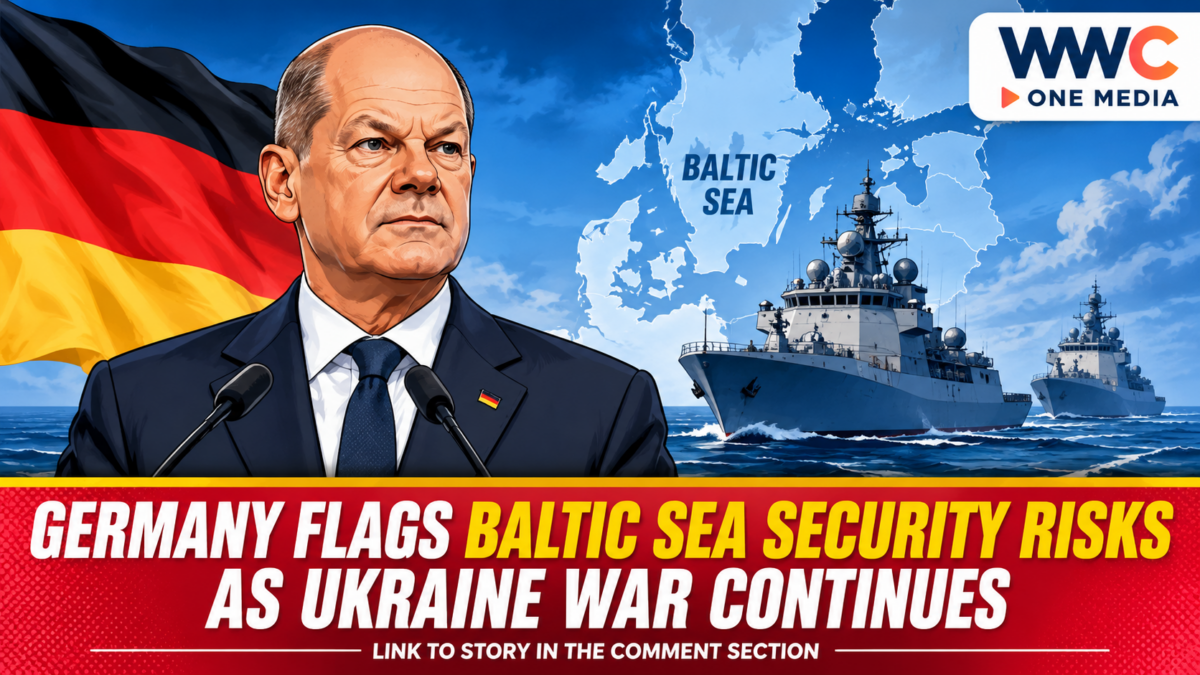
BERLIN, Nov. 29, 2026 — German Chancellor Friedrich Merz has publicly identified the security of the Baltic Sea region as a concern for European governments, while NATO officials have warned that threats to maritime infrastructure and critical networks are becoming increasingly interconnected.
The statements came as Germany continued defence cooperation with Ukraine, including a November 23 meeting between Defence Minister Boris Pistorius and his Ukrainian counterpart, Evgeniy Khmara. The published account of that meeting focused on air defence and military-industrial cooperation, while separate German government statements highlighted concerns about the Baltic Sea.
The distinction matters. Europe faces overlapping security challenges, but public evidence of regional concern should not be confused with proof that a wider military confrontation is imminent—or that a particular private warning was delivered to Kyiv.
Germany’s Baltic Sea security concerns are on the public record
Merz addressed Baltic security during a November 23 press conference with NATO Secretary General Mark Rutte at the Federal Chancellery in Berlin.
The German government’s summary of the meeting said Merz considered stability and security in the Baltic Sea region crucial and under threat from Russia. He also stressed the importance of maintaining freedom of navigation.
His remarks formed part of a wider discussion about European security, Russia’s war against Ukraine and the need to strengthen NATO’s capabilities.
Merz also referred to Russian violations of Polish airspace and expressed solidarity with Poland in defending allied territory. The government’s account placed these issues within the broader security relationship between the war in Ukraine and the protection of NATO members.
This is a significant distinction for readers: Berlin has publicly identified the Baltic Sea as a security priority. That position is documented independently of claims about private diplomatic exchanges.
What the Pistorius-Khmara meeting actually confirms
The two defence ministers met in Berlin on November 23, according to Ukraine’s Ministry of Defence.
Its published account identified support for Ukraine ahead of winter, particularly strengthening air defence, as the main subject of the discussions.
The ministers discussed securing additional interceptor missiles and reached preliminary agreements in that area. They also discussed cooperation between the two countries’ defence industries, procurement of drones for 2027 and the expansion of technologies already used on the battlefield.
The Ukrainian ministry said six flagship joint production projects between Ukraine and Germany were being implemented, with a combined value of more than €1 billion.
Those details show that the relationship remains focused on practical defence cooperation. Germany is supporting Ukraine’s military capabilities while the two governments are also developing industrial arrangements that could have longer-term implications for their defence sectors.
However, the published account does not mention a warning from Pistorius about Ukrainian attacks in the Baltic Sea. Without a corresponding official statement or published record, that specific claim cannot be treated as established fact.
NATO sees maritime infrastructure as part of a wider security challenge
The Baltic Sea issue also fits into NATO’s broader concern about protecting infrastructure that supports civilian and military activity.
In an address to the NATO Parliamentary Assembly in Berlin on November 23, Rutte described threats affecting pipelines, cables, energy grids and economies as interconnected. He also referred to NATO’s Baltic Sentry activity, which was launched to protect vital undersea infrastructure.
The alliance’s concern is not limited to conventional military deployments. Undersea cables, energy connections and shipping routes are important to the operation of modern economies. Damage or disruption can therefore have consequences beyond the immediate location of an incident.
Germany’s Foreign Office had already highlighted similar concerns earlier in November. In a November 5 statement about regional cooperation, it identified hybrid threats in the Baltic Sea region and raised concerns about Russia’s so-called shadow fleet, including risks to shipping routes and critical infrastructure.
These official positions provide a clearer picture of the region’s security agenda than speculation about a single private conversation.
WWC ONE MEDIA has also examined NATO’s position on its military posture in Eastern Europe, a separate issue that helps explain why the alliance’s eastern and northern security arrangements remain politically sensitive.
Why the Baltic Sea matters beyond military strategy
The Baltic Sea is an important route for commercial shipping and regional connectivity. Its security affects the movement of goods, access to energy infrastructure and the reliability of networks connecting European economies.
A serious disruption could create operational difficulties for shipping companies, energy operators and businesses that depend on predictable transport routes. However, the possibility of disruption should not be reported as evidence that trade has already been interrupted.
The region’s geography also adds to its strategic sensitivity. Several NATO members border the Baltic Sea, while Russia maintains a presence in the region, including in Kaliningrad.
That geography helps explain why incidents involving drones, maritime activity or critical infrastructure can attract attention across Europe. It does not, on its own, establish who was responsible for a particular incident or whether a military escalation will follow.
WWC’s previous examination of reported drone activity around Kaliningrad illustrates why an alert or suspected aerial incident should not automatically be described as a confirmed strike.
The wider defence debate is also taking place alongside increased military investment across Europe. As explored in the discussion of Russia’s warnings over European rearmament, governments face the challenge of strengthening deterrence while managing the political and economic consequences of higher defence spending.
What happens next
The next developments to watch are official statements from Berlin, Kyiv and NATO about maritime security, defence cooperation and the protection of critical infrastructure.
Further public clarification from the German Defence Ministry would be needed to establish whether Pistorius raised specific concerns about possible Ukrainian activity in the Baltic Sea during his meeting with Khmara.
For now, the documented position is narrower but still important: Germany has publicly described Baltic Sea security as a concern, NATO is emphasising protection of critical infrastructure, and German-Ukrainian defence cooperation continues.
The available records do not establish that the Ukraine conflict is about to spread into the Baltic Sea. They show that European governments are treating the region’s security as an issue requiring sustained attention.
Frequently asked questions
Why is Germany concerned about Baltic Sea security?
German officials have identified threats to regional stability, freedom of navigation and critical infrastructure as important security concerns.
Did Boris Pistorius warn Ukraine against attacking in the Baltic Sea?
The published Ukrainian account of his November 23 meeting with Evgeniy Khmara does not mention such a warning. The specific claim remains unverified in the public records reviewed.
What did Germany and Ukraine discuss on November 23?
Their defence ministers discussed air defence, additional interceptor missiles, drone procurement for 2027 and cooperation between their defence industries.
Why is the Baltic Sea strategically important?
It is a major maritime and infrastructure region connecting several European countries. Shipping routes, energy links and undersea communications make its security important to regional economies.
Does Germany’s warning mean the war will spread to the Baltic Sea?
No. Public statements about security risks do not establish that an expansion of the war is imminent. The available official records do not confirm such an outcome.