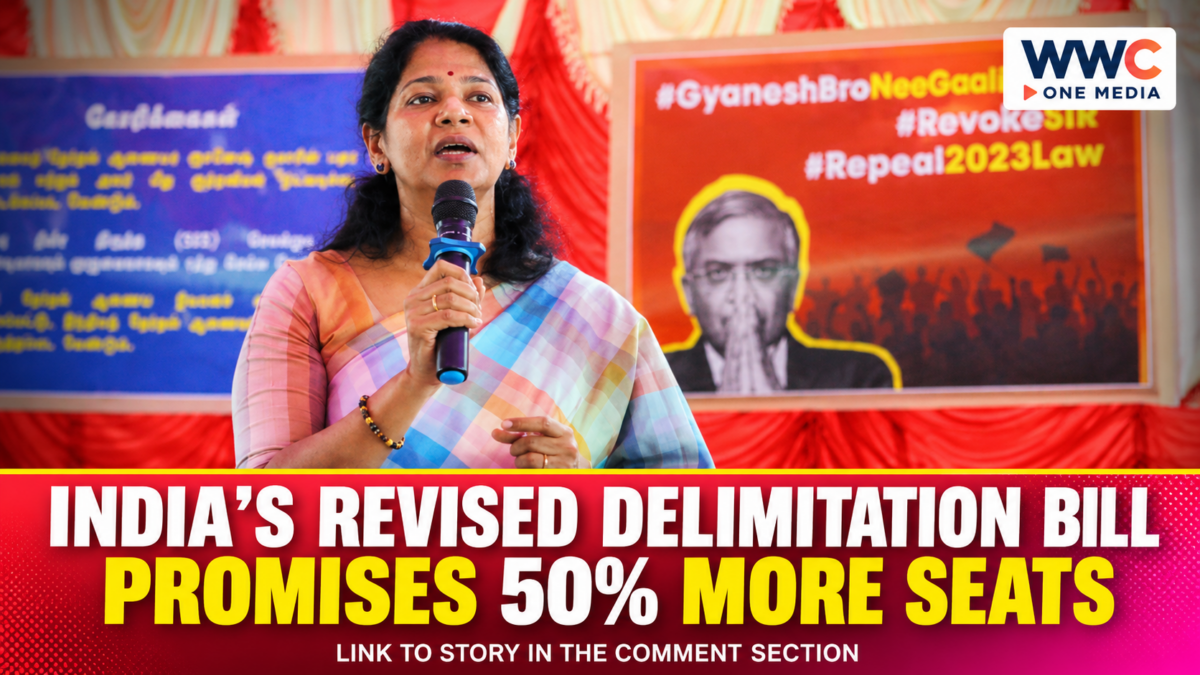
India’s delimitation debate has entered a new phase after the government outlined a revised legislative package that would increase the number of parliamentary and state assembly seats by 50% for every state and Union territory at the first delimitation conducted under the proposed framework.
The revised India delimitation proposal follows the failure of an earlier constitutional amendment in April 2026. The government now intends to replace the original Delimitation Bill with a second bill and introduce a new constitutional amendment, linking the expansion of legislative seats with the implementation of women’s reservation.
The change addresses one of the central concerns raised during the earlier parliamentary debate: whether differences in population growth between states could affect their relative representation in the Lok Sabha. However, the revised proposal remains legislation to be considered by Parliament. Its provisions are not yet law.
Why India’s Earlier Delimitation Proposal Failed
The government’s November 27 statement explains the legislative background.
Three related bills were introduced in the Lok Sabha on April 16, 2026: the Constitution (One Hundred and Thirty-First Amendment) Bill, 2026; the Delimitation Bill, 2026; and the Union Territories Laws (Amendment) Bill, 2026.
The constitutional amendment was taken up for consideration on April 16 and 17. It did not secure the special majority required under Article 368(2) of the Constitution and consequently failed to pass on April 17.
The two related bills were not proceeded with after their introduction. The original Delimitation Bill remained pending in the Lok Sabha, according to the government’s statement.
The government acknowledged that concerns had been raised about the possible effect of delimitation on the representation of different states, particularly because population growth has varied across the country.
That concern is important to the political debate. A system that relies heavily on population figures can raise questions about the relative influence of states that have experienced different demographic trends.
The revised proposal is intended to address the representation issue through a uniform increase in seats rather than simply relying on a redistribution of the existing total.
What the Revised 50% Seat Increase Would Do
The central change is a proposed 50% increase in the number of seats allocated to every state and Union territory in the Lok Sabha.
The same increase would apply to the total number of seats in each state and Union territory legislative assembly.
The increase would be calculated against the number of seats existing immediately before the proposed constitutional amendment takes effect and the first delimitation is undertaken under the new framework.
The government says the uniform expansion would increase overall representation while maintaining the existing relative distribution of seats among states.
This is a significant distinction. The proposal does not describe a system in which the existing seats are simply redistributed among states according to population. Instead, it provides for an increase across all states and Union territories.
The practical consequences would depend on the final legislation, the applicable constitutional provisions and the delimitation process that follows.
The government’s statement also explains that the revised bill is intended to give immediate effect to women’s reservation in the Lok Sabha and state and Union territory legislative assemblies.
Census Figures and the Delimitation Commission
The revised proposal also changes how census information would be used.
The government says the new Delimitation (Second) Bill removes the earlier definition of “population” and introduces the expression “latest census figures.” Under the proposed wording, this means the latest census figures published as of the commencement of the legislation.
The distinction matters because the proposed framework separates the adjustment of seat numbers from the drawing of individual constituency boundaries.
Under the government’s explanation, the allocation of seats in the Lok Sabha and the total number of seats in state legislative assemblies would be readjusted in accordance with the proposed law. The division of states and Union territories into territorial constituencies would be based on the latest census figures.
The revised bill would also require the Central Government to constitute the Delimitation Commission as soon as possible after the proposed legislation commences, rather than constituting it from time to time.
The commission would have a central role in carrying out the delimitation process. The final effects on individual constituencies would therefore depend on the law and the commission’s subsequent work.
WWC previously examined why the earlier proposals remained unresolved in India’s Delimitation Bills Remain Stalled as Winter Session Plans Take Shape.
Women’s Reservation Is a Major Part of the Revised Framework
The revised legislation is also connected to the implementation of women’s reservation.
The government says the new bills are designed to give immediate effect to the reservation of seats for women in the Lok Sabha and legislative assemblies.
Under the revised proposal, seats reserved for women would be allotted by rotation in the manner determined by the Delimitation Commission.
The government’s statement identifies the 50% increase in seats as a new provision intended to facilitate the implementation of women’s reservation under Article 334A of the Constitution.
The distinction between the existing constitutional framework and the proposed changes remains essential. The Constitution already contains provisions for women’s reservation, but the new legislative package seeks to alter the process and timing through which those provisions would be implemented.
The revised bills would therefore need to pass through Parliament before their proposed changes could take effect.
For a broader explanation of the parliamentary and constitutional questions surrounding the earlier proposal, see WWC’s report, India’s Parliament Faces a New Test—but Can Delimitation and Women’s Reservation Move Forward?.
Why the Proposal Matters to Southern States
The debate over delimitation has particular significance for states that have raised concerns about the consequences of population-based representation.
The government’s November 27 statement directly acknowledges that differences in population growth were among the concerns raised during consideration of the earlier constitutional amendment.
A uniform 50% increase is intended to maintain the existing relative distribution of seats among states while expanding the overall size of legislatures.
That approach could address one aspect of the representation debate, but it does not eliminate every question about delimitation.
The use of the latest census figures for drawing territorial constituencies, the powers of the commission and the final implementation of reserved seats will remain important matters for lawmakers and affected states.
The final impact cannot be determined solely from the government’s explanation. The text of the bills, parliamentary amendments and the eventual decisions of the Delimitation Commission would need to be examined.
WWC has also tracked the parliamentary timetable in India Parliament Returns November 30 – Will Delimitation Be Back?, which provides context for the government’s renewed legislative plans.
What Happens Next
The government has announced plans to bring forward three revised measures: the Constitution (One Hundred and Thirty-Second Amendment) Bill, 2026; the Delimitation (Second) Bill, 2026; and the Union Territories Laws (Amendment) Second Bill, 2026.
The Lok Sabha is scheduled to begin a special sitting on November 30, while the Rajya Sabha is scheduled to meet from December 2, according to the government’s public announcement.
The constitutional amendment will require the special majority prescribed by Article 368. The proposed framework cannot be treated as operative law merely because the Cabinet has approved it or the government has announced its intention to introduce the bills.
The coming parliamentary proceedings will show whether the revised package can secure the necessary support and whether lawmakers seek further changes.
For now, the clearest development is the government’s attempt to address the earlier representation dispute through a uniform increase in seats, while connecting delimitation more directly to the implementation of women’s reservation.
The central question is no longer only how many seats Parliament may eventually contain. It is whether the revised legal framework can balance expanded representation, state-level concerns and the constitutional process required to redraw constituencies.
Frequently Asked Questions
1. What is India’s revised delimitation proposal?
It is a proposed legislative framework that would increase the number of Lok Sabha seats allocated to every state and Union territory by 50% at the first delimitation under the proposed constitutional amendment. It also covers state assembly seat totals and women’s reservation.
2. Why was the earlier delimitation proposal not passed?
The Constitution (131st Amendment) Bill, 2026 failed to secure the special majority required under Article 368(2) when it was considered in the Lok Sabha on April 17, 2026. The related bills were consequently not proceeded with.
3. Will every Indian state receive 50% more Lok Sabha seats?
That is what the revised proposal provides for at the first delimitation under the proposed framework. The provision is not yet law and would require Parliament to pass the relevant legislation.
4. What role would the latest census figures play?
Under the government’s explanation, the latest census figures published when the proposed legislation commences would be used as the basis for dividing states and Union territories into territorial constituencies.
5. Is women’s reservation already part of India’s Constitution?
Yes. The Constitution contains provisions for women’s reservation through the 106th Amendment Act, 2023. The new legislative package seeks to provide a revised route for implementing those reservations through delimitation and an increase in seats.
6. Has the revised delimitation proposal become law?
No. The government has outlined the revised bills and plans to introduce them in Parliament. Their proposed provisions must still pass through the required legislative process before they can take effect.