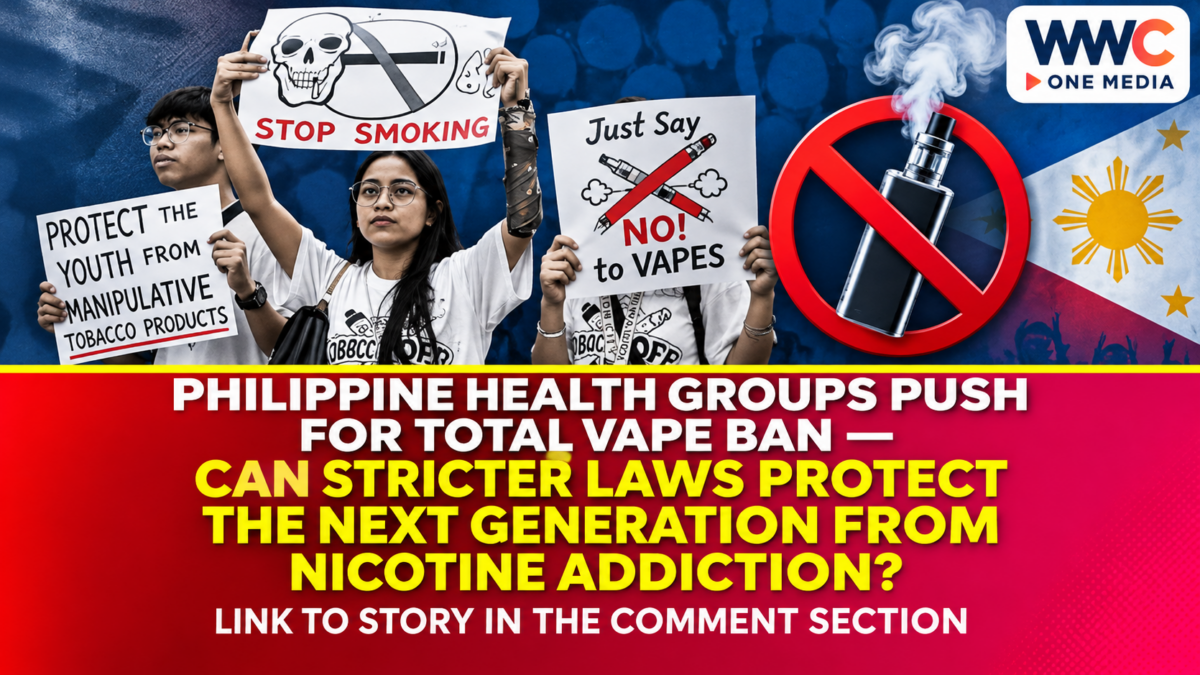
MANILA, PHILIPPINES — Philippine public health advocates are pressing for stronger restrictions on tobacco and electronic cigarette products, including a nationwide vape ban, as the country confronts longstanding concerns over nicotine addiction among children and adolescents.
The campaign gained momentum throughout 2026, with HealthJustice Philippines and youth advocacy organisations calling for comprehensive policy reforms while lawmakers consider stronger protections against exposure to tobacco smoke and vape aerosol.
The debate places public health, consumer protection, government regulation and the future of the country’s nicotine industry under renewed scrutiny.
Philippine vape ban campaign puts youth protection at the forefront
On March 13, 2026, HealthJustice Philippines formally appealed to President Ferdinand Marcos Jr. and Congress to enact legislation banning vape products nationwide.
The organisation argued that preventing young people from developing nicotine dependence should remain a national public health priority.
The campaign continued on April 7, coinciding with World Health Day, when HealthJustice reiterated its demand alongside youth organisations supporting stronger restrictions on electronic cigarettes.
An international open letter signed by more than 60 youth groups and health advocates also supported efforts to prevent the expansion of novel nicotine products.
Their recommendations included protecting children from nicotine exposure, strengthening public health policies and safeguarding health-related policymaking from tobacco industry interference.
The proposed nationwide prohibition represents a substantially different approach from the existing framework, which permits the sale of regulated vaping products to adults.
Nearly one in four Filipino students had tried vaping in 2019
Historical national survey data demonstrate that youth vaping was already a significant public health concern before the passage of the country’s current vape regulation law.
The 2019 Global Youth Tobacco Survey recorded substantial exposure to tobacco and electronic cigarettes among Filipino students aged 13 to 15.
A total of 10,602 eligible students participated in the survey, including 6,670 students within the principal age group.
| Survey indicator | Percentage |
|---|---|
| Students who had tried electronic cigarettes | 24.6% |
| Current electronic cigarette users | 14.1% |
| Current tobacco product users | 12.5% |
| Current cigarette smokers | 10.0% |
| Students exposed to tobacco smoke at home | 29.3% |
| Students exposed to tobacco smoke in enclosed public places | 41.7% |
These figures represent historical findings from 2019 and should not be interpreted as current 2026 prevalence estimates.
The results nevertheless establish an important baseline for evaluating subsequent tobacco-control measures and youth protection policies.
What does the Philippine vape law currently allow?
Republic Act No. 11900, also known as the Vaporized Nicotine and Non-Nicotine Products Regulation Act, establishes the country’s regulatory framework for electronic cigarettes and novel tobacco products.
The law sets the minimum age for purchasing, selling and using covered products at 18.
Retailers are responsible for verifying customers’ ages, including requiring appropriate government-issued identification.
The legislation also prohibits the sale, advertising, promotion and demonstration of covered products within 100 metres of schools, playgrounds and other facilities particularly frequented by minors.
Online sales are permitted subject to age restrictions, registration requirements and applicable product regulations.
The existence of these restrictions does not necessarily establish that every retailer complies with them.
Enforcement remains an important consideration, particularly as local governments implement their own tobacco-control measures.
WWC ONE MEDIA previously examined these challenges in its coverage of Baguio’s intensified crackdown on cigarette and vape sellers following its ASEAN smoke-free recognition.
Congress considers stronger smoke-free and vape-free environments
House Bill No. 9603, filed on June 1, 2026, seeks to strengthen protections against exposure to tobacco smoke and vape aerosol.
Albay First District Representative Krisel Lagman is the measure’s lead author.
The proposed reforms include eliminating designated indoor smoking and vaping areas, expanding restrictions in public spaces, providing local health funding and strengthening enforcement mechanisms.
The measure also proposes establishing task forces and enhancing applicable penalties.
However, a prohibition on smoking or vaping in public places is legally different from a nationwide prohibition on manufacturing, importing or selling these products.
The legislation represents an effort to strengthen environmental protections, while public health organisations continue to advocate broader restrictions.
Both approaches seek to reduce exposure but differ considerably in their legal scope and potential economic consequences.
Higher vape taxes emerge as another policy option
Alongside calls for an outright prohibition, public health organisations have advocated higher taxation as another mechanism for discouraging nicotine consumption.
In September 2026, the Healthy Philippines Alliance supported vape taxes of ₱80 or higher, arguing that greater financial barriers could discourage youth consumption.
The organisation also expressed opposition to proposals that would substantially reduce taxes on certain vaping products.
WWC ONE MEDIA previously covered the campaign for an ₱80 vape tax amid growing concerns over youth nicotine use.
The distinction between taxation and prohibition remains central to the policy debate.
Higher taxation seeks to discourage consumption through increased prices, while a comprehensive prohibition would restrict legal market availability.
Both approaches would require effective enforcement to address unauthorised sales and illicit distribution.
Why nicotine exposure presents particular risks to children
Nicotine is highly addictive and can negatively affect brain development during childhood and adolescence.
Electronic cigarette aerosols may contain nicotine and other potentially harmful substances, including chemicals associated with respiratory and cardiovascular health risks.
Exposure is not limited to the person using the device, as people nearby may also inhale aerosol emissions.
Although the full long-term health consequences of vaping continue to be investigated, electronic cigarettes are not considered harmless.
Conventional cigarette smoking also presents substantial and well-established health risks.
The appropriate public health response must therefore address prevention among young people while supporting existing smokers and nicotine users who want to quit.
Illegal vape distribution remains an enforcement challenge
Any expansion of tobacco and vape restrictions would also need to consider the government’s ability to enforce existing and future regulations.
Unauthorised distribution creates challenges involving product safety, taxation, consumer protection and access restrictions.
These issues have featured in WWC ONE MEDIA’s coverage of the Bureau of Internal Revenue’s enforcement campaign against illicit vaping products.
A comprehensive prohibition would not automatically eliminate illegal sales. Effective implementation would require coordination between regulatory agencies, law enforcement authorities and local governments.
Providing accessible cessation services would also remain important for individuals who have already developed nicotine dependence.
What happens next for Philippine tobacco and vape policies?
The Philippines is also updating its national tobacco surveillance through the 2026 Global Adult Tobacco Survey.
Data collection was scheduled from Oct. 26 to Nov. 18, 2026, covering individuals aged 15 and above.
The survey is designed to provide updated information on tobacco consumption, smoking cessation, secondhand smoke exposure and tobacco-control initiatives.
Its findings could provide additional evidence for evaluating existing regulations and future legislative proposals.
For now, public health advocates continue to support stronger restrictions, including a nationwide vape prohibition.
Whether the government ultimately adopts a comprehensive ban, higher taxation or expanded regulatory controls will depend on legislative decisions and the development of supporting enforcement measures.
Frequently asked questions
Is vaping completely banned in the Philippines?
Republic Act No. 11900 permits regulated vaping products for adults subject to legal restrictions. A nationwide prohibition is being advocated but has not been confirmed as enacted.
Why are Philippine health groups calling for a vape ban?
Health advocates cite nicotine dependence, health risks and concerns over children’s access to vaping products.
What is the legal age for buying vapes in the Philippines?
The minimum legal age under Republic Act No. 11900 is 18 years old.
What is House Bill No. 9603?
It is a proposed legislative measure seeking stronger protections against exposure to tobacco smoke and vape aerosol in public environments.
Are e-cigarettes harmless?
No. E-cigarettes can expose users and nearby individuals to nicotine and other harmful substances. Children and adolescents are particularly vulnerable to nicotine’s effects.