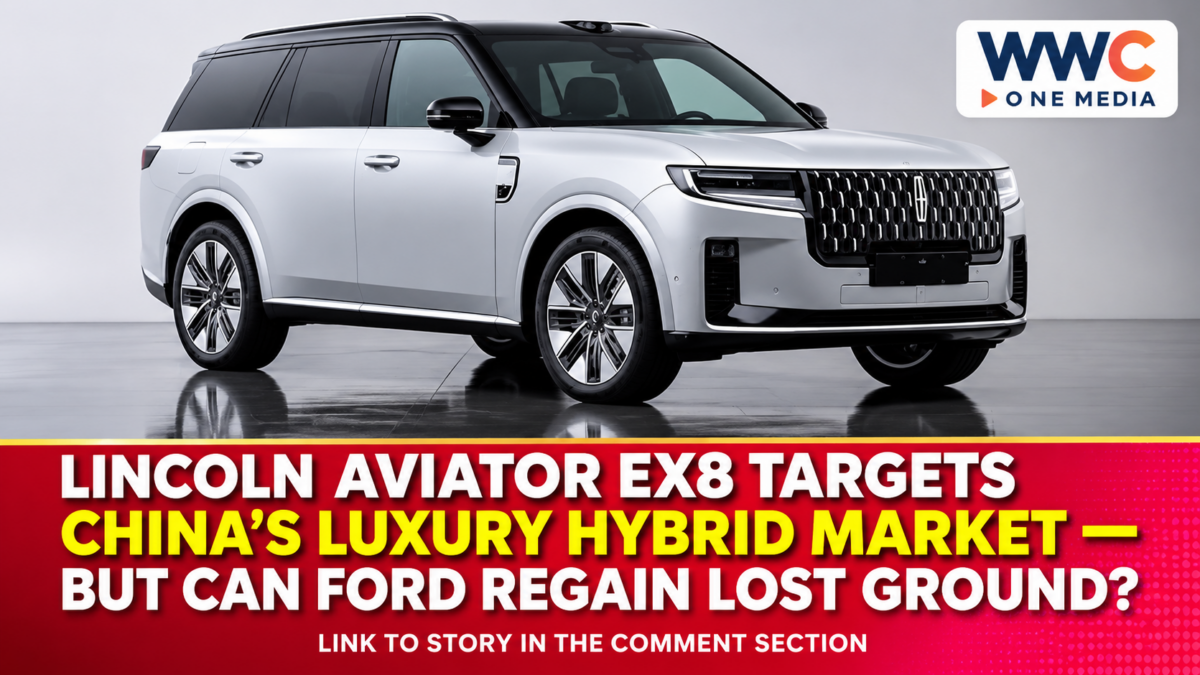
BEIJING, CHINA — Lincoln is preparing a new chapter in its Chinese automotive business with the announcement of the Lincoln Aviator EX8, an electrified luxury SUV that arrives at a challenging time for parent company Ford Motor Co.
Announced on Nov. 11, 2026, the new model introduces Lincoln’s latest luxury hybrid technology as the American automotive group confronts declining vehicle volumes among its Chinese affiliates.
Ford’s third-quarter financial disclosures show that approximately 70,000 Ford, Lincoln and JMC vehicles produced by its unconsolidated Chinese affiliates were sold in China during the period, down from approximately 90,000 a year earlier.
The decline places additional importance on future product launches and raises a strategic question: can Lincoln’s approach to electrification help Ford strengthen its position in China?
Lincoln Aviator EX8 Introduces a New Hybrid Direction
Lincoln has positioned the Aviator EX8 as the first model to feature its newly announced luxury intelligent hybrid technology.
The announcement represents another step in the development of Lincoln’s electrified vehicle portfolio in China, where the company already markets luxury SUVs and passenger cars.
Lincoln’s existing Chinese product range includes the Navigator, Aviator, Nautilus, Corsair and Zephyr.
The EX8’s introduction creates an opportunity for Lincoln to differentiate its new electrified offering from its established vehicle lineup.
From a commercial perspective, the challenge will extend beyond introducing another powertrain. Lincoln must establish a compelling combination of luxury, technology, pricing and ownership benefits.
The importance of these factors is also evident in the regional expansion of Chinese luxury-oriented automotive companies, including Li Auto’s Singapore entry and wider Asia-Pacific expansion strategy.
For Lincoln, the central challenge is demonstrating that its established luxury identity remains relevant as consumers evaluate an increasingly diverse selection of electrified vehicles.
Ford’s Chinese Affiliate Vehicle Volumes Fall
Ford’s latest financial disclosures provide important context for the Aviator EX8 announcement.
During the second quarter of 2026, approximately 82,000 vehicles produced by Ford’s unconsolidated Chinese affiliates were sold in China, compared with approximately 97,000 during the corresponding period in 2025.
The third quarter recorded another year-on-year decline, from approximately 90,000 vehicles to 70,000.
Based on these rounded figures, the third-quarter reduction was approximately 22.2%.
The longer-term figures also indicate pressure on the company’s Chinese operations.
Ford reported approximately 438,000 vehicles under the same measurement in 2024, falling to approximately 375,000 in 2025.
These figures include Ford, Lincoln and JMC vehicles rather than Lincoln alone.
Consequently, they demonstrate broader challenges within Ford’s Chinese affiliate operations but cannot establish Lincoln’s individual market share or exact sales decline.
The distinction is particularly important for investors attempting to determine whether the EX8 can materially improve Ford’s overall performance in China.
A successful model could contribute to a recovery, but the available financial disclosures do not establish how many vehicles Lincoln would need to sell to reverse the broader decline.
Changan Ford Remains Central to Ford’s Chinese Operations
Ford’s established manufacturing relationship with Changan Automobile forms an important part of its Chinese automotive business.
Ford’s 2025 annual report identifies Changan Ford Automobile Corporation as a joint venture owned equally by Ford and Chongqing Changan Automobile.
The joint venture operates four assembly plants, an engine plant and a transmission plant in China.
Its activities include the manufacture and distribution of Ford and Lincoln passenger vehicles.
This existing industrial relationship provides a foundation through which Ford can pursue products adapted to Chinese market requirements.
However, the announcement of a new luxury hybrid SUV does not independently establish that additional factories will be constructed or that manufacturing capacity will increase.
The financial benefits of future products will depend on production volumes, component costs, customer demand and the commercial arrangements governing their manufacture and distribution.
Ford’s relationship with Chinese automotive technology also extends beyond its Chinese operations, as examined in its US battery manufacturing strategy involving CATL technology.
These separate initiatives illustrate the importance of manufacturing partnerships and technology access within the global automotive industry.
Why Hybrid Technology Matters to Lincoln’s Luxury Strategy
The Aviator EX8 gives Lincoln an opportunity to develop its luxury positioning around an electrified powertrain rather than relying exclusively on conventional combustion-engine products.
For prospective buyers, however, the value of a hybrid vehicle depends on more than the technology’s marketing designation.
Purchase price, energy consumption, charging convenience, maintenance requirements and warranty coverage can all influence the overall ownership experience.
A premium vehicle must also justify its price through comfort, design, materials, driving characteristics and customer service.
Lincoln’s challenge will therefore involve integrating its hybrid technology into a vehicle that appeals to customers seeking both luxury and practical transportation.
Without confirmed retail pricing and complete commercial specifications, it remains premature to determine whether the EX8 will offer better value than competing luxury SUVs.
The vehicle’s market performance will ultimately provide a more meaningful assessment than the initial product announcement.
Automotive Competition Extends Beyond China
The Aviator EX8’s introduction also illustrates the increasingly interconnected nature of automotive competition across APEC economies.
Established manufacturers must consider how their products fit different markets while managing international manufacturing relationships and technology requirements.
At the same time, governments are assessing how foreign automotive investment can support domestic manufacturing and employment.
These competing priorities are evident in Canada’s efforts to attract Chinese electric-vehicle investment and potential manufacturing partnerships.
For Ford, adapting products to individual markets could provide opportunities to improve competitiveness without necessarily introducing identical vehicles throughout its international dealership network.
The EX8 announcement should therefore be assessed within its Chinese commercial context.
It does not independently establish that the model will become available in the United States, Canada, Australia or other Asia-Pacific markets.
What Happens Next?
The next important developments will involve Lincoln’s confirmation of the Aviator EX8’s complete commercial specifications, retail pricing, ordering arrangements and delivery schedule.
Investors will also need more detailed sales information to determine whether the new model generates additional demand or primarily attracts customers who would otherwise purchase existing Lincoln vehicles.
A meaningful recovery would require sustained improvements in vehicle demand rather than publicity surrounding a single product announcement.
For Lincoln, the Aviator EX8 represents an opportunity to strengthen its electrified luxury vehicle offering.
For Ford, it represents another test of whether its established Chinese manufacturing relationships and evolving product strategy can translate into improved commercial performance.
Whether the new SUV becomes a turning point will depend on how successfully Lincoln converts its technological ambitions into customer demand.
Frequently Asked Questions
What is the Lincoln Aviator EX8?
The Lincoln Aviator EX8 is a new luxury SUV announced by Lincoln China on Nov. 11, 2026, featuring the brand’s newly introduced intelligent hybrid technology.
Are Ford’s vehicle sales in China declining?
Ford reported that combined third-quarter vehicle volumes involving its unconsolidated Chinese affiliates declined from approximately 90,000 in 2025 to 70,000 in 2026.
Does Ford own Changan Ford?
Ford holds a 50% interest in Changan Ford Automobile Corporation. Chongqing Changan Automobile holds the remaining 50%.
How much will the Lincoln Aviator EX8 cost?
An independently verified final retail price has not been established for this report.
Will the Lincoln Aviator EX8 be available outside China?
The official announcement concerns the Chinese market. Availability in other countries has not been independently confirmed.