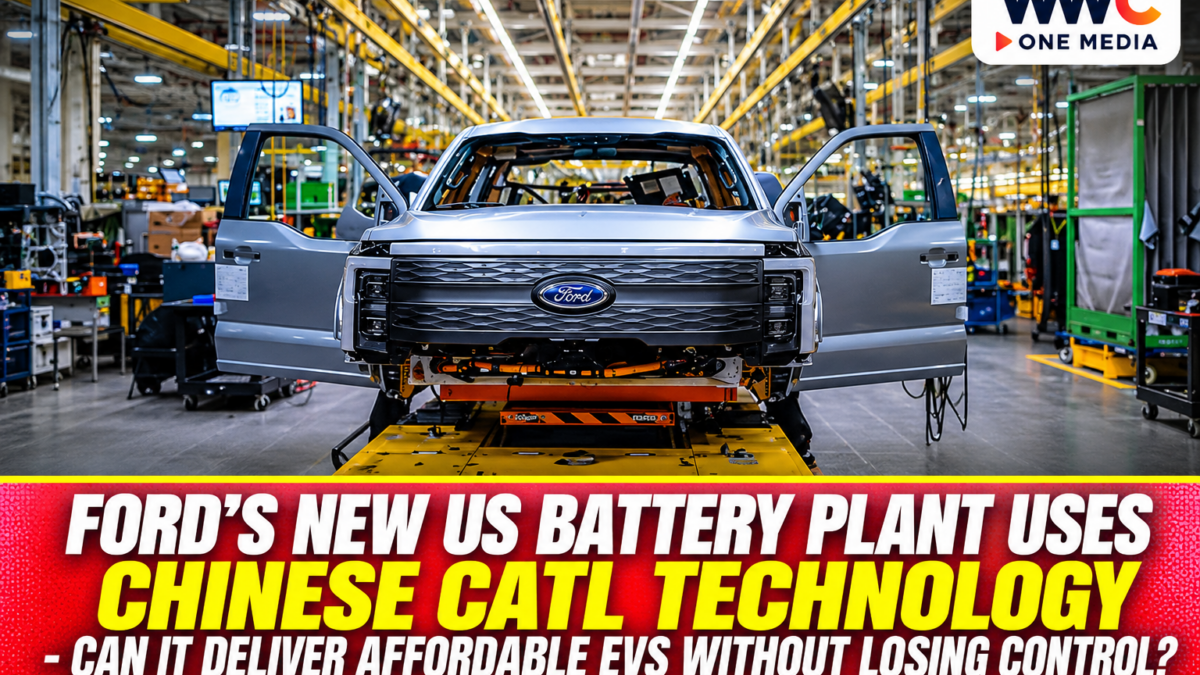
Ford Motor Company has started shipping its first lithium-iron-phosphate (LFP) battery cells from BlueOval Battery Park Michigan in Marshall, with the initial production headed to Louisville Assembly Plant for prototypes of its upcoming Fathom electric pickup.
The milestone puts Ford in a strategically important position: it owns and operates the Michigan facility, but its battery manufacturing process relies on technology licensed from Chinese manufacturer Contemporary Amperex Technology Co. Ltd. (CATL). That arrangement is now drawing attention not only for its industrial potential, but also for the questions it raises about technology dependence, supply-chain security and American manufacturing policy.
The distinction matters. Building batteries in the United States does not necessarily mean every technology used to manufacture them is American. Ford’s project shows how automakers are trying to combine domestic production with expertise developed by companies that already operate at enormous global scale.
Ford’s Michigan battery factory reaches its first major production milestone
The first LFP prismatic cells have moved off the production line at BlueOval Battery Park Michigan and are being sent to Louisville for Fathom prototype development.
Ford describes the facility as a plant it owns and operates. The company says the project involved years of work to design, build and launch the factory, with the objective of developing manufacturing capabilities for more affordable electric vehicles.
The production milestone is significant because battery manufacturing involves more than assembling cells into a vehicle. It requires specialised processes for preparing electrode materials, forming cells, controlling production conditions and checking finished products for defects.
Ford says the Michigan assembly lines can produce 40 cells per minute. It describes the operation as among the fastest LFP prismatic battery assembly lines outside China, based on the number of cells produced each minute.
That figure refers to individual battery cells, not complete battery packs or vehicles. The distinction is important when assessing what the factory can actually deliver.
Why Ford chose LFP batteries for its electric pickup
LFP stands for lithium iron phosphate, a battery chemistry that uses iron and phosphate in its cathode material rather than the nickel- and cobalt-based combinations found in some other lithium-ion batteries.
Ford says its LFP cells do not use nickel or cobalt, helping reduce material costs. The company also points to durability over years of charging and use as an advantage for the technology.
The chemistry is only part of the manufacturing decision. Ford selected a prismatic cell design, meaning the cells have a rectangular shape. The company says this format fits its vehicle architecture and allows the battery pack to serve as a structural component rather than simply sitting inside a separate housing.
Ford is also working to reduce the number of parts required in the battery system. Its design combines electrical and sensing connections into a flexible circuit board and integrates compact power electronics into the pack.
These decisions could help reduce weight, simplify assembly and lower manufacturing costs. However, the company has not established that every anticipated saving will translate directly into a lower retail price for customers.
For the broader EV industry, the development adds to the growing importance of battery design as automakers search for ways to make electric vehicles more competitive with petrol-powered models.
WWC has previously examined the wider expansion of battery manufacturing in its report on South Korean battery producers facing tougher regulatory scrutiny in Hungary. The investment challenge is not simply building factories; manufacturers must also secure technology, maintain production quality and operate within changing regulatory environments.
The CATL agreement is the project’s biggest strategic question
Ford’s relationship with CATL is central to understanding the Michigan operation.
In its September 2026 statement responding to Transportation Secretary Sean Duffy, Ford described the arrangement as a limited technology-licensing and services agreement. The company said it was not a joint venture or a foreign-owned manufacturing operation.
Ford also stated that it owns the plant, controls its operations and employs the workforce.
Those details distinguish the agreement from a structure in which CATL would own or jointly operate the facility. But they do not mean the project is independent of CATL’s technical contribution. Ford’s own announcement identifies the Chinese manufacturer as the source of the licensed battery technology.
That creates a business trade-off.
Working with an established battery technology provider can help an automaker shorten development time and avoid building every manufacturing process from scratch. It can also provide access to production knowledge that would otherwise take years to develop internally.
The other side is dependence. When a manufacturer relies on an external technology partner, it must manage licensing arrangements, technical support, process knowledge and the possibility that future products or production improvements will require continued cooperation.
The public statements do not disclose the full licensing terms, fees, intellectual-property restrictions or duration of the services arrangement. Those details should not be assumed.
Washington’s national-security concerns add pressure
The project has also become part of a wider debate about American dependence on Chinese technology.
On Sept. 8, 2026, the US Department of Transportation published a letter from Secretary Sean Duffy urging Ford to reduce its ties to Chinese companies. The department specifically identified Ford’s use of CATL-licensed technology at BlueOval Battery Park Michigan as a concern.
Duffy framed the issue around national security, industrial independence and the risks of relying on strategic competitors for important technologies.
Ford disputed the administration’s characterisation of its manufacturing arrangement. Its September response emphasised American ownership, domestic operations and local employment, while rejecting the suggestion that the project was a foreign-owned manufacturing operation.
These are competing policy and corporate positions, not proof that the plant is either a security threat or entirely free of foreign technology dependence.
The distinction is important for readers. A factory can be physically located in the United States, employ American workers and remain under American corporate ownership while still using technology developed by a foreign company.
That tension is likely to remain relevant as governments consider how to strengthen domestic manufacturing without cutting companies off from global suppliers and expertise.
What the factory could mean for Ford’s wider business
The initial cells are intended for Fathom prototypes, not immediate mass-market vehicle deliveries. Ford says the battery-pack plant in Marshall is planned to become operational in 2027 ahead of the vehicle’s launch.
The company is also linking the experience gained in Michigan to Ford Energy’s battery energy-storage activities in Kentucky. It says manufacturing expertise, production controls and design knowledge developed for vehicle batteries can support that separate business.
This gives the project a wider industrial purpose. The facility is not only intended to supply one electric pickup; it is also a way for Ford to build experience in cell production and battery manufacturing at scale.
Still, the first shipment should be treated as a manufacturing milestone rather than proof that the entire commercial programme has succeeded. Prototype development, quality validation, production ramp-up and the eventual launch remain separate steps.
Ford will need to demonstrate that the factory can maintain consistent cell quality while increasing output. It will also have to show that its cost structure supports the company’s affordability goals.
For the global market, the project illustrates how competition in electric vehicles increasingly depends on control over battery production and technology. WWC’s coverage of China’s expanding vehicle exports and the pressures facing its automakers provides another part of that picture: established manufacturers are competing in a market where production scale, costs and access to overseas markets can shape the next phase of the industry.
Why the development matters to the Philippines
The Michigan project is taking place in the United States, but its implications extend to markets such as the Philippines.
Battery prices, manufacturing capacity and access to reliable supply chains influence how quickly electric vehicles can become more accessible in different countries. Changes in battery technology can also affect vehicle choices, maintenance considerations and the development of energy-storage products.
The Philippines is working to expand its own electric-vehicle ecosystem. Its policy framework under the Electric Vehicle Industry Development Act and continuing industry initiatives are intended to encourage wider adoption and investment.
WWC has covered the local industry’s development through its report on the Philippine Electric Vehicle Summit and the growing EV community.
Ford’s production milestone does not mean its batteries will be available in the Philippine market, nor does it establish that local EV prices will fall. Its relevance is broader: the cost and availability of battery technology are increasingly important factors in the global transition to electric mobility.
What happens next
Ford’s immediate task is to use the first cells in Fathom prototypes and continue developing the battery system. The company has identified 2027 as the planned operating target for the Marshall battery-pack plant.
The next important evidence will come from production performance, quality consistency and the progress of the vehicle programme. Further details about the CATL licensing arrangement would also help clarify how much technical dependence remains within the manufacturing process.
For now, Ford has demonstrated that it can begin producing LFP cells at a factory it owns and operates. Whether that becomes a durable competitive advantage will depend on what the company can deliver beyond the first shipment.
The bigger question is not simply whether Ford can make batteries in America. It is whether it can build the technical capability to compete over the long term while continuing to rely on expertise developed abroad.
Frequently asked questions
1. Is Ford manufacturing its own battery cells in the United States?
Yes. Ford says the first LFP prismatic cells have started coming off the line at its BlueOval Battery Park Michigan facility in Marshall. The plant is owned and operated by Ford.
2. What is CATL’s role in Ford’s Michigan battery plant?
Ford says CATL provides licensed battery technology and services under a limited agreement. Ford maintains that the arrangement is not a joint venture or foreign-owned manufacturing operation.
3. What type of batteries is Ford producing?
The factory is producing lithium-iron-phosphate, or LFP, prismatic battery cells. Ford says the chemistry uses no nickel or cobalt and is intended to help reduce battery costs.
4. Which Ford vehicle will use the new batteries?
The initial cells are being sent to Louisville Assembly Plant for prototypes of Ford’s Fathom electric pickup. Ford says the battery-pack plant in Marshall is planned to be operational in 2027 ahead of launch.
5. Does the first battery shipment mean Ford’s electric pickup is ready for sale?
No. The first shipment supports prototype development. Vehicle testing, battery-pack production, quality validation and the remaining steps before a commercial launch are separate stages.