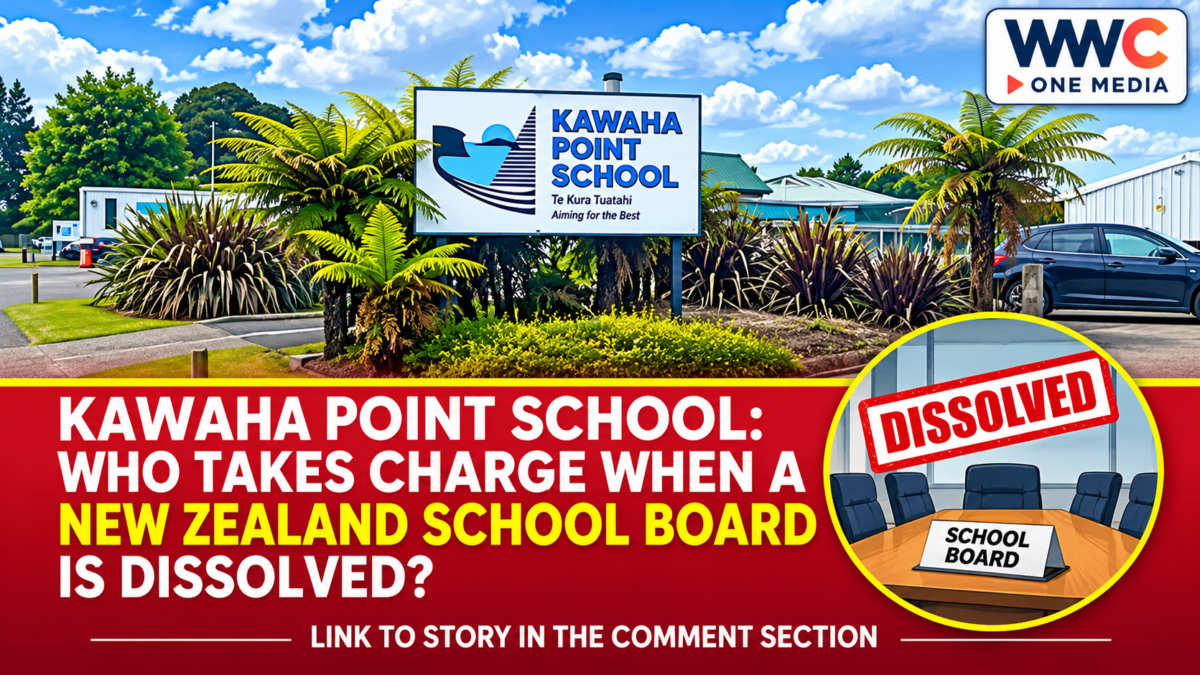
ROTORUA, New Zealand — Kawaha Point School, a state primary school serving Year 1 to Year 6 pupils, operates within New Zealand’s education governance framework, which provides for government intervention when significant institutional challenges arise.
Under the Education and Training Act 2020, education authorities can implement statutory interventions ranging from additional administrative support to the appointment of a commissioner.
For parents and caregivers, understanding the distinction between school governance and educational leadership is particularly important when institutions experience administrative transitions.
Kawaha Point School and Its Governance Structure
Located along Aquarius Drive in Rotorua, Kawaha Point School provides coeducational primary education.
The Education Review Office’s school directory displays an enrolment figure of 227 students, although the date of that particular roll count is not specified.
The Ministry of Education’s public directory identifies Maria Gillard as the school’s principal.
The school’s published governance framework provides for five elected board members, a staff representative, the principal and up to four additional co-opted members.
Its published arrangements also provide for regular board meetings and access to meeting minutes through the school office.
School governance and principal leadership serve distinct but interconnected functions.
The importance of educational leadership has also featured in the recent appointment of Thea Kilian as principal of New Zealand’s St Cuthbert’s College.
What Happens When a New Zealand School Board Is Dissolved?
New Zealand’s education legislation provides nine forms of statutory intervention to address institutional challenges.
These range from requiring additional information from a school board to more extensive measures involving external management.
A commissioner appointment represents one of the higher-level interventions available under the country’s education framework.
Such interventions primarily address governance responsibilities rather than automatically replacing the principal or teaching staff.
The principal generally retains responsibility for daily school operations during a governance intervention.
Consequently, the appointment of a commissioner does not, by itself, establish that the school will close or that its principal must leave.
Each intervention must be understood within its particular circumstances and legal requirements.
Kawaha Point School’s Educational Priorities
A school profile dated June 1, 2023, documented Kawaha Point School’s educational development priorities following the appointment of a new principal during Term 2 of 2022.
These priorities included improving consistency in classroom instruction, establishing shared approaches to learning and strengthening systems for monitoring pupil achievement.
Reading, writing and mathematics were identified as important areas of educational evaluation.
The historical assessment also recognised the school’s leadership team’s commitment to improving teaching practices and educational outcomes.
However, the 2023 findings should not be interpreted as a comprehensive assessment of conditions in November 2026.
More recent information would be required to establish the school’s current academic performance and organisational circumstances.
Who Pays for Government Intervention in Schools?
Statutory interventions can create additional administrative expenses for educational institutions.
New Zealand’s intervention framework generally requires school boards to meet the associated costs.
However, the Ministry of Education may contribute towards those expenses when paying them would negatively affect educational provision.
This arrangement recognises the importance of addressing administrative challenges without diverting essential resources away from students.
The wider issue of institutional accountability has also received attention through the New Zealand Teaching Council’s leadership and governance reforms.
While school boards and national education regulators have different responsibilities, both operate within frameworks intended to support effective educational administration.
Maintaining Education During Administrative Transitions
Kawaha Point School’s published 2026 calendar schedules the fourth academic term from Oct. 12 to Dec. 15.
Its website also provides access to school policies, annual planning documents, attendance management procedures and communication channels for families.
School newsletters are distributed through its website and other official communication platforms.
These channels provide practical opportunities for school communities to receive information about administrative arrangements and educational activities.
The importance of continuity for students and families is also reflected in discussions surrounding the future of Gloriavale Christian School.
That case involves separate circumstances and a different institutional framework. It should not be interpreted as evidence of any proposed closure or similar action involving Kawaha Point School.
What Happens Next When a Commissioner Is Appointed?
New Zealand’s Ministry of Education reviews statutory interventions at least annually.
An intervention may continue until the relevant authority determines that it is no longer necessary or that a different level of assistance is appropriate.
The wider objective is to restore independent school governance once the intervention’s requirements have been satisfied.
For school communities experiencing administrative transitions, important questions include who exercises governance authority, how families receive information and how educational programmes will continue.
Any school-specific changes to leadership, staffing or governance arrangements require separate confirmation through the appropriate official communications.
Frequently Asked Questions
Where is Kawaha Point School located?
Kawaha Point School is located along Aquarius Drive in Rotorua, New Zealand.
What year levels does Kawaha Point School teach?
The state primary school provides education for pupils in Years 1 to 6.
What does a school commissioner do in New Zealand?
A commissioner assumes governance responsibilities as part of a statutory intervention when appointed under the relevant education legislation.
Does a school commissioner replace the principal?
Not automatically. Governance intervention and the principal’s responsibility for daily school management are distinct functions.
How long does a statutory school intervention last?
There is no single fixed duration for every intervention. Education authorities review interventions at least annually and determine when they are no longer necessary.