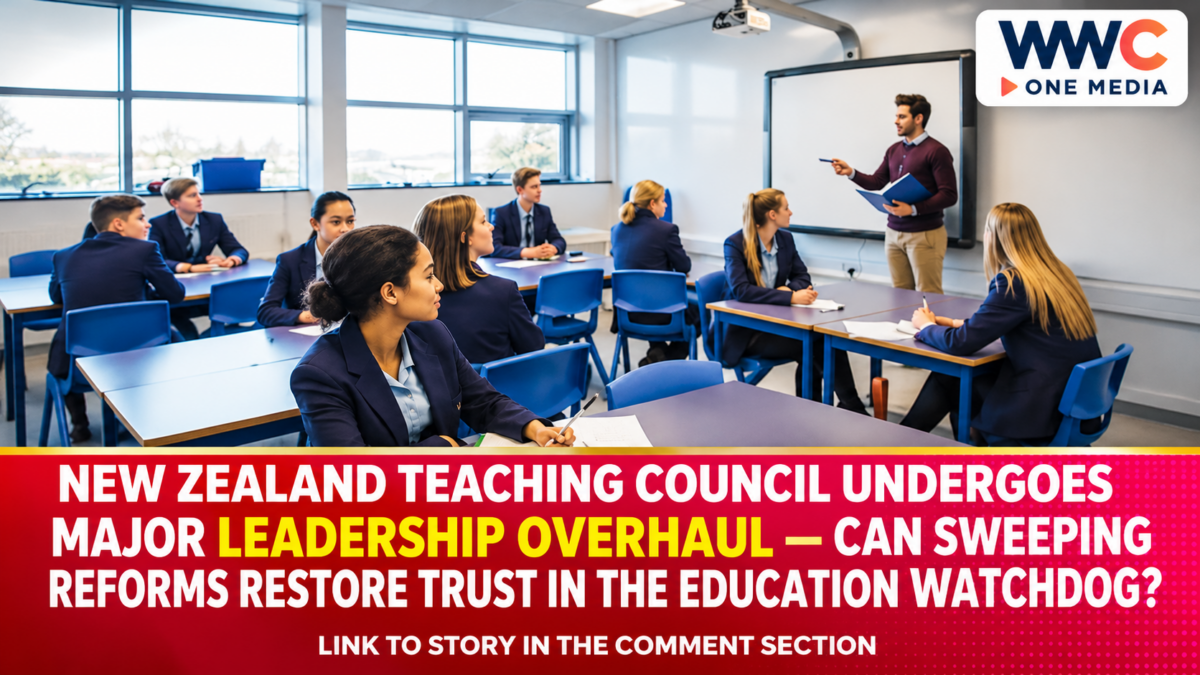
WELLINGTON, New Zealand — The Teaching Council of Aotearoa New Zealand is undergoing a significant institutional transformation following external investigations that identified shortcomings in organisational governance, procurement practices, conflict-of-interest management and child protection.
The New Zealand Teaching Council has introduced new executive leadership and governance arrangements alongside legislative reforms that redistribute key responsibilities within the country’s education system.
Sean McKinley officially assumed the position of chief executive on July 29, 2026, as the organisation entered a new phase of regulatory oversight.
However, an independent child safety review released in October has reinforced the urgency of addressing institutional weaknesses and strengthening public protection.
The developments place the education watchdog under considerable pressure to demonstrate that its leadership changes can produce meaningful improvements.
New Zealand Teaching Council Faces Serious Governance Findings
The institutional overhaul follows an investigation initiated after New Zealand’s education minister received an anonymous complaint in June 2025.
The complaint raised concerns involving procurement, conflicts of interest and organisational practices associated with senior leadership.
On Feb. 17, 2026, Public Service Commissioner Sir Brian Roche released the investigation’s findings.
The investigation established that certain procurement activities had failed to meet the organisation’s internal requirements and broader public-sector expectations.
Investigators also identified shortcomings in managing a significant conflict of interest involving the chief executive, alongside inadequate oversight and failures to complete necessary procurement procedures.
These findings highlighted weaknesses in the administrative safeguards intended to protect institutional integrity.
The investigation’s conclusions are particularly significant because the Teaching Council is responsible for regulating the professional conduct and competence of educators.
An organisation entrusted with maintaining professional standards must also demonstrate that its own administrative practices meet appropriate governance requirements.
New Leadership Takes Charge of the Education Watchdog
The Governing Council announced Sean McKinley’s appointment as incoming chief executive on July 22, 2026.
He officially commenced his duties one week later.
McKinley’s appointment coincided with changes to the organisation’s governing body, including Patrick Walsh becoming chair and Andrée Atkinson assuming the deputy chair position.
The new governance arrangements bring together experience in school leadership, financial management, organisational performance and institutional oversight.
Walsh has served as headmaster of Sacred Heart College in Auckland, while Atkinson has extensive experience in financial advisory work and governance.
The government also appointed members with backgrounds in primary and secondary education, early childhood services and organisational development.
Educational leadership continues to receive considerable attention across New Zealand, including the recent appointment of Thea Kilian as principal of St Cuthbert’s College.
The Teaching Council’s leadership transition, however, involves the additional responsibility of restoring confidence in a national professional regulator.
Government Transfers Responsibility for Teaching Standards
New Zealand has also implemented legislative changes affecting the regulation of its teaching workforce.
The Education and Training (System Reform) Amendment Act 2026 changes how regulatory responsibilities are distributed between the Ministry of Education and the Teaching Council.
Under the revised framework, responsibility for establishing, maintaining and reviewing professional teaching standards now rests with the Secretary for Education.
The Ministry’s responsibilities include standards governing teaching practice, teacher education, registration criteria, practising certificates and professional responsibilities.
The Teaching Council continues to operate as an independent professional regulator responsible for applying those standards.
It retains important functions involving teacher registration, certification, professional competence and disciplinary matters.
The distinction means that the organisation has not lost all regulatory authority.
Instead, the government has separated responsibility for developing regulatory standards from responsibility for applying them in professional decisions.
Existing teaching standards remain in effect unless subsequently amended through the applicable processes.
October Review Places Child Safety Under Renewed Scrutiny
The leadership and legislative changes have been followed by additional concerns regarding the organisation’s child protection responsibilities.
An independent review conducted by Katherine Anderson KC and released on Oct. 13, 2026, established that the Teaching Council had failed to adequately protect children in its handling of a particular professional conduct case.
The government responded by requiring the organisation to develop a detailed corrective action plan and undergo continued monitoring.
The findings reinforce the importance of ensuring that professional disciplinary procedures prioritise student protection.
Professional accountability remains a significant issue across education systems internationally.
In Canada, a recent British Columbia teacher disciplinary case involving a Grade 2 student similarly highlighted the importance of appropriate conduct standards and student safeguarding.
The two cases involve different circumstances and regulatory frameworks, but both demonstrate the significance of effective professional oversight.
For New Zealand’s Teaching Council, the immediate responsibility is to ensure that identified institutional weaknesses are addressed through practical corrective measures.
What the Reforms Mean for Teachers and Schools
Despite the institutional changes, educators will continue to use the Teaching Council for many existing professional services.
Teachers will still register with the organisation, apply for practising certificates and renew their professional credentials through established regulatory processes.
Initial teacher education providers will also continue engaging with the Council regarding programme approval, monitoring and review.
Future changes to professional standards will involve consultation with the Teaching Council and relevant education-sector representative organisations.
The reforms therefore alter institutional responsibilities without immediately replacing existing professional requirements.
Teacher support and professional regulation remain important education policy considerations throughout the Asia-Pacific region.
For example, Taiwan’s revised parental leave protections for education personnel address a separate aspect of institutional responsibilities towards educators.
New Zealand’s reforms are specifically focused on governance, regulatory accountability and the protection of students and the wider public.
What Happens Next for the Teaching Council?
The organisation’s new leadership must address the findings of external investigations while implementing the revised regulatory framework.
The government’s requirement for a detailed action plan establishes an important mechanism for assessing the Council’s response to the October child safety review.
Future progress will need to be evaluated through documented improvements rather than leadership appointments alone.
The central issues include the effectiveness of procurement controls, conflict-of-interest management, professional disciplinary procedures and institutional oversight.
For teachers, parents and education administrators across APEC economies, the developments highlight the importance of maintaining confidence in organisations responsible for professional regulation.
New Zealand has introduced substantial structural changes to its education watchdog. Whether those changes translate into lasting institutional improvements remains the next major test.
Frequently Asked Questions
Why is the New Zealand Teaching Council undergoing reforms?
External investigations identified shortcomings involving procurement, conflicts of interest, governance and child protection.
Who is the chief executive of the New Zealand Teaching Council?
Sean McKinley officially commenced his role as chief executive on July 29, 2026.
Who now sets professional teaching standards in New Zealand?
The Secretary for Education is responsible for setting, maintaining and reviewing professional teaching standards under the revised regulatory framework.
Does the Teaching Council still regulate teachers?
Yes. It continues to make independent regulatory decisions involving teacher registration, practising certificates, professional conduct and competence.
What did the October 2026 child safety review find?
The independent review identified failures in the Teaching Council’s handling of a professional conduct case involving child protection. The government subsequently required corrective action and continued monitoring.