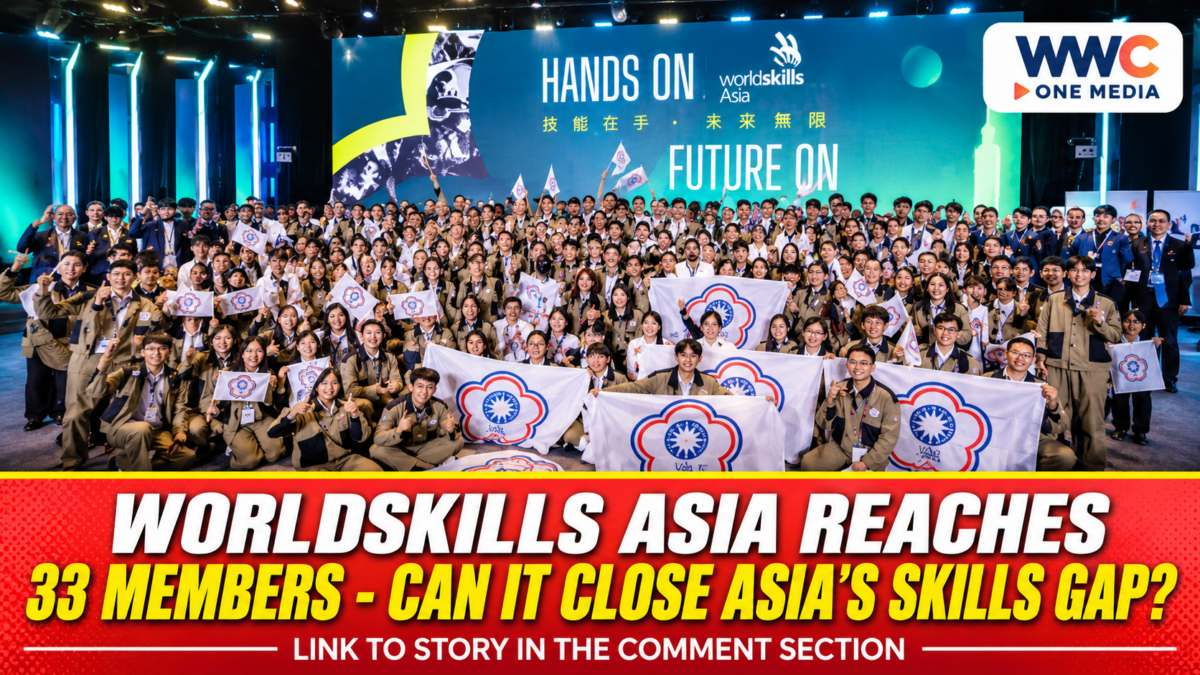
WorldSkills Asia has expanded to 33 member countries after admitting Australia, Syria and Vanuatu, adding fresh momentum to regional efforts to improve technical education, vocational training and workforce development.
The expansion was announced following the organisation’s 10th General Assembly, held in Dili, Timor-Leste, from November 18 to 20, 2026. Delegates also elected two vice-presidents, representing Thailand and Japan, to oversee external affairs and competitions, respectively.
The decisions come as governments across Asia face a common challenge: preparing young people for jobs increasingly shaped by automation, artificial intelligence, advanced manufacturing, clean energy and changing industrial requirements.
But the bigger question is whether a larger regional network can deliver more than international meetings and skills competitions. Its long-term value will depend on whether member countries can turn cooperation into stronger training systems, recognised qualifications and better employment opportunities.
WorldSkills Asia Membership Reaches 33 Countries
Australia, Syria and Vanuatu are the latest additions to WorldSkills Asia, bringing its membership to 33 countries.
The General Assembly took place at Palm Springs Hotel in Dili and was hosted by Timor-Leste’s National Institute for Workforce Development, known as INDMO. Delegations included representatives of member countries, WorldSkills International and industry partners.
The expansion follows a period of growing interest in technical and vocational education and training, commonly referred to as TVET.
WorldSkills Asia is a non-profit organisation registered in Abu Dhabi, United Arab Emirates. Its stated purpose is to promote professional excellence and strengthen skills development across Asian countries.
Its membership framework is designed to bring together organisations representing national or regional vocational education and training systems. Members appoint official and technical delegates who participate in the organisation’s activities.
The admission of new members is not simply a symbolic exercise. Under the organisation’s constitution, membership applications are handled by its Board of Directors and require approval by the General Assembly.
With three additional countries admitted, WorldSkills Asia has widened the network through which governments and training institutions can exchange experience, discuss standards and develop cooperation.
Thailand and Japan Take New Leadership Roles
The General Assembly also elected two vice-presidents, with representatives from Thailand and Japan assigned responsibilities for external affairs and competitions.
The leadership appointments give the organisation additional direction in two important areas.
External affairs involve engagement with organisations, partners and other stakeholders. The competitions portfolio concerns the preparation and delivery of regional skills events, including coordination with participating members and technical specialists.
WorldSkills Asia’s constitution identifies the General Assembly as its highest authority. Its responsibilities include electing the Board of Directors and approving the admission of members.
The organisation’s rules also establish a formal election process, including secret ballots and procedures for checking the vote count.
The new appointments therefore form part of the organisation’s governance structure rather than being honorary positions alone.
The leadership challenge will be to make the expanded membership useful. Countries enter the network with different education systems, industry requirements, institutional resources and levels of technical training. Effective cooperation will require more than agreeing on broad objectives.
Why Technical Training Matters More Across Asia
The expansion comes at a time when the definition of a skilled worker is changing.
Manufacturing, construction, transport, energy, healthcare, hospitality and digital services increasingly require workers who can combine practical knowledge with technological capabilities.
A technician may need to understand conventional machinery while also working with automated systems, digital diagnostics and computer-controlled equipment. Energy-sector workers may need additional training in solar installations, electrical systems and battery technologies.
These changes make the quality and relevance of vocational training an economic issue, not just an education concern.
WorldSkills Asia identifies four major areas in its organisational framework: promoting skills, education and training, international cooperation, and skills competitions. Its constitution also describes biennial competitions as a central part of its work.
The organisation’s competition system provides a platform for young people to demonstrate technical abilities under established standards. Its wider cooperation activities are intended to help training institutions, governments and industry partners exchange knowledge and improve professional development.
However, competitions cannot substitute for accessible, high-quality training throughout a country. A medal can demonstrate an individual’s performance, but it cannot establish that an entire education system is producing enough qualified workers.
That distinction is important as countries invest in vocational education to respond to new technologies and changing labour demand.
Japan’s proposed expansion of its technical-college system into agriculture illustrates how countries are considering practical education beyond traditional engineering disciplines. The debate also highlights the importance of connecting specialist training with the needs of regional industries.
India’s 2027 Competition Adds Another Test
The next major regional milestone is expected to take place in India.
Prime Minister Narendra Modi announced that India will host the WorldSkills Asia competition in 2027 in Greater Noida, Uttar Pradesh. The announcement was made during the fifth Kaushal Deekshant Samaroh in Lucknow on November 21, 2026.
The planned competition gives India an opportunity to bring regional competitors, technical experts and skills institutions together on its own territory.
It also arrives as the Indian government pursues a broader vocational-training modernisation programme.
During the Lucknow event, Modi highlighted new industrial training trades, including artificial intelligence assistance, cybersecurity, drone technology, green hydrogen, industrial robotics, electric vehicles and semiconductor technology.
He also cited the government’s PM-SETU programme, which includes an announced investment of ₹60,000 crore for modernising industrial training institutions, improving equipment and strengthening links between training providers and industry.
These are government-announced initiatives and investment plans. Their actual impact will depend on implementation, training quality and whether graduates secure suitable work.
India’s hosting of WorldSkills Asia 2027 will therefore have significance beyond the competition itself. It will provide a regional platform at a time when the country is promoting vocational education as a route into emerging industries.
Where the Philippines Fits Into the Regional Skills Push
The Philippines already participates in the wider WorldSkills movement through the Technical Education and Skills Development Authority, or TESDA.
At WorldSkills Asia Taipei 2025, the Philippine delegation fielded six young competitors across five skill areas, including cooking, electrical installations, graphic design technology, mechatronics, and refrigeration and air conditioning.
The participation demonstrated how Filipino trainees can compete in an international environment where technical ability and professional standards are tested.
The country’s broader workforce strategy also includes efforts to modernise vocational training facilities. WWC has examined TESDA’s planned expansion of high-tech Regional TVET Innovation Centers, a programme intended to strengthen training for technology-driven occupations.
Private-sector participation is another part of the picture. Toyota Motor Philippines, for example, has been developing its automotive training pipeline, with a student winning gold in Automobile Technology at the WorldSkills Philippines Clark 2026 competition. The initiative reflects the increasing technical demands placed on workers servicing conventional and hybrid vehicles. More details are available in WWC’s report on Toyota’s efforts to expand the Filipino automotive technician pipeline.
The regional challenge is not limited to automotive work. Countries also need qualified people for renewable energy, construction, electronics, industrial maintenance and digital services. WWC has explored this demand in its coverage of India’s expanding skills training programmes for solar energy and other technical occupations.
For the Philippines and other economies across the region, international skills cooperation can create opportunities to compare training approaches and develop professional standards. But participation alone does not guarantee that qualifications will be recognised across borders or that workers will find better-paid jobs.
Those outcomes require sustained cooperation among training institutions, employers and government agencies.
What Happens Next?
WorldSkills Asia now enters its next phase with 33 members and newly elected leadership for external affairs and competitions.
The immediate focus will be on strengthening cooperation among member organisations and preparing for the 2027 competition in Greater Noida, India.
The organisation’s expansion creates a wider platform for countries with different vocational systems to exchange knowledge and promote professional excellence. It could also open opportunities for training partnerships and greater exposure to international skills standards.
But the most important measure will be what happens outside the competition venue.
If regional cooperation helps institutions improve training, gives young people access to relevant qualifications and makes it easier for employers to find capable workers, the expansion could have lasting economic value.
If membership growth produces little change in training quality or employment outcomes, the additional countries may offer more visibility than practical impact.
For now, WorldSkills Asia has widened its reach. The next test is whether that reach can translate into a stronger and more connected skilled workforce across the region.
Frequently Asked Questions
How many members does WorldSkills Asia have now?
WorldSkills Asia has 33 member countries following the admission of Australia, Syria and Vanuatu at its 10th General Assembly in November 2026.
Where was the 2026 WorldSkills Asia General Assembly held?
The 10th General Assembly took place in Dili, Timor-Leste, from November 18 to 20, 2026. It was hosted by the National Institute for Workforce Development, or INDMO.
Which countries supplied the newly elected vice-presidents?
The two elected vice-presidents represent Thailand and Japan. They were assigned responsibilities for external affairs and competitions, respectively.
Where will WorldSkills Asia 2027 take place?
India is scheduled to host the WorldSkills Asia competition in 2027 in Greater Noida, Uttar Pradesh.
What is the purpose of WorldSkills Asia?
WorldSkills Asia promotes professional excellence, technical and vocational education and training, international cooperation and skills competitions across the region.
Does the Philippines participate in WorldSkills Asia?
The Philippines has participated in WorldSkills Asia events. At the Taipei 2025 competition, the country fielded six competitors across five skill areas through its national skills delegation.