WINNIPEG, Manitoba — Nov. 27, 2026
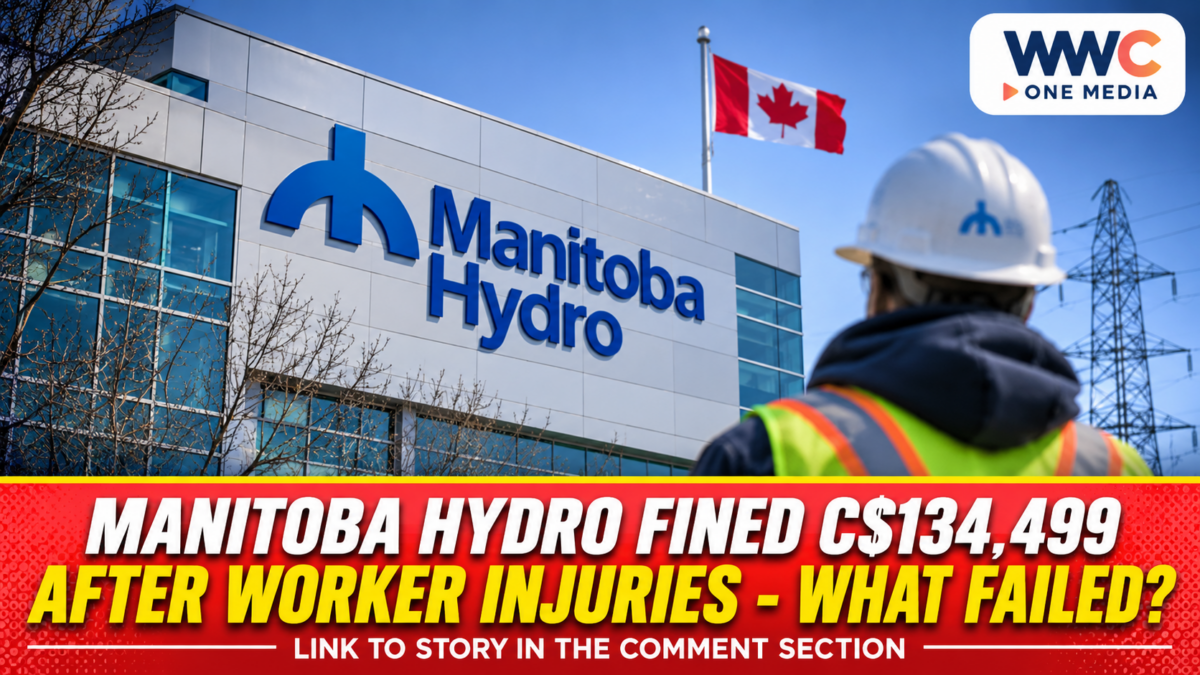
Manitoba Hydro has been ordered to pay a combined C$134,499.70 in fines and surcharges after pleading guilty to two workplace safety violations linked to separate accidents that injured four workers in 2023.
The cases involve two very different hazards: a maintenance building that rapidly filled with water and a hydro pole that collapsed while workers were positioned near its top.
Both incidents happened during work carried out by Manitoba Hydro, a provincial Crown corporation responsible for providing electricity and natural gas services across Manitoba, Canada.
The guilty pleas were entered on Sept. 29, 2026, under subsection 4(2)(b) of Manitoba’s Workplace Safety and Health Act. The provision requires employers to provide workers with appropriate information, instruction, training, supervision and facilities to protect their safety and health.
The financial penalties were imposed separately: C$64,999.90 for the first incident and C$69,499.80 for the second.
The amount raises a wider question about workplace safety in the electricity sector: how can employers protect workers carrying out maintenance and infrastructure work in hazardous environments?
A Maintenance Building Filled With Water
The first incident happened on April 5, 2023, at the Laurie River Generating Station.
Two Manitoba Hydro workers were carrying out maintenance work when a hoist house rapidly filled with water. The water rose almost to the top of the enclosed space, creating what the provincial government described as a significant hazard.
Water pressure eventually forced open a door, allowing both workers to get out. However, both sustained injuries.
The government did not disclose the nature or severity of those injuries in its public announcement.
Following an investigation by Workplace Safety and Health officials, Manitoba Hydro pleaded guilty to contravening subsection 4(2)(b) of the act.
The court imposed a fine and surcharges totalling C$64,999.90.
The incident highlights the risks associated with maintenance work in facilities where water, machinery and enclosed spaces can combine to create dangerous conditions. However, the public announcement does not identify the precise technical cause of the flooding or describe the specific corrective measures taken afterward.
Those details should not be assumed from the incident alone.
A 45-Foot Hydro Pole Collapsed in Wasagamack
The second incident occurred on Aug. 29, 2023, in Wasagamack First Nation.
Two Manitoba Hydro workers were positioned at the top of an approximately 45-foot hydro pole when the structure collapsed and struck a boom truck.
Both workers sustained serious injuries as a result of the fall.
The incident involved a different type of workplace hazard from the Laurie River accident, but the legal provision was the same. Following an investigation, Manitoba Hydro again pleaded guilty to contravening subsection 4(2)(b) of the Workplace Safety and Health Act.
The court imposed a further C$69,499.80 in fines and surcharges.
The public record released by the province does not explain why the pole collapsed, whether a structural defect was identified or whether the boom truck’s position contributed to the accident. It also does not provide the workers’ medical conditions.
Without those findings, it would be premature to attribute the collapse to a particular engineering, equipment or operational failure.
What the Law Requires From Employers
The provision involved in both guilty pleas concerns more than the existence of safety equipment.
Subsection 4(2)(b) requires employers to provide workers with information, instruction, training, supervision and facilities necessary to protect them, so far as reasonably practicable.
The wider act also requires employers to take reasonably practicable steps to protect workers’ safety, health and welfare. It separately addresses safe workplaces and equipment, awareness of hazards, and competent supervision.
In practical terms, workplace safety involves more than responding after an accident. Employers must identify risks, communicate them to workers, provide appropriate training and ensure that work is properly supervised.
Manitoba’s Workplace Safety and Health Branch says its enforcement work focuses on reducing workplace fatalities, serious injuries and illnesses. Its activities include inspections and investigations, with particular attention to high-risk hazards and repeated or wilful non-compliance.
The province also explains that prosecutions can follow investigations where injuries are directly connected to breaches of safety legislation, among other circumstances.
The Manitoba Hydro cases therefore represent formal legal accountability: the corporation entered guilty pleas, and courts imposed financial penalties.
The C$134,499.70 Is Not the Entire Government Announcement
The Manitoba government’s Nov. 26 release also disclosed a separate prosecution involving Anvil Tree Inc., a small fabrication and general contracting company.
On Nov. 28, 2023, one of its workers fell approximately 10 metres after a temporary work platform at the edge of a building failed.
The company pleaded guilty on Sept. 17, 2026, to a different provision of the legislation, subsection 4(2)(a). The court imposed C$25,000 in fines and surcharges, with C$10,000 directed towards public education on occupational safety and health.
That case is separate from Manitoba Hydro’s two guilty pleas.
The distinction matters when interpreting the figures: C$134,499.70 is the combined amount imposed on Manitoba Hydro, while Anvil Tree Inc.’s C$25,000 is an additional penalty involving a different employer and incident.
The province’s announcement covered three workplace incidents involving two employers.
What Happens Next?
The public announcement confirms the guilty pleas and the court-imposed amounts, but it does not provide a detailed account of the corrective measures Manitoba Hydro introduced after either accident.
It also does not establish whether the company has faced other enforcement action connected to these particular incidents.
For workers, contractors and employers across Manitoba, the central issue is whether lessons from these cases translate into stronger hazard assessments, safer maintenance procedures, effective supervision and better protection around electrical infrastructure.
The incidents also underline the importance of transparency after workplace accidents. Publicly available information about causes, corrective action and compliance can help workers and communities understand whether identified risks have been addressed.
The penalties establish that Manitoba Hydro admitted violating a specific employer duty under provincial law. They do not, by themselves, explain every technical failure behind the accidents or prove that every possible safety concern has been resolved.
The next important question is whether the company can demonstrate that similar hazards are being prevented before workers are put at risk again.
Frequently Asked Questions
How much was Manitoba Hydro fined?
The two court-imposed totals were C$64,999.90 and C$69,499.80, bringing the combined amount to C$134,499.70.
How many workers were injured?
Four Manitoba Hydro workers were injured across the two incidents in 2023. Two were hurt at Laurie River Generating Station and two sustained serious injuries in the Wasagamack First Nation pole collapse.
When did the accidents happen?
The first incident occurred on April 5, 2023, at Laurie River Generating Station. The second happened on Aug. 29, 2023, in Wasagamack First Nation.
What law did Manitoba Hydro violate?
The corporation pleaded guilty to contravening subsection 4(2)(b) of Manitoba’s Workplace Safety and Health Act, which covers employers’ duties to provide information, instruction, training, supervision and facilities for worker safety.
Was another company fined in the same announcement?
Yes. Anvil Tree Inc. was separately ordered to pay C$25,000 after a worker fell when a temporary work platform failed. That penalty is not part of Manitoba Hydro’s C$134,499.70 total.